The episode in detail
Femmes en Mouvement: mobility designed for women
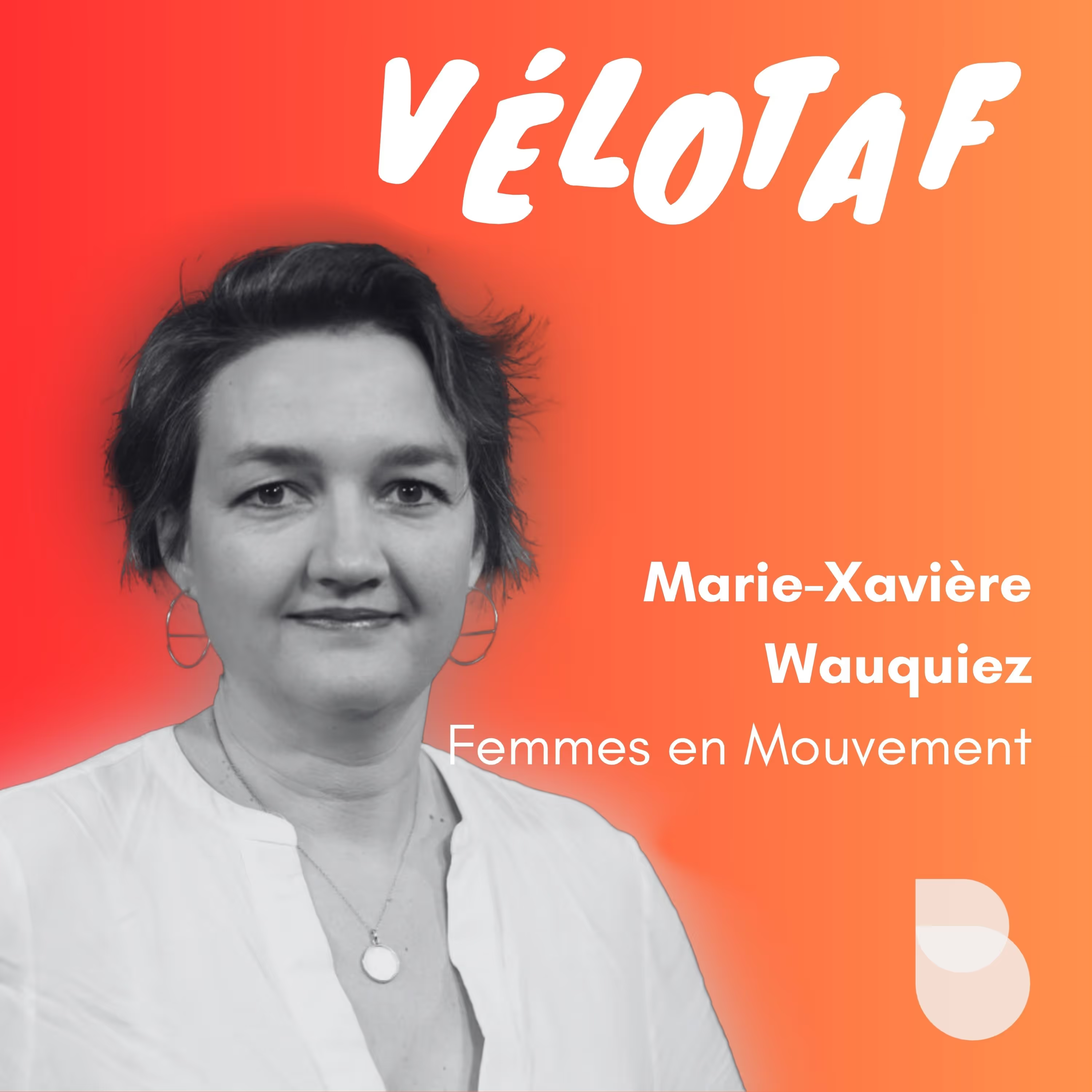
In 2015, Marie-Xavière Wauquiez, an engineer by training who became a mobility expert, noticed that industry conferences only gave a platform to men. She decided to organise a full day with 26 women speakers. While putting the programme together, the team realised that women do not travel the way men do, and that transport systems are designed without taking this reality into account. This was the birth of Femmes en Mouvement, an association with a double aim: to make women’s specific mobility visible, and to increase the presence of women in mobility trades.
“When you are a man and you do not think about women’s experience, you design systems that work well for men. Women, meanwhile, have to adapt.”
From a Dutch bike carried on the Thalys to the Véligo
Marie-Xavière has bike commuted since her student years in Compiègne. In 2002, she brought a Dutch bike back on the Thalys, paying for three extra tickets for the bike. This bike, named Maxima after the Dutch princess, went with her everywhere in Paris for years. Then she discovered the Île-de-France region’s Véligo. The electric assist changed things: headwinds along the Seine and long distances became manageable. She also practises intermodality without dogma: bike to the RER, electric car when that makes more sense.
“The Île-de-France region’s Véligo, what a joy, what a pleasure. This bike works so well.”
Cycling infrastructure: what is missing beyond the cycle tracks
Marie-Xavière identifies gaps that decision-makers overlook. Vertical signage is almost entirely absent along cycling routes: between Saint-Maur and Paris, no sign shows which local council you are in. In the event of an accident, it is impossible to give the emergency services a precise location. She argues for luminescent paint on poorly lit paths: pigments that charge up during the day and give off light at night, at minimal cost. Lighting and signage directly determine how much women use cycle tracks at night.
“Several of us cyclists stopped to call the emergency services. We all stood there like fools, not knowing how to say where we were.”
Covid and temporary cycle tracks: a turning point for the bike
Marie-Xavière was general delegate of the FUB (Fédération française des usagers de la bicyclette, the bike users’ federation) during the first lockdown. She points to a factor that is often forgotten: spring 2020 was exceptionally fine weather. Without that, the temporary cycle tracks would not have had the same success. The combination of the weather, fear of public transport and lobbying by associations created a rapid shift. For a long time, Marie-Xavière herself put her bike away from autumn to spring, out of fear of winter conditions. Post-Covid infrastructure made year-round bike commuting possible.
“If it had rained every day, everyone would have been sent packing. The sky helped us.”
The essentials for women bike commuters
Marie-Xavière recommends three items of gear. Waterproof trousers, the 20-euro ones from Decathlon with overshoes, do their job perfectly and also work as an insulating layer in winter. A hi-vis yellow vest to be seen, especially on unlit towpaths. And a whistle around the neck: it never runs out of charge, lets you signal if you fall, and puts off a potential attacker. Her riding philosophy: ride in the middle of the lane, take up space, do not hug the kerb.
“You ride in the middle. They have an engine, they have brakes. They can well put up with you taking up a bit of space.”
Femmes en Mouvement: how the association works
The association runs on membership fees (50 euros a year, 25 euros for under-25s, 250 euros for companies) and on sales of its Happy Families card game on women in mobility (2,200 copies sold out of 2,500 printed). The game features 42 women from the sector, from the minister to bike mechanics, including France’s only woman astronaut. It can be customised for member companies. The association has 100 individual members and 20 member companies. Marie-Xavière quotes Christine Lagarde: when you do not have quotas, you find excuses; when you have quotas, you find women.