Our services
Biodiversity
Back to Nature
Biodiversity loss is accelerating. Regulations are catching up. The companies and local authorities that act now, with the right methodology, will gain a competitive edge while meeting their ecological obligations.
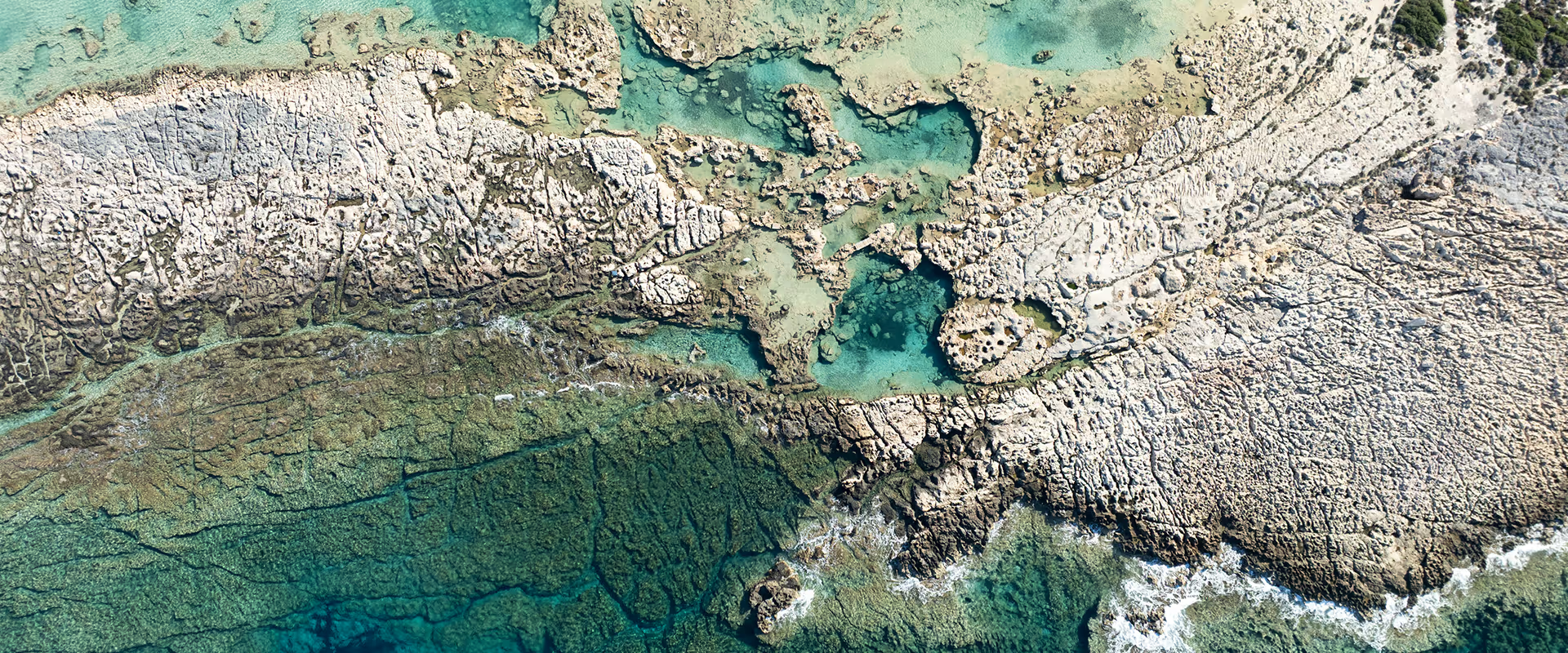
Over one million species face extinction. 55% of global GDP depends on services provided by nature (World Economic Forum, 2020). Ignoring biodiversity is no longer a reputational risk. It is a financial and regulatory one.
Key Takeaways
- Biodiversity consulting helps organizations assess, plan, and manage their relationship with natural ecosystems.
- Services include ecological diagnostics, nature-positive strategies, SBTN targets, CSRD/TNFD reporting, and net gain planning.
- EU regulations (Nature Restoration Law, CSRD, TNFD) require organizations to disclose and act on biodiversity impacts starting 2025-2026.
- Expert consultants turn regulatory obligations into operational and strategic value for stakeholders.
- Bleen supports the full cycle: ecological assessment, strategy, implementation, monitoring, and reporting.
What Is Biodiversity Consulting for Businesses?
Biodiversity consulting is professional advisory work that helps organizations integrate biodiversity into their strategy, operations, and reporting. It goes beyond one-off environmental impact studies.
A biodiversity consultant works at the intersection of ecology, regulation, and business strategy. The scope typically includes ecological diagnostics (mapping species, habitats, and ecosystem dependencies), strategic planning (setting science-based targets for nature), regulatory compliance (meeting CSRD, TNFD, and national biodiversity law requirements), and team training.
The core services span five areas: ecological assessment and biodiversity footprint measurement, nature-positive strategy and SBTN target-setting, regulatory compliance support (CSRD, TNFD, ERC sequence), nature-based solutions and biodiversity net gain planning, and ecological monitoring and reporting.
The organizations that need this support range from industrial companies managing sites with ecological sensitivity, to real estate developers subject to the Avoid-Reduce-Compensate (ERC) sequence, to large corporations reporting under CSRD, and local authorities planning urban development around ecological corridors.
The difference between a biodiversity consultant and a traditional environmental study office: scope and continuity. A study office typically delivers a regulatory document. A consultant integrates biodiversity into the organization's decision-making over time, connecting ecological data to business outcomes.
Why Businesses Need Biodiversity Consulting Now
Biodiversity has shifted from a peripheral concern to a regulatory, financial, and commercial reality that affects business operations directly.
First, regulation. The EU Nature Restoration Law (2024) mandates restoration of 20% of degraded ecosystems by 2030. The CSRD expands sustainability reporting to include biodiversity impacts. The TNFD framework, adopted by over 400 major companies since 2023, is becoming a standard reference for investors and insurers. In France, the 2016 Biodiversity Law established the Avoid-Reduce-Compensate (ERC) sequence, requiring any development project to first avoid ecological damage, then minimize what cannot be avoided, and finally compensate the residual impact with measurable, long-term ecological gains.
Second, financial risk. The World Economic Forum estimated in 2020 that 55% of global GDP depends on ecosystem services: pollination, water purification, soil fertility, flood regulation. Companies with operations or supply chains dependent on these services face material risk when ecosystems degrade. According to the IPBES Global Assessment (2019), species are going extinct 100 to 1,000 times faster than the pre-industrial baseline. This is not an abstract future risk. It is a measurable, accelerating trend that directly affects business operations dependent on natural resources.
Third, stakeholder expectations. Investors now screen for nature-related risks alongside climate risks. Clients in construction, energy, and food sectors increasingly require biodiversity commitments from their suppliers. Employees, particularly younger talent, expect their employer to account for ecological impact.
The sectors most exposed include real estate and construction (ERC compliance for every project in ecologically sensitive zones), industry and agri-food (supply chain dependencies on pollinators and soil health), energy and infrastructure (habitat disruption), finance and insurance (portfolio exposure to nature-related risks), and local authorities (urban planning, ecological corridor management).
Waiting for enforcement is more expensive than acting now. Early adopters of biodiversity strategy reduce compliance costs and gain preferred status with regulators, investors, and partners.
How Bleen Runs a Biodiversity Consulting Mission
Every mission follows five phases, calibrated to the client's sector, scale, and regulatory context.
Phase 1: Scoping and context analysis. Bleen starts by understanding your operations, sites, supply chain, and regulatory exposure. This includes mapping the ecological context of each site using databases like INPN (France's National Natural Heritage Inventory) and identifying applicable regulations (CSRD, TNFD, national biodiversity law, ERC sequence).
Phase 2: Ecological diagnostic and biodiversity footprint. Field assessments and data analysis to establish a baseline: species inventories, habitat mapping, ecosystem dependency analysis. This phase quantifies your organization's biodiversity footprint and identifies the most material nature-related risks and dependencies.
Phase 3: Strategy co-construction. Based on the diagnostic, Bleen works with your teams to set science-based targets for nature (SBTN methodology), define a nature-positive roadmap, and identify the right mix of avoidance, reduction, restoration, and compensation measures.
Phase 4: Implementation and field support. Bleen stays through execution. This means designing nature-based solutions (green infrastructure, ecological corridors, habitat restoration), supporting procurement teams on sustainable sourcing, and training internal teams on biodiversity governance.
Phase 5: Monitoring, measurement, and reporting. Track ecological KPIs over time. Produce CSRD-compliant biodiversity reporting. Prepare TNFD-aligned disclosures. Each report is built to satisfy regulatory auditors while communicating progress clearly to investors and stakeholders.
The reference frameworks used throughout: SBTN (Science Based Targets for Nature), TNFD, IUCN Red List categories, GRI biodiversity standards, IPBES assessments. The TNFD framework includes the LEAP approach (Locate, Evaluate, Assess, Prepare), a structured methodology for identifying and managing nature-related dependencies, impacts, risks, and opportunities across operations and value chains. Each mission is tailored. A real estate developer facing ERC requirements needs different deliverables than a food company assessing pollinator dependency in its supply chain.

Who Needs Biodiversity Consulting?
Biodiversity consulting applies to any organization with operations, sites, or supply chains that interact with natural ecosystems.
Real estate and construction companies face the most immediate regulatory pressure. The Avoid-Reduce-Compensate (ERC) sequence applies to every development project in ecologically sensitive zones. Getting it wrong delays permits and increases costs.
Industrial and agri-food companies depend on ecosystem services: pollination, soil fertility, water purification. When those services degrade, supply chains feel it first. A food producer sourcing from regions with declining pollinator populations faces a procurement risk that no contract clause can offset.
Energy and infrastructure operators disrupt habitats at scale. Regulatory requirements for biodiversity net gain mean that projects must deliver measurable ecological improvement, not just minimize damage.
Financial institutions and insurers are screening portfolios for nature-related risk. The TNFD framework is becoming the standard reference. If your portfolio includes land-intensive assets, nature risk is financial risk.
Local authorities managing urban development, ecological corridors, and public green spaces need ecological data to plan responsibly and meet EU restoration targets.
Companies reporting under CSRD must disclose biodiversity impacts under ESRS E4. Without a structured approach, this reporting requirement becomes a scramble.
Not sure where your biodiversity exposure lies? A scoping call with Bleen takes 30 minutes and costs nothing.
How to Start a Biodiversity Mission with Bleen
Bleen stays through execution. We build the nature-positive roadmap, support the implementation of nature-based solutions on your sites, and produce the CSRD and TNFD reporting your auditors and investors need.
The first conversation covers three things: which sites and supply chains carry ecological exposure, which regulations apply to your sector and geography, and what biodiversity data you already have. That scoping call takes 30 minutes and costs nothing.
From there, Bleen builds a mission proposal tailored to your situation. Available formats: one-off diagnostic (ecological audit, biodiversity footprint), long-term strategic partnership (multi-year roadmap with SBTN targets), team training (biodiversity governance for boards and operational teams), and flash audit (rapid regulatory compliance check).
The diagnostic phase alone typically takes two to four weeks and produces a biodiversity risk map, a regulatory gap analysis, and a prioritized list of actions.
They transformed with Bleen
Cofinimmo: Portfolio-wide Biodiversity Strategy
Portfolio-wide Biodiversity Strategy. We analyzed 358 healthcare properties across 9 countries, identifying biodiversity risks and opportunities at scale. Combining top-down assessment with 18 detailed site visits, we delivered quick-win and best-in-class action plans that meet CSRD requirements while protecting ecosystems.

Drees&Sommer: Biodiversity Quiz for Construction Consultants
Biodiversity Quiz for Construction Consultants. Drees&Sommer wanted to raise biodiversity awareness among its Belgian team, with a format adapted to the construction sector. We co-designed a hybrid interactive quiz anchored in real project examples, tested it iteratively, and delivered it in a mixed virtual and on-site session.

Common questions
An environmental study office typically delivers one-off regulatory documents: species inventories, impact assessments. A biodiversity consultant takes a broader approach: integrating biodiversity into the organization's overall strategy, building an action plan, and providing ongoing support. The scope is systemic and continuous, not limited to a single regulatory filing.
In France, the 2016 Biodiversity Law imposes the Avoid-Reduce-Compensate (ERC) sequence on development projects. At EU level, the Nature Restoration Law (2024) sets binding restoration targets for degraded ecosystems. The CSRD requires biodiversity impact reporting. The TNFD framework is becoming a standard reference for investors and large companies.
Biodiversity net gain means the project leaves ecosystems in a better state than before. The mission includes a baseline ecological diagnostic, identification of avoidance and reduction measures, then design of measurable, long-term compensation measures. The goal is a quantifiable and verifiable positive balance for biodiversity over the project's lifetime.
Yes. Biodiversity consulting adapts to all organization sizes. For SMEs, missions are calibrated to their scope and budget: rapid diagnostic, team training, integration of biodiversity criteria into procurement. Acting early often prevents significantly higher compliance costs down the line, especially for companies in the supply chain of CSRD-reporting clients.
Check the team profiles (ecologists, environmental engineers, CSRD/TNFD specialists), sector references, and ability to cover the full mission chain from diagnostic to reporting. A credible firm uses recognized methodologies (SBTN, TNFD, IUCN) and produces deliverables that integrate directly into regulatory reporting frameworks.
The TNFD (Taskforce on Nature-related Financial Disclosures) is an international reporting framework for nature-related risks and opportunities, modeled on the TCFD for climate. It is becoming a standard for investors, insurers, and companies subject to CSRD. Preparing for TNFD now reduces reputational and financial risks tied to ecosystem dependencies.
Take stock of your biodiversity position
Talk to a Bleen biodiversity expert. First call is exploratory, free, and without commitment.