The episode in detail
Barriers to bike network development: a question of space and political will
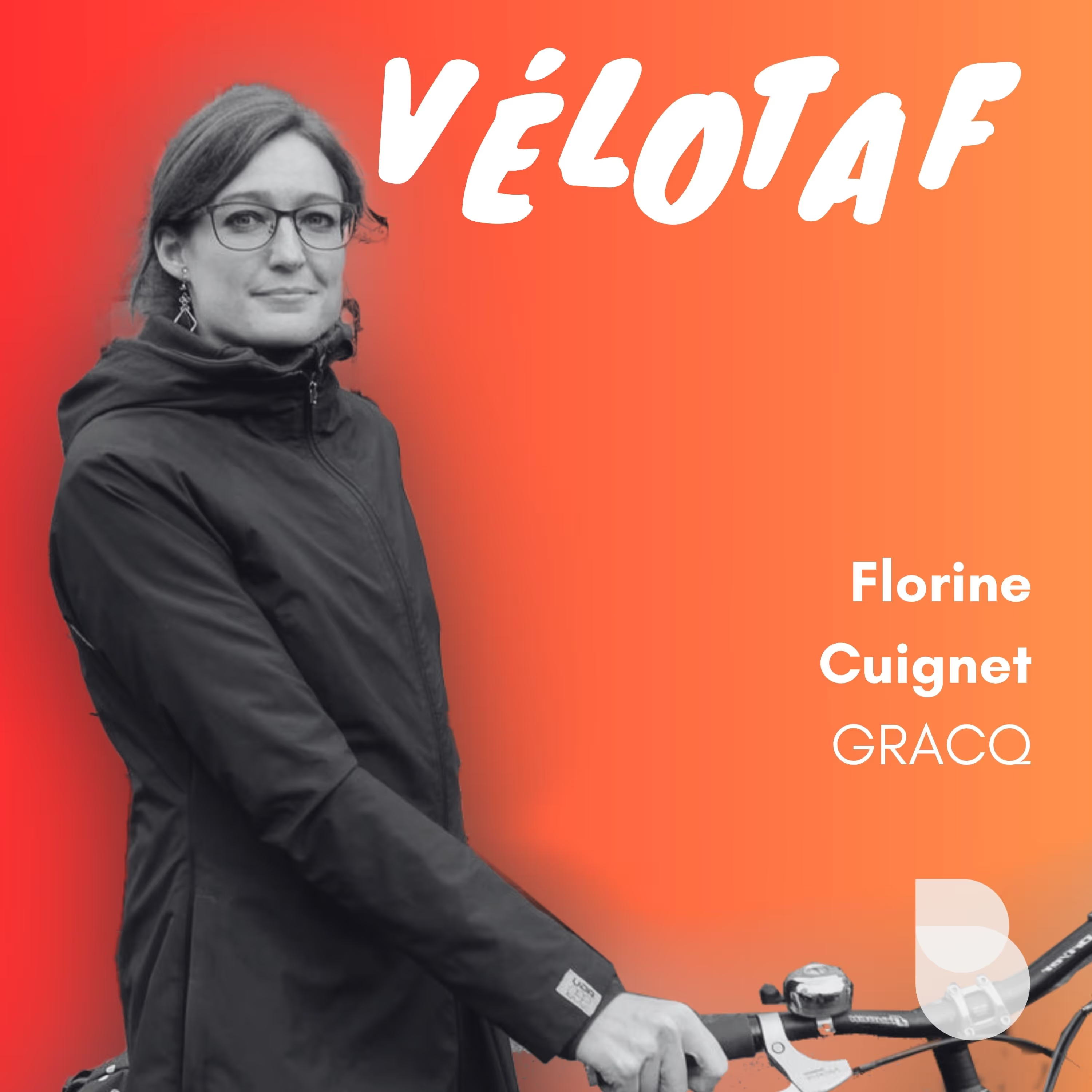
Barriers to bike network development are not a matter of missing technical solutions. Florine Cuignet, Brussels policy officer at GRACQ (Groupement de Recherche et d’Action des Cyclistes du Quotidien, the everyday cyclists’ research and action group), sets out a precise diagnosis in this episode of the Vélotaf podcast. In Brussels, about 80% of the road network should be able to work with cyclists and motorised traffic mixed together, provided car speed and volume are reduced. The remaining 20%, on the main routes, needs separate infrastructure. It is on this fraction that everything is decided, and everything gets stuck.
The core problem comes down to one sentence: to create cycle tracks, space has to come from somewhere. Not from the pavements, which are already too narrow. Not from public transport lanes. The available space sits on the car’s side, between traffic lanes and on-street parking. And that is exactly where resistance builds up.
“To create bike infrastructure, where it does not exist yet, space has to come from somewhere.”
The Vélo Plus network: a key project held back by compromise
The Brussels Region has developed the Vélo Plus network, a key set of routes aimed at the main roads where motorised traffic is heavy. The Petite Ceinture, Rue de la Loi and the main boulevards are among the priorities. The principle is simple. Where cars drive fast and in large numbers, physical separation between cyclists and motorised traffic becomes essential.
But between principle and delivery, the gap stays wide. The missing link on Avenue de Tervuren shows the blockages clearly. This stretch between Mérode and Square Léopold II, via Montgomery, was meant to be fitted out quickly with light measures: bollards, concrete blocks, a first step towards a bigger scheme. The project was launched in 2016. Eight years on, it is still going through public inquiry, caught up in disputes between the Region and the Etterbeek and Woluwe-Saint-Pierre local councils.
“We thought it would be a simple project, and in the end, it is not.”
Overlapping jurisdictions: an institutional barrier to bike networks
Brussels has one particular feature that slows down every mobility project: overlapping layers of government. The Region manages regional roads, but the local councils keep a say. When the two levels do not agree, projects get stuck or lose their substance through repeated compromise.
Florine Cuignet describes the concrete result in plain terms: cycle tracks squeezed in wherever they cause least disturbance, without any real ambition for quality. Narrow layouts, sometimes pushed onto the pavement, which shift the conflict from cars against cyclists to cyclists against pedestrians. GRACQ, founded in 1975, has been watching this pattern for close to fifty years.
“Everyone gets a little something. So in the end, a cycle track gets built to keep cyclists happy, but it gets squeezed in wherever there is room.”
This constant mechanism of compromise explains why some layouts do not do their job. A cycle track that is too narrow, or shared with pedestrians, is not quality infrastructure capable of attracting new riders.
Build it and they will come: the link between infrastructure and cycling levels
One argument keeps coming back in the debate over bike network barriers: does demand justify the investment? Florine Cuignet turns the question around. The link between quality infrastructure and a rise in cyclist numbers is documented and visible. The Petite Ceinture, which once had no cycling infrastructure at all, now carries a heavy flow of bikes at peak times.
The principle works both ways. The more roads and car parks get built, the more cars turn up. The more secure cycle tracks get built, the more cyclists appear. Public authorities have solid data to justify these investments. In construction terms, bike infrastructure costs less than road infrastructure, especially when tunnels or bridges are involved. In maintenance terms, a bike wears down asphalt far less than a car or a lorry. In terms of space, a bike takes up a fraction of the surface a car requires.
“If bike infrastructure gets built, people will come. In the end, it is much the same logic as for the car.”
Beyond infrastructure: individual barriers and collective levers
Barriers to bike take-up do not stop at infrastructure. Florine Cuignet identifies several obstacles at the individual level: fear of theft (and the lack of a secure place to park a bike), concern about road safety, distance perceived as too long, and Belgian weather. Each of these barriers can be removed, but not by the cyclist alone.
The growth of e-bikes cuts down the distance barrier. Training and support from experienced cyclists defuse concerns about traffic. Community repair workshops and local bike shops complete the ecosystem that is needed. A coherent bike policy has to bring all these levers together: infrastructure, secure parking, training, action against theft, and access to repairers.
“Not everyone starts from the same place with cycling. If public authorities do not provide a minimum set of conditions, some groups will find it harder than others.”
GRACQ has argued for this systemic view since it was founded. The organisation also points out that enjoyment remains an underrated driver. Rational arguments (cost, the environment, health) dominate public debate, but the sense of freedom and daily physical activity are often the real reason cyclists keep at it.