The episode in detail
Ride Your Future: bike courses to learn and reduce inequality
The Ride Your Future association has been installing bike pumptracks in Brussels and elsewhere in Belgium since 2020. Its mission goes beyond sport: the aim is to open up cycling in neighbourhoods that lack cycling infrastructure and where residents are not used to riding. The association offers two types of course, the pumptrack for the sporting side and the Vélomaster to simulate urban obstacles.
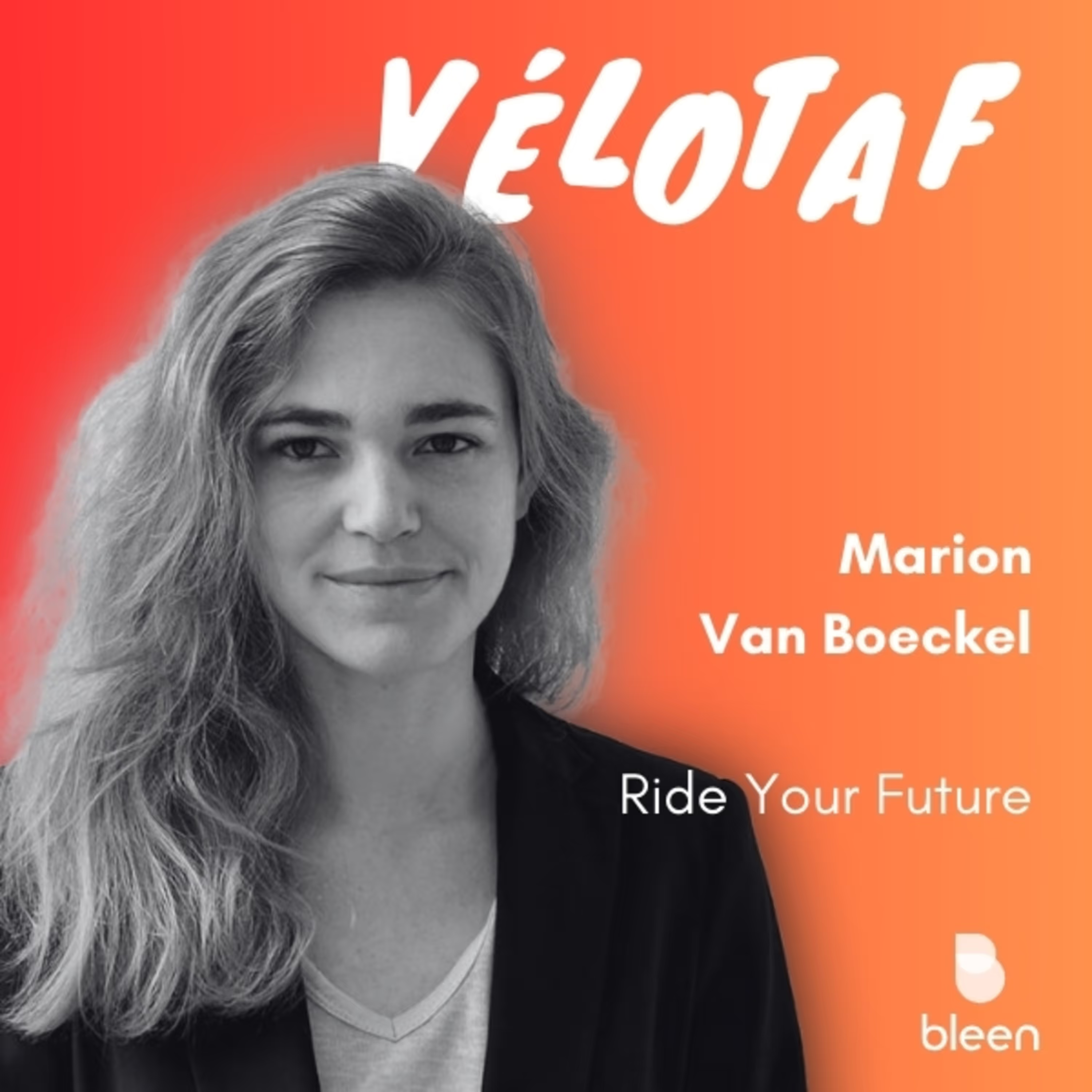
Justine Peullemeulle, co-director, and Marion Van Boekel, project officer, explain how it works. Ride Your Future does not stop at installing structures. The association lends bikes and helmets free of charge, runs the courses with instructors and works with local players over the long term. The BXL Pump Park in Laeken, Brussels’ first pumptrack, welcomes more than 10,000 visitors a year.
“The bike is a very interesting social indicator. Show me your bike and I’ll tell you what social category you belong to.”
The pumptrack: a sports course that builds cycling skills
A pumptrack is a looped track made up of bumps and turns, designed to be ridden without pedalling, using only body movement. The BXL Pump Park covers 1,000 square metres in Laeken. It is the only pumptrack in Belgium with permanent staffing, including instructors, equipment loans and supervised taster sessions.
The staffing makes the difference. At weekends, on public holidays and during school holidays, eight bikes of different sizes are made available free of charge, from balance bikes to adult dirt bikes. Schools and out-of-school associations contact Ride Your Future to organise taster sessions. The City of Brussels funds part of these free sessions. Justine Peullemeulle stresses one point: investing in a pumptrack without a budget for staffing wastes the investment.
“It’s the only pumptrack in Belgium with real staffing and real resources behind it. Putting resources into staffing makes the difference.”
Vélomaster: simulating city obstacles to build confidence
The Vélomaster course recreates, in a safe setting, the obstacles found in urban traffic: potholes, tight bends, kerbs, bridges, steps. The equipment is made of wood by Vélosolutions and designed to last for years. It can be set up temporarily for a single day or permanently in a park or a school playground.
The Vélomaster for School programme trained more than 2,200 pupils in one year. The approach is entirely hands-on: children learn to control their bike and their body in real situations, rather than receiving theoretical training. Bruxelles Environnement bought a Vélomaster course for Porte de Ninove park, and the City of Brussels installed one on the red track at Neder-Over-Hembeek.
“A lot of people know how to ride a bike, but not necessarily well enough to anticipate accidents.”
Investing in working-class neighbourhoods where cycling is absent
Ride Your Future deliberately chooses to set up in neighbourhoods where cycling levels are lowest. At Porte de Ninove park, 90% of the public are children and young people from a neighbourhood poorly equipped with cycling infrastructure. In Neder-Over-Hembeek, the Versailles neighbourhood contract is funding a four-year programme after years of public disinvestment.
Ride Your Future’s approach brings in local players. The association works with AMO (aide en milieu ouvert, open-environment youth support) services, social cohesion programmes and neighbourhood associations. Young people trained by the Cyclo association run a mobile repair workshop alongside the activities on the course. This combination of activities and repairs works particularly well to embed cycling in residents’ daily lives.
“We want to break the continuity of certain social inequalities in mobility by investing in neighbourhoods where little is offered around cycling.”
Convincing local councils to invest in bike courses
The association works in stages. It first sets up a mobile course for a day or two in a local council area. If the experience proves successful, the local council calls back to repeat it. Some then take the step of a permanent investment, as Bruxelles Environnement did with the Vélomaster at Porte de Ninove, or the City of Brussels did with the BXL Pump Park.
Ride Your Future’s message to elected officials is direct: local councils invest in swimming pools and skateparks, and they can now invest in bike courses too. The association already works in Antwerp, Ostend, Liège and Wallonia. About ten pumptracks exist in Belgium, in Leuven, Middelkerke and Neuville, but most are installed on the outskirts, without staffing or support. The BXL Pump Park model shows that a pumptrack in a dense urban area, staffed and supported, produces far better results.
“We strongly encourage local councils to invest in this type of infrastructure, just as they invest in a swimming pool or a skatepark.”