The episode in detail
The Netherlands in the 1970s: a country of cars
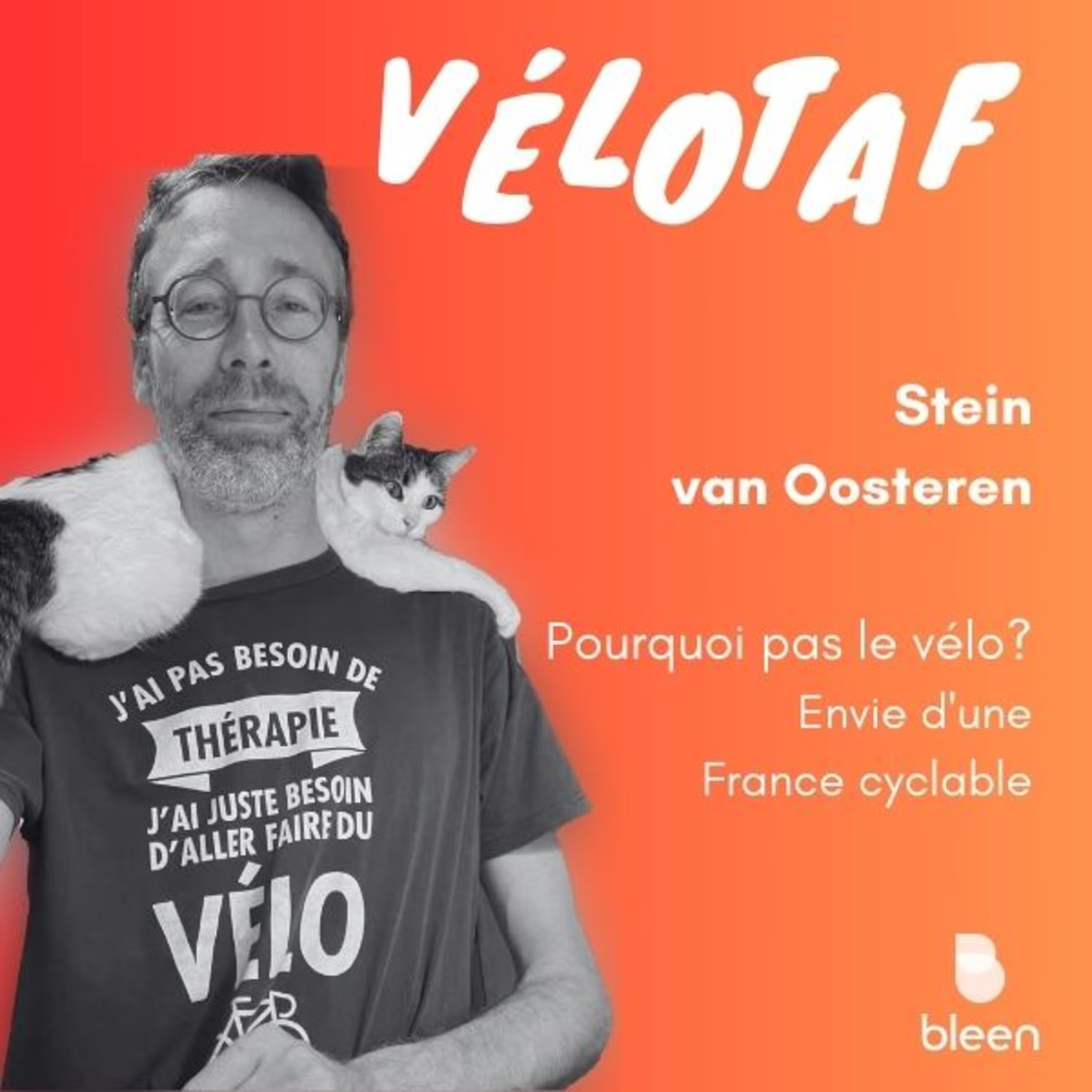
Stein van Oosteren, diplomatic attaché at the Dutch delegation to UNESCO and author of Pourquoi pas le vélo?, breaks a myth from the outset. The Netherlands has not always been a cycling paradise. In the 1970s, the car had taken over completely. Public squares had become car parks. Road deaths kept rising, many of them children.
The bike, which had been the dominant mode of transport until the 1950s, had almost disappeared. The situation was the same in France, in Belgium, across Western Europe. The difference between the Netherlands and the rest is what happened next.
“The car had taken over completely, at the expense of everyone else. The squares in front of Notre-Dame, the Invalides, everything was a car park.”
Stop the murder of children: citizen mobilisation
In 1971, a young girl on a bike is killed by a driver in the Netherlands. Her father, journalist Victor Langenhoff, refuses the silent march followed by a return to normal. He publishes an article titled Stop the murder of children in his newspaper. Thousands of Dutch people take to the streets. The Stop de Kindermoord movement is born.
Citizens start to imagine a calmer city, where children can play outside and get to school on their own. Children themselves take part and put forward a traffic-calming plan to Parliament. But citizen mobilisation alone is not enough. For the authorities to act, a shock is needed.
“Crises are rare. Crises force us to change. You should never waste a good crisis.”
The 1973 oil crisis: the trigger
The 1973 oil crisis brings everything to a halt. No more oil, no more traffic. The Dutch government closes the motorways to motorised traffic. Citizens take over the space: cycling, roller skating, games of chess on the asphalt. The shock to people’s mindset is total. This huge space given over to the car can be used for something else.
In 1974, the government launches the first national cycling plan, 44 years before France. Tilburg is the first city to volunteer. A cycle track links the campus to the town centre. The Hague follows with a scheme in a shopping street, despite anger from shopkeepers afraid of losing customers. 50 years later, every Dutch city is cyclable and a child can ride a bike alone anywhere in the country.
“Human beings are so inert, so attached to their habits. They need to be shaken up.”
France: from the Gilets jaunes to the temporary cycle tracks
In France, citizen mobilisation begins in 2017 with the Parlons Vélo campaign led by Olivier Schneider, co-chair of the Fédération française des usagers de la bicyclette (FUB). Thousands of postcards are sent to elected officials. The result: 10% of the amendments to the mobility orientation law concern cycling. The national cycling plan follows on 14 September 2018.
The Gilets jaunes crisis in October 2018 reveals how dependent rural areas are on oil. The strikes of December 2019 put thousands of French people on their bikes. But the real turning point is Covid. For the first time, a crisis does not just put people on bikes: it builds infrastructure. The coronapistes (temporary cycle tracks), built in a rush using building-site equipment, reshape French urban planning.
“We did more for cycling in a few days than we used to do in several years.”
Tactical urban planning and the Dutch junction
The temporary cycle tracks introduced tactical urban planning to France: build fast using concrete blocks, test, adjust, make permanent. This method unblocked projects that would have taken ten years through the standard process. Le Havre has made permanent the first Dutch junction in France, a layout where cyclists go around the junction instead of passing through the middle of traffic. CEREMA published a national technical guide.
Mobility governance also changed. Before Covid, cycling associations were not listened to. During the crisis, everyone ended up around the same table. Collectif Vélo Île-de-France, founded in 2019, took part in decisions on the temporary cycle tracks on equal footing with public authorities. Stein points out that change is still too slow, that cycle paths still break off in the middle, that too many towns remain at 50 km/h. But looking back over the past five years, the transformation is considerable.
“Once someone takes up cycling, they never go back. The bike is not Dutch. The bike is logical.”