The episode in detail
RRSS: the pillars of the cycling society
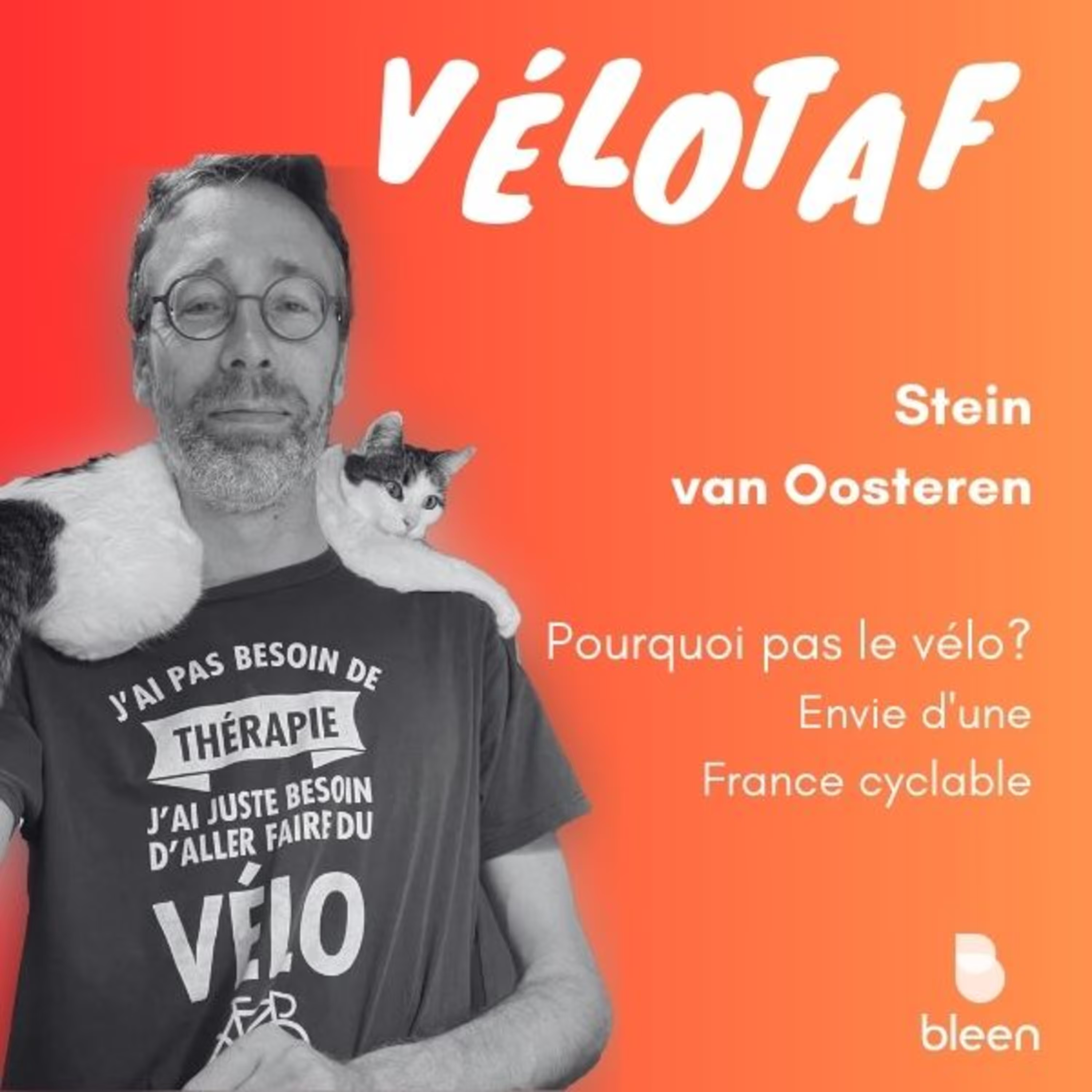
Stein van Oosteren, a cycling advocate and author of ‘Pourquoi pas le vélo? Envie d’une France cyclable’, sums up the cycling society in one acronym: RRSS. Four letters, plus an S for service that he adds to them: the essentials of what needs to be put in place to transform tomorrow’s mobility.
R for réseau (network). Not isolated stretches, but a connected web. Many local councillors build a cycle path here and there, with no connection between them. The result is inevitable: nobody uses it. R for réduire (reduce). Two things: speed (a 30 km/h city, not 50) and the volume of cars. In the Netherlands, traffic plans route heavy traffic onto certain roads and free up residential areas. Streets become cycle-friendly ‘as if by magic’.
S for séparer (separate). People do not cycle because they do not feel safe around cars, not because they dislike pedalling. Physical separation on main roads is essential. S for stationnement (parking). A bike takes up ten times less space than a car, but it still needs somewhere to be parked. Without dedicated infrastructure, bikes end up on pavements. S for service: learning to ride (teaching children to cycle at school), raising awareness of the health benefits, budget and well-being.
“Network, reduce, separate, parking, service. Once you’ve heard that, you’re a cycling expert. Everything else is detail.”
Public space is not a car park: a reversed way of looking at the city
Stein makes an observation that most city dwellers no longer see: public space is saturated with cars, and that saturation has become invisible. Like water to a fish. People complain about an ‘ugly’ bike rack while entire rows of parked cars shock nobody.
Until the 1950s, parking a car in public space was forbidden. That space belonged to everyone, not to those who owned a vehicle. Stein asks us to picture a pedestrian street with a car parked in the middle. The absurdity is obvious. Yet it is the norm on most French streets.
The cycling society is also an aesthetic project. The photos in Stein’s book show colourful streets, human-scale vehicles, children getting around on their own. A city where public space becomes a ‘second living room’ again.
“Public space is your first social network. It’s your second living room. Why use it as a storage lot?”
Cycle streets and intermediate vehicles: the line between bike and car disappears
For Stein, the future of mobility is not bike or car. It’s the disappearance of the line between the two. The bike is becoming more car-like: bigger tyres, cargo bikes, electric bikes. The car is becoming more bike-like: lighter weight, intermediate vehicles weighing between 50 and 600 kilos. Between a classic bike and a light car, a whole range of vehicles already fills Parisian cycle paths.
Current cycle paths are overflowing. They will need widening, more will need to be built, and new forms of layout will need to be invented. The cycle street is one of them: a street where the bike has priority and the car is tolerated. The equivalent for cyclists of what the pedestrian zone is for walkers. In the Netherlands, the main network running through town centres is already designed for bikes and pedestrians, not cars.
“The future of mobility is not bike or car. It’s the disappearance of the line between the two.”
Cycling in rural areas: the twenty-minute France
The classic objection that cycling is for cities does not hold up against the data. The BL Évolution study ‘La France des 20 minutes’ shows that proximity exists everywhere, even in rural areas. Only 30% of car journeys exceed 10 kilometres. The vast majority are within cycling range, especially now that bikes are electrified.
In the countryside, public transport will never be as developed as in cities. That is exactly where the bike matters most: it fills a mobility gap that neither bus nor train can cover. E-bikes now make journeys of 15 to 20 kilometres possible without excessive effort.
Stein points out that the past is not necessarily a step backwards. Bikes from the 1940s were heavy and uncomfortable. Today’s bikes are light, electric and capable of carrying loads. In Strasbourg, cobblestones delivered by boat were taken to the building site by bike trailers. Not a step back, a technical leap forward.
“Only 30% of our car journeys exceed 10 kilometres. Even in the countryside, proximity exists.”
Multimodal node-point networks: connecting every mode of transport
Stein describes a concept developed by the company Vizia, inspired by the Dutch node-point cycling model. In the Netherlands, every junction on the cycle network carries a number. A map displayed on site lets people find their way without a smartphone. The multimodal node-point network extends this principle to every mode of transport.
The method: analyse travel flows across an area using INSEE data, identify existing links (roads, greenways, cycle paths, rail), then connect everything into a single network. Services are installed at the connection points: bike-share schemes, shared cars, car-pooling areas linked to cycle paths.
The aim: shifting from ‘I live in the countryside, so I take the car’ to ‘I live in the countryside, so I choose the mode of transport suited to each journey’. The smartphone becomes the tool for navigating between these modes. This is the concept of Mobility as a Service: the phone suggests the best route by combining walking, cycling, train and shared cars, depending on the time, the weather and the destination.
“The question is not what the future will look like. It’s what future do you want? Because it depends on us.”