The episode in detail
40 gigatonnes of CO2 a year: why decarbonising transport is urgent
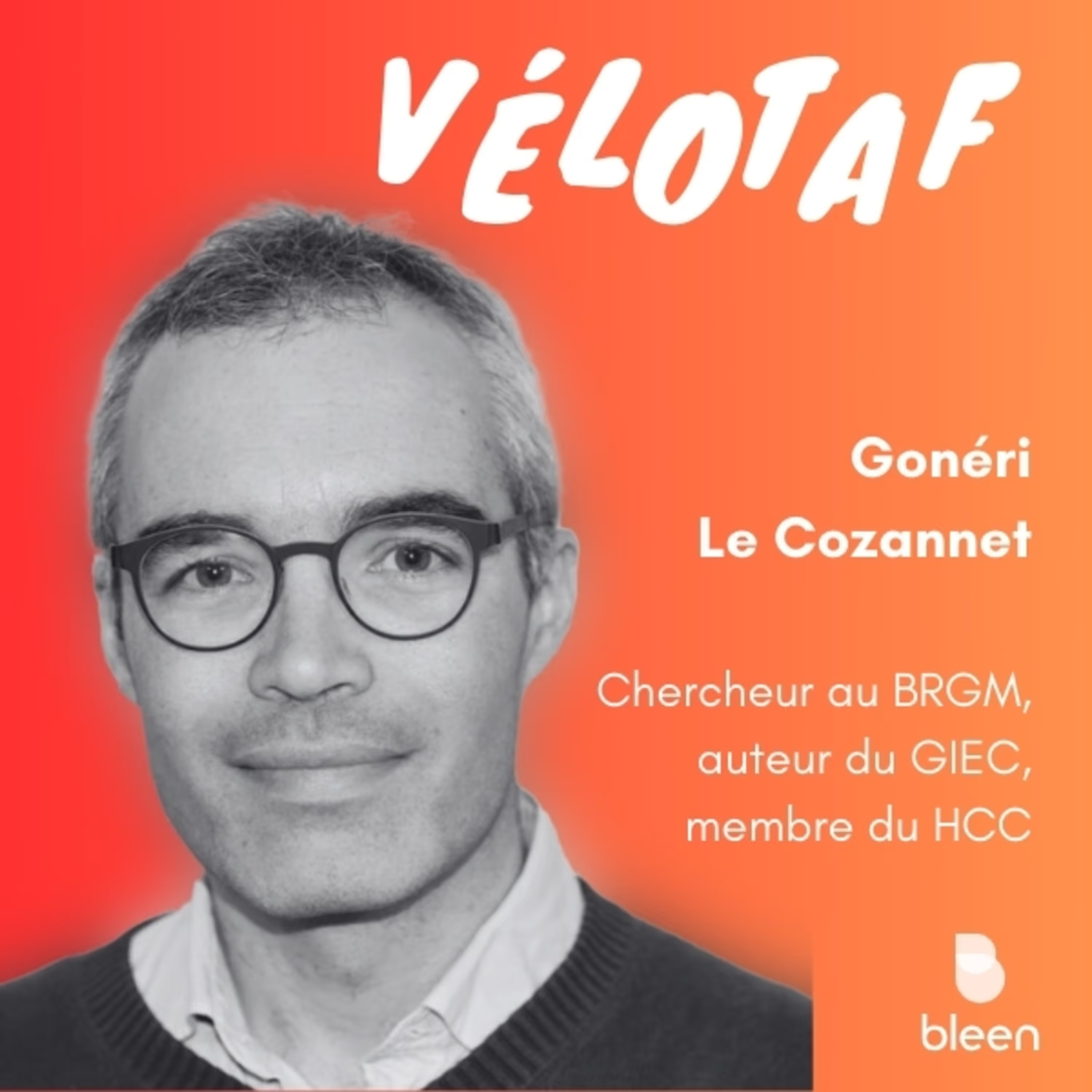
Gonéri Le Cozannet is a researcher at BRGM (Bureau de Recherche Géologique et Minière), author of the IPCC’s sixth report and recently appointed to the Haut Conseil pour le Climat, France’s High Council on Climate. His research covers coastal risk, but his contribution to the IPCC led him to systematically review every reference to cycling in the report, together with Valérie Masson-Delmotte.
The starting point is measurable: humanity emits 40 gigatonnes of CO2 a year. Warming has already reached 1.2°C above the pre-industrial period. The 1.5°C threshold will probably be crossed in the 2030s. Beyond that, the damage becomes irreversible: loss of tropical coral reefs (30% of marine biodiversity), deaths during heatwaves. At 3°C of warming, Europe would see around 100,000 heat-related deaths a year.
Transport accounts for 15% of global emissions and 30% in France. It is the top source in the carbon footprint of people in France.
“As long as we keep emitting more CO2 than ecosystems and technology can absorb, the climate will keep warming.”
Net zero: why the electric car is not enough
Reaching net zero means not emitting more CO2 than forests and carbon capture technology can absorb. But forests are already suffering from climate change. In north-eastern France, they have become net carbon emitters. Spruce trees, poorly suited to the changing climate, are dying from drought and pests.
On the technology side, carbon capture will only offset a few hundred million tonnes a year, earmarked for the hardest sectors to decarbonise, such as aviation. For everyday transport, the IPCC’s pathway rests on three levers: avoid unnecessary trips, shift to decarbonised modes (train, bike, walking), and electrify the remaining traffic.
France has 40 million vehicles on the road, up from 30 million 20 years ago. Replacing them all with electric vehicles would create unsustainable demand for copper and other metals. Material sufficiency is a condition of the transition, not an ideological luxury.
“We cannot imagine meeting a demand that only keeps growing. We also need to moderate it. That is what we call sufficiency.”
Cycling in the decarbonisation strategy: a modest CO2 lever, a major source of co-benefits
In terms of avoided emissions, shifting to cycling represents between 100 and 200 million tonnes of CO2 equivalent a year, according to the IPCC. That is small compared with the rollout of renewable energy. But Gonéri insists that cycling might be the most enjoyable part of the transition, because the co-benefits are considerable.
Better air quality (visible in Paris), less noise, more pleasant journeys, less physical inactivity: once cycle paths are in place, the benefits build up. The e-bike widens access for people with physical difficulties.
The potential is huge. Cycling’s modal share in France sits at around 5%. That is lower than the modal share among people over 70 in Germany and the Netherlands. In Orléans, 70 to 80% of trips are made by car even though half of these distances are under 7 kilometres.
“Cycling’s modal share in France is lower than the modal share among people over 70 in Germany and the Netherlands.”
Sufficiency and public policy: cycling is not just an individual choice
Gonéri unpacks a common misunderstanding. Sufficiency is not a sacrifice imposed on individuals. It is a framework built by institutions that makes low-consumption choices possible and appealing. Cycling policy is the clearest example: when public authorities build safe cycle paths, the shift to cycling happens naturally.
Cycling fits a logic of material and energy sufficiency. A bike uses a fraction of the resources of a car, takes up a fraction of the space, and its infrastructure costs a fraction of the road budget. This is progress for the majority, not a step backwards.
These decisions sit with urban authorities, départements and the state. The budget allocated to cycle paths directly determines the pace of modal shift. Without public investment, cycling stays confined to a bold minority.
“If we open cycle paths, if we have the budgets to open cycle paths, the shift to cycling happens.”
What the IPCC really says about cycling: a solid scientific consensus
Gonéri and Valérie Masson-Delmotte carried out a systematic review of every reference to cycling in the IPCC’s sixth report. They found references in the Working Group 2 (adaptation) and Working Group 3 (mitigation) reports, spread across the chapters on cities, health, urban planning and CO2 emissions.
The IPCC does not make recommendations. It informs states. But the findings are clear: rolling out cycle paths drives modal shift, cuts emissions and improves health and air quality. The IPCC is not prescriptive, but the direction of the most effective action reads clearly in the data.
What Gonéri finds remarkable is the overlap between the IPCC’s scientific conclusions and the demands of cycling advocacy groups such as the FUB (Fédération des Usagers de la Bicyclette, the French cyclists’ federation). The message is the same. The difference is that the IPCC’s version rests on thousands of published, peer-reviewed studies, brought together by hundreds of researchers.
“We have a positive project that benefits everyone and moves in the direction of the transition.”