The episode in detail
Nine months cycling across France: the hardest part is leaving
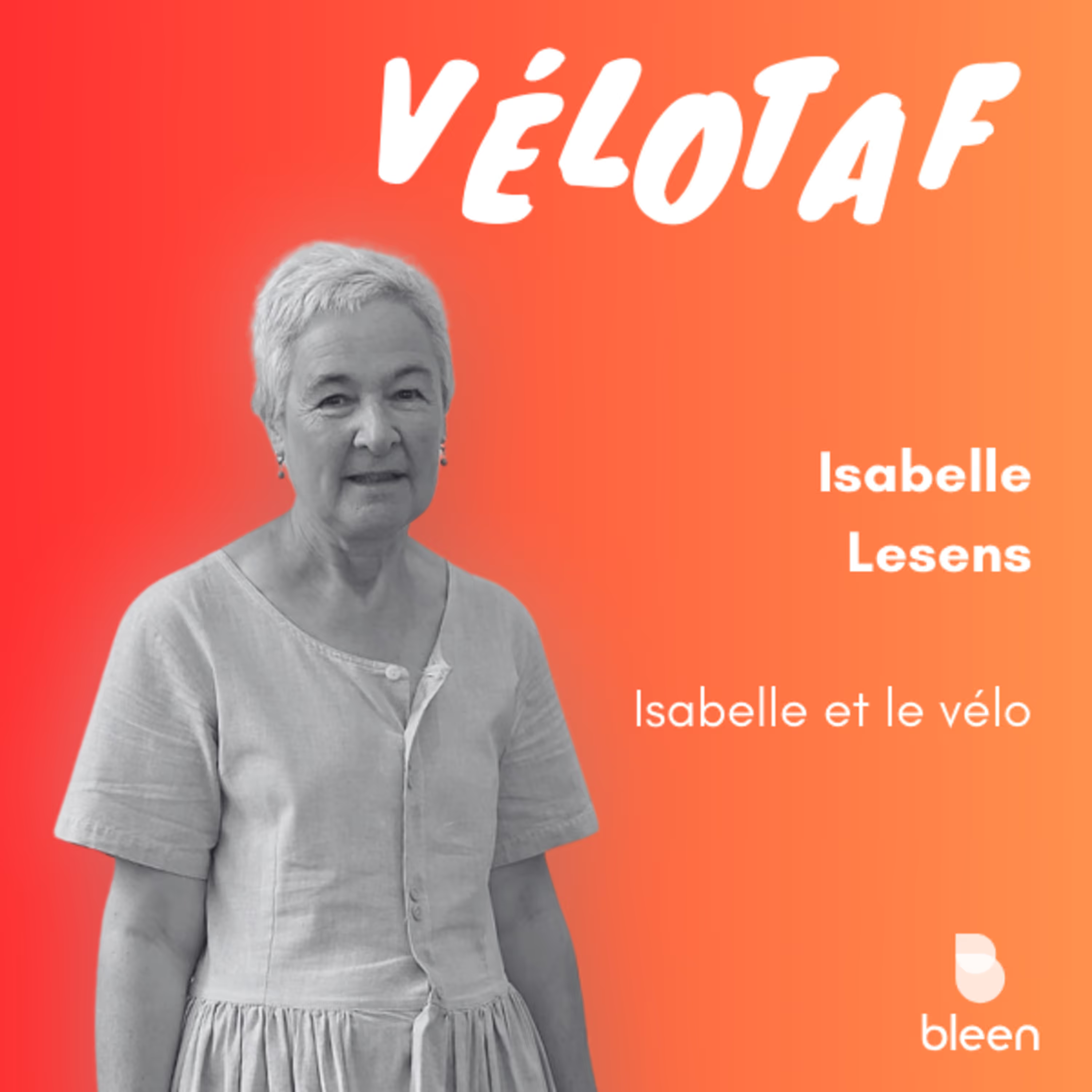
In 1990, Isabelle Lesens left the DATAR, where she had edited the monthly newsletter since 1988, and decided to set off on a nine-month cycling tour of France. The idea did not come from a precise plan. She wanted to see what she had written about in the DATAR newsletter, meet every figure in French cycling and explore the country differently. At the time, the list of those figures fit on a single sheet of paper.
“The hardest part of a trip is leaving. It’s deciding to go. My partner told me: if you don’t go, I’ll leave you, because you’ll be too pathetic. That was the kick up the backside I needed.”
She set off with panniers, no tent, no GPS. Housed one night in three with locals or people she met along the way, she filled in the rest with youth hostels, hikers’ lodges and young workers’ hostels. In Lille, she stayed a fortnight in a hostel until she was politely asked to free up the room. On her return, she had the same amount of money in her pocket as when she left, thanks to article commissions earned along the way.
Meeting local politicians by bike: turning up at the town hall and asking for the mayor
At the time, very few French people toured France by bike. French touring cyclists went abroad; in France, it was mostly foreigners you met on the roads. A young woman travelling alone with her gear stood out quickly, which earned Isabelle write-ups in the local daily press as she went.
To meet local politicians, her method was direct: turn up at the town hall, say she was a journalist with a commission for the magazine Commune de France (a publication for Socialist Party elected officials), and get an appointment within half an hour. Her standing as a journalist, built up at the DATAR where she knew the whole of the specialist regional planning press, opened doors. A congress in Toulouse, where she reconnected with her contacts, brought in further commissions to fund the rest of the trip.
Michelin maps and small white roads: navigating without GPS
Without GPS or an app, navigation relied on Michelin maps and the art of reading the terrain. Experienced cyclists avoided the red roads (national roads) and stuck to the small white ones (departmental and local roads). The problem: road signage was aimed exclusively at motorists. Asking for directions was useless when locals only knew the fast roads.
“To find the small road leaving to the north, you say: I’d like the road to the cemetery. Because if you don’t say that, people can’t find it, they don’t even know it exists.”
Isabelle ended up on a motorway two or three times, particularly on the Atlantic coast, where no alternative existed for non-motorists. It was a time when travelling any other way than by car was simply not imagined.
The first cycling cities barometer: Strasbourg comes out on top
The idea for the ranking did not come before the trip. It was on her return that Isabelle realised she had the material for it: dozens of articles on the cycling infrastructure of the towns she had passed through, meetings with local officials, and first-hand knowledge nobody else had. By then, she knew every cycle track in France by heart.
“The city of Strasbourg boasted about being first in France for at least 20 years. And if only they knew it was just me who decided that, all on my own, like a grown-up.”
The ranking was reasoned but home-made: no scientific grid, no panel. Isabelle ranked the cities “a bit like playing cards”, drawing on the expertise she had built up over nine months. Strasbourg came first, Bordeaux eighth. The Bordeaux city councillor, stung by the ranking, went so far as to hide copies of the results under a table during a meeting of the Club des villes cyclables.
50 Millions de Consommateurs: getting published through sheer nerve
Isabelle drew up a list of publications to approach, in order of priority. First choice: 50 Millions de Consommateurs, whose offices were in her own arrondissement. She used a contact on the inside to get past security at the entrance, had someone point her to the editor’s office, turned up without an appointment and pitched her project. Twenty minutes later, it was accepted.
“I went in on pure bluff. And the editor told me later: I was stingy, I didn’t pay you enough for what we got out of it.”
50 Millions’ press officer did the rest: Isabelle was “hauled around like a sack of potatoes” from TV to radio. The media coverage was massive. The main effect: cycling forced its way into French public debate.
From home-made barometer to FUB survey: the legacy of a pioneering ranking
Isabelle Lesens’s ranking inspired similar efforts abroad, particularly in Germany. Today, it is the FUB (Fédération française des usagers de la bicyclette) that runs the Cycling Cities Barometer, a participative survey put to citizens with quantified criteria. The method is more scientific, but Isabelle points to a bias: citizens’ opinions do not always reflect objective reality.
“People tell you a junction is dangerous. I correct that: no, it’s frightening. There’s a difference. What’s dangerous is where there are accidents. But citizens don’t have the figures.”
The value of today’s barometer lies in medium-term comparison: tracking the cities that improve and those that stagnate. But the principle stays the same as in 1990: measure, compare, publish, and force public debate.