The episode in detail
La Cyclo pour le Climat: cycling to raise awareness
La Cyclo pour le Climat began in the Netherlands five years ago. The original idea: link the south of the country to the north along the future coastline if global warming is not contained. In the Netherlands, a large part of the territory lies below sea level. A one-metre rise would be enough to wipe entire areas off the map. The initiative has spread across Europe: France, Italy, Belgium, Poland, England, Switzerland.
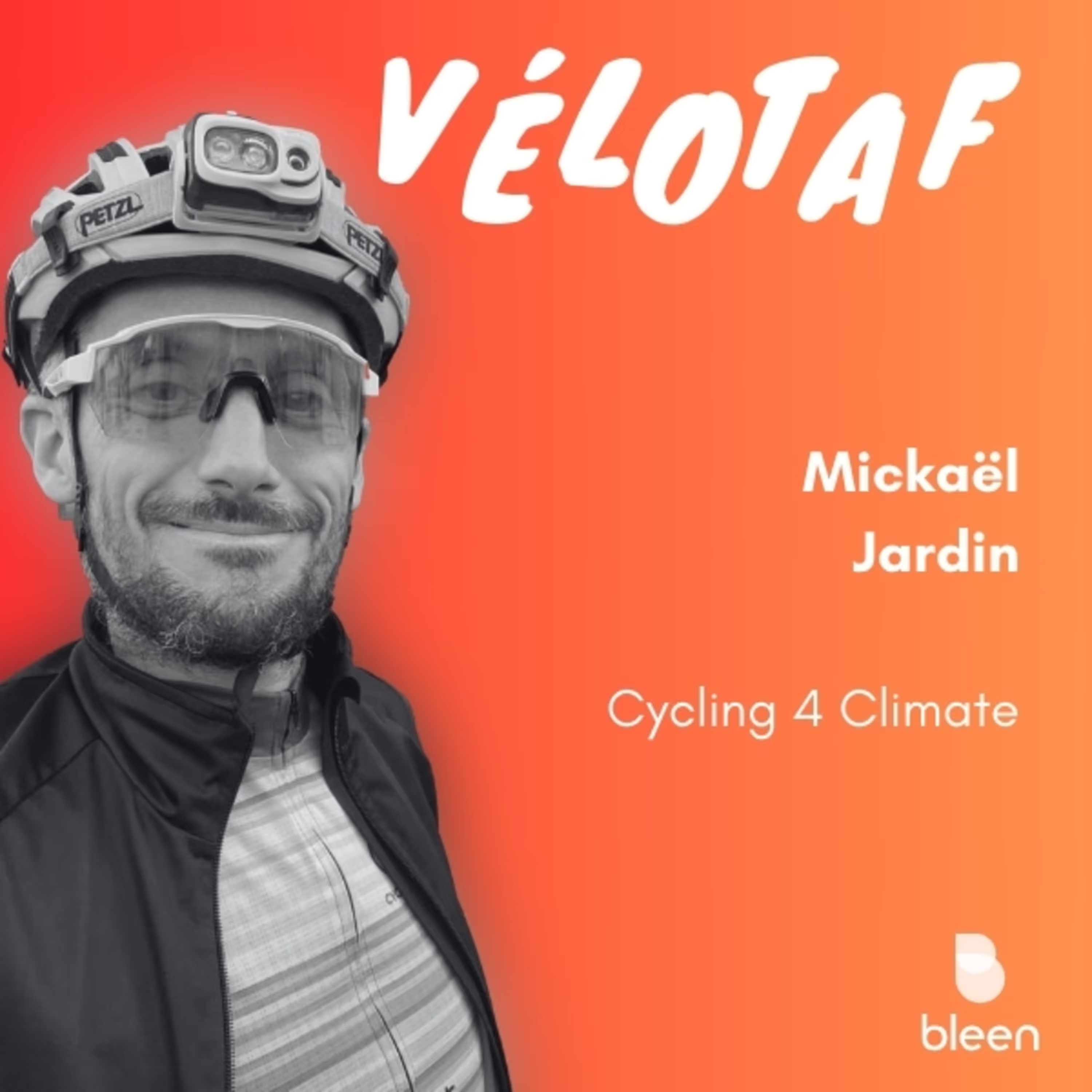
Mickaël Jardin, 45, a cycling enthusiast for 25 years, took charge of organising the event in France. The first edition in 2022 had 40 participants between Brest and Mont-Saint-Michel, 313 kilometres across Brittany. The second edition, in Saint-Malo, had 150 participants. The third edition: between 200 and 250 entrants in Saint-Malo, plus around a hundred in Lyon.
“The aim is really solidarity. We set off together, we help each other, and we arrive together.”
Routes from 100 to 500 kilometres for every level
La Cyclo pour le Climat is not a race. There is no timing, no ranking. The event offers routes suited to every level. In Saint-Malo: a first 100 km for beginners, a 150 km ride to Cap Fréhel (hilly), a 150 km ride to Mont-Saint-Michel (flat), and a 300 km ride combining both loops. And for those who want to try ultra-distance: a 500 km ride starting in Versailles, with a full night of riding.
Each group is led by experts, some of whom have ridden Paris-Brest-Paris. They advise on road positioning, pacing and equipment, and help with mechanical problems. The ‘mon premier 100’ (‘my first 100’) format aims to prove to occasional cyclists that 100 kilometres is within reach, which opens up a range of 30 to 40 kilometres on holiday.
“Showing people who have never ridden 100 kilometres that it’s entirely possible, with the right support.”
Carbon footprint and climate pledge: the trade-off
To register for La Cyclo pour le Climat, each participant must calculate their carbon footprint. The exercise is not a judgement. It is a first step towards awareness. The French average is 10 tonnes of CO2 equivalent per person per year. The target set by the Paris Agreement: 2 tonnes by 2050. A return flight between Paris and New York already accounts for 2 tonnes.
After the assessment, participants write a climate pledge. No one checks it. The idea is to put a concrete commitment in writing: eat less meat, commute by bike more, fly less. The event’s food stops are entirely vegetarian, including the end-of-day burger. Feedback is positive: participants discover that a vegetarian meal can be filling and excellent after 300 kilometres.
“Working out your carbon footprint is often the first step towards awareness.”
The bike, the most logical tool against climate change
Mickaël sets out a simple calculation. A car weighing a tonne and a half carries one person weighing 70 kilos. A 15-kilo bike carries the same person. The ratio of vehicle weight to weight carried says everything. Even an electric bike, at 20 to 25 kilos, stays within a coherent proportion.
The bike also offers an underestimated range. 50 to 70 kilometres in a day are within reach of an occasional cyclist. That is enough to explore a region, stop whenever you want, and see what you would miss by car. For his daily bike commute, Mickaël covers 23 kilometres between home and Rennes in an hour, almost the same time as by car, without the traffic jams, the stress or the parking.
“The bike really is the most logical mode of transport in the fight against climate change.”
An association backed by ADEME and the city of Saint-Malo
La Cyclo pour le Climat France is a non-profit association made up of 8 to 9 volunteers. Partners for the third edition include the city of Saint-Malo, which provides a venue and actively supports the development of local cycle tracks, and ADEME (Agence de la Transition Écologique, the French ecological transition agency), which provides financial and communication support.
Starts and finishes are always organised in towns accessible by train: Saint-Malo (TGV station), Versailles, Lyon. Putting 250 cyclists on the road while getting them there by car would be contradictory. Prices stay minimal: 30 euros for the 300 km if you already own the Warming Stripes jersey, which barely covers the food stops.
“We’re not chasing numbers. We just want everyone to have a good day.”