The episode in detail
A bike-commuting e-shop born from a glaring lack of online advice
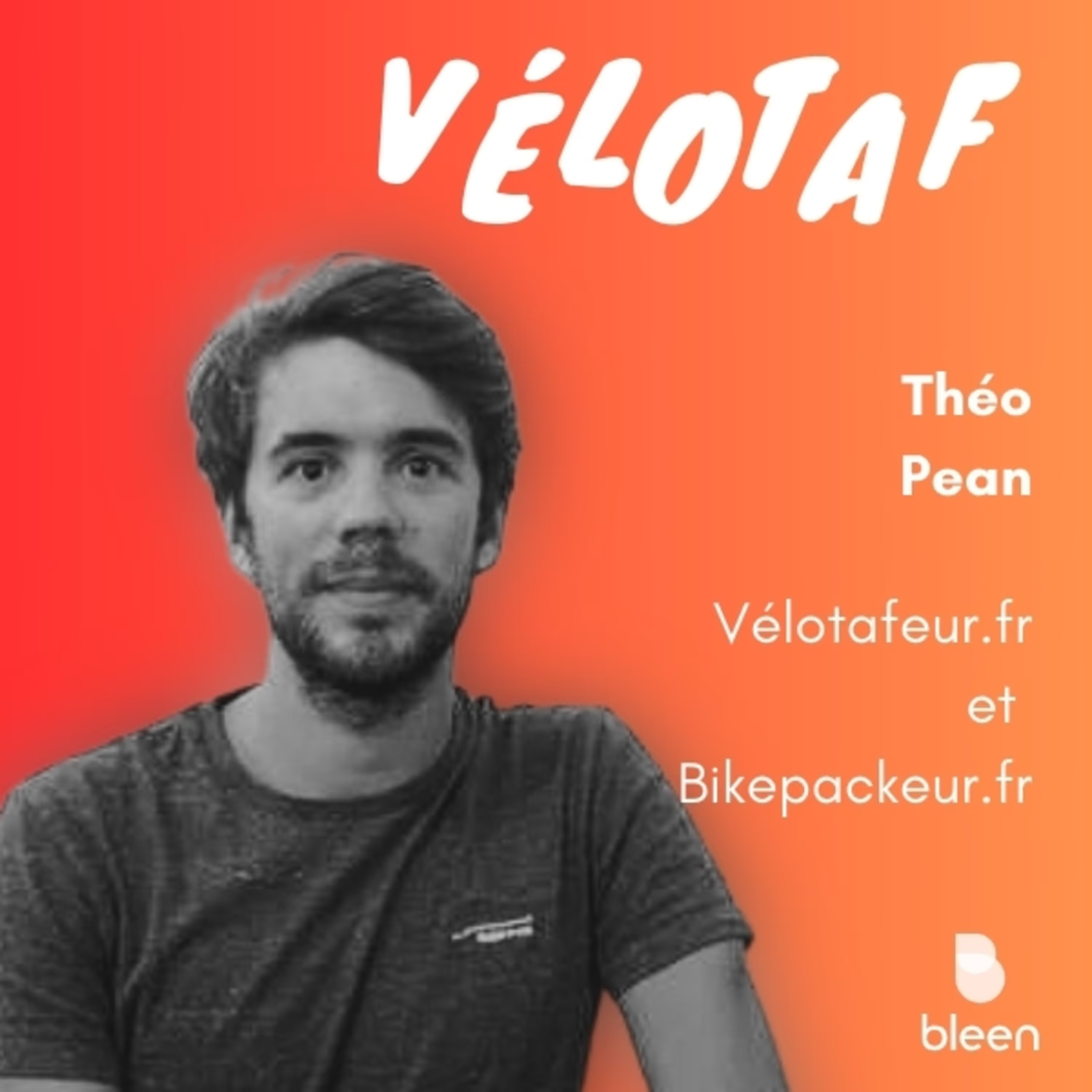
Théo Pean has been cycling since childhood. He competed from age 12 to 18, then reached a good level in triathlon, yet he had never thought of cycling as a form of transport. That changed when an injury took him out of competition and pushed him towards bike commuting. The realisation was immediate: he was badly equipped. A road bike that threw his weight forward, no lights, no rain protection. He looked for answers online. He didn’t find enough.
In 2019, with his brother and later their business partner Ségolène, he launched Vélotafeur. The site doesn’t just sell accessories. It offers advice comparable to that of a specialist physical shop. A chat window connected directly to Théo’s phone allows real-time conversation, with no chatbot and no multiple-choice menu.
“We want to offer the same advisory experience as a specialist shop, on our website.”
Théo calls it a local-feel e-shop. The term sums up his approach: selling, but above all guiding newcomers who feel lost on large general platforms such as Alltricks or Pro Bike Shop.
Search visibility: what makes or breaks a bike-commuting e-shop
Asked about the biggest challenge for a site like his, Théo doesn’t talk about logistics. He talks about Google. Being visible in search results is what keeps an independent e-commerce business alive. Without it, even the best catalogue in the world stays invisible.
SEO work is handled by Ségolène, a web copywriter. The numbers show the scale of it: Google recognises Vélotafeur for 15,000 keywords. Of these, around 10,000 rank the site beyond position 50 and generate almost no traffic. Nearly 1,000 keywords, however, place the site in the top 3. The goal is twofold: widen the total number of indexed keywords and push as many of them as possible into the top positions.
“What matters most is being ranked on Google. You can have the best-looking site in the world, but if you’re on page three, no one will find it.”
On the logistics side, Théo chose to handle everything himself. Stock is kept at his home, and parcels go out from his own hands. He reckons he packs 9 out of 10 orders himself. It’s a small-scale model that raises questions about scaling up, but it guarantees full control over the customer experience.
Why commute by bike: health, savings and urban planning
Théo points to the documented benefits of bike commuting. On the health side, the WHO recommends at least 2.5 hours of physical activity a week. Five 30-minute commutes are enough to reach that threshold. The effects span a wide range: cardiorespiratory fitness, muscular strength, and a lower risk of diabetes and depressive symptoms.
On the financial side, Théo estimates the annual cost of a car at around €5,000, including fuel, insurance and depreciation. A bike or an e-bike costs 5 to 10 times less over the same period. The financial gain is direct and measurable.
The third argument concerns land use planning. A bike takes up far less space than a car. If 10 to 30% of commuters switched to cycling to work, urban space would be transformed, with a marked reduction in land take, the leading cause of biodiversity loss.
“If 10, 20, 30% of people used a bike to get to work tomorrow, our cities would be laid out differently.”
Modal share and barriers: bike parking, the blind spot of public policy
Despite these benefits, cycling’s modal share of commuting trips in France stays around 2 to 3%, far behind countries such as the Netherlands. There’s considerable room for growth, but it depends on removing concrete barriers.
The first barrier is safety. Without cycle tracks, many potential cyclists give up. The second, less talked about, is parking. Théo stresses this point: companies often offer a shelter of a few square metres against a car park with hundreds of spaces. For cargo bikes, the situation is even worse. Théo himself, if he sold his car, would have no secure way to park a cargo bike in or near his building.
Some solutions are emerging. In Brussels, secure bike boxes are being rolled out, but the waiting list runs to 15 years. The demand is there; the supply isn’t keeping up.
“People tell us: we’re happy to cycle in, but we’ve got a measly 6 by 3 metre shelter for 10 bikes, against a car park with hundreds of spaces.”
Made in France and Europe: sourcing that’s hard but improving
Théo openly favours made in France and made in Europe products. Today, only 5% of Vélotafeur’s range is sourced in France. The figure is low, but Théo reckons he’s among the best in the sector on this front. The main problem remains price. French brands that manage to offer a competitive price can be counted on one hand.
He mentions Suzon et Suzette, a brand of handlebar mitts made in France in workshops that support people back into employment, priced slightly above Asian competitors but not prohibitively so. He also mentions l’Atelier de la Baleine à Bosses, a leather craftsperson in Saint-Malo who makes bags by hand. Volumes stay modest, but every sale counts.
At European level, brands such as Ursus (kickstands, Italy), Vaude (textiles, Germany) and Abus (angle-grinder-resistant locks, Germany) show that credible alternatives exist outside Asia.
“There’s no point offering fully circular products if no one can afford to buy them.”
Bikepacking: why a second site separate from Vélotafeur
Alongside Vélotafeur, Théo launched Bikepackeur, a site dedicated to bike touring. The split between the two sites comes down to editorial consistency. Selling bikepacking bags on a bike-commuting site still made sense. Offering tents, sleeping mats and camping stoves on Vélotafeur would have muddled the message.
Strictly speaking, bikepacking describes a way of touring by bike where bags are fixed directly to the frame, fork or seatpost, with no pannier rack. The term has broadened to cover any form of bike touring, but Théo is keen to point out the original definition.
His advice for anyone hesitant to start bike commuting or bikepacking: start small. One trip a week is enough to kick off the change. There’s no need to sell the car overnight.