The episode in detail
Women and cycling: a blind spot in cycling policy
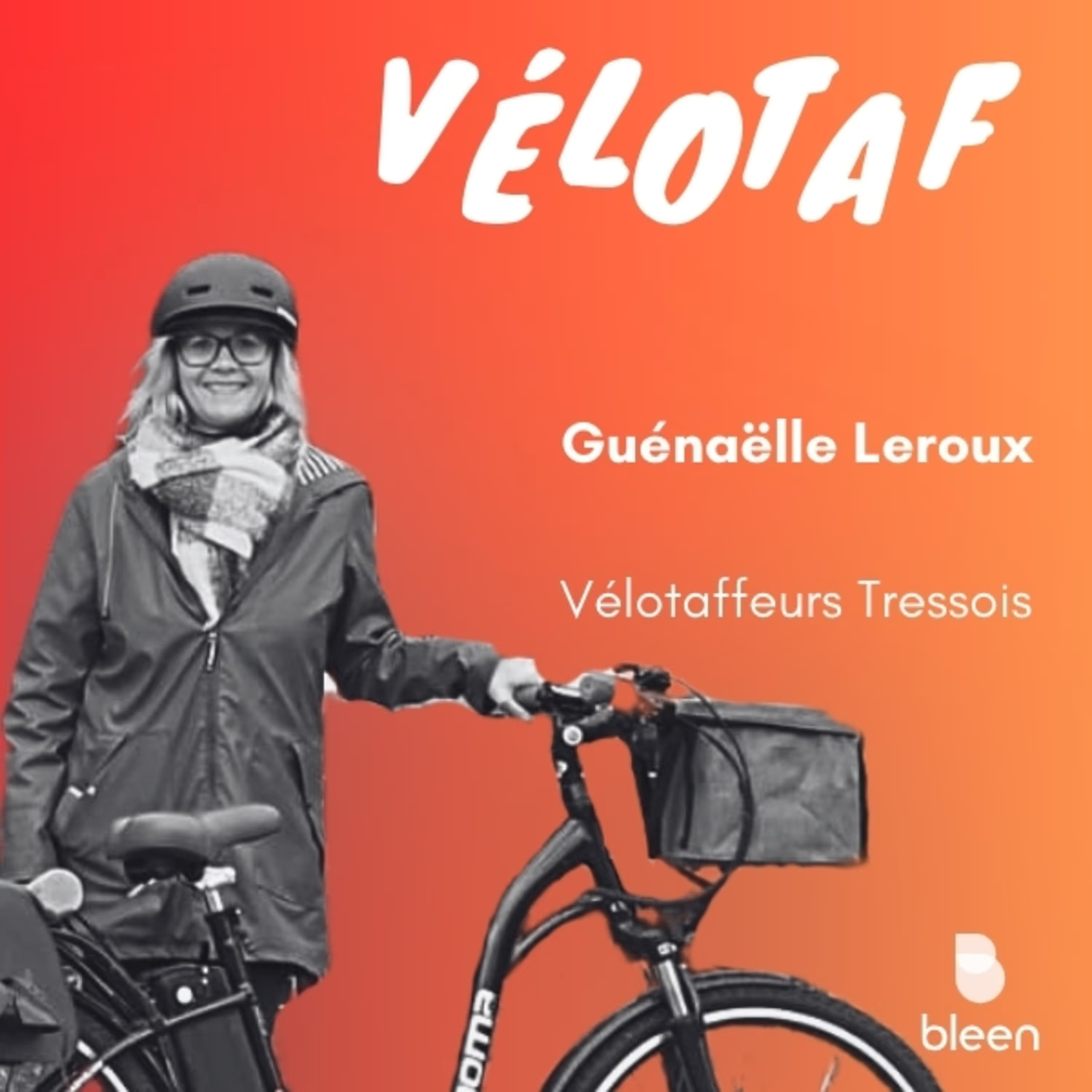
Women account for only 30% of daily cycling trips, according to ADEME, and just 10% of cycle-touring trips. Guénaëlle Leroux, chair of the Vélotaffeurs Tressois near Bordeaux, noticed this imbalance by comparing the statistics with her own experience on the ground. Her partner, also a cyclist, felt completely differently about daily journeys. That difference in experience triggered her thinking: the bikes, equipment and infrastructure on offer do not meet the needs of women cycling with children and shopping.
“As children and teenagers, boys cycle six times as much as girls. Parents push girls less towards learning to cycle.”
Cycling equipment poorly suited to women’s needs
The mismatch starts with buying the bike. Models labelled ‘women’s bikes’ often require lifting the leg high to get on the saddle, while Dutch bikes with a low frame have solved this problem for a long time. The front basket tips when loaded. Double kickstands, essential for stabilising a bike with a child seat, are neither fitted as standard nor always possible to install.
As soon as you need to carry children and shopping, the market points towards longtail or cargo bikes, which are expensive. Guénaëlle chose a trailer instead, a compromise that keeps the handling of a standard bike while offering the carrying capacity she needs. But this solution creates other problems once you get to the question of infrastructure.
Inclusive cycling infrastructure: the trailer test
Cycling infrastructure in France is designed for a standard bike. Anti-scooter chicanes, rocks placed at the entrance to paths, hoop barriers set too close together or installed on a slope: all of this blocks a trailer, a cargo bike or a bike adapted for a disabled person. CEREMA recommends a 1.40 m gap between obstacles to let these oversized bikes through. In practice, planners do not know these recommendations.
Cycle lanes measuring 80 cm instead of the recommended 1.50 m expose families to cars passing close by. Guénaëlle asks decision-makers a simple question: would you put your children on this piece of infrastructure at rush hour? The answer, almost always, is no.
“When rocks are placed to stop people passing on a small country lane, I can no longer get through with my trailer. That closes the door on this kind of mobility.”
Local advocacy: convincing town halls one email at a time
The work of the Vélotaffeurs Tressois runs through direct contact with local authorities. Every exchange with the town hall or the community of communes becomes a small case for change. Guénaëlle draws on CEREMA recommendations and FUB guides to back up her requests. The response is generally positive: planners admit they had not thought of it.
The FUB follows the association’s work closely. Colourful portraits of women cycle commuters, and the careful communication led by Lucie (communications) and Guillaume (photography), have earned the Vélotaffeurs Tressois several articles and national profile pieces. The FUB repeats that rural areas, where the cycling modal share drops to 1%, are the priority for reaching national targets.
Three measures for more women on bikes
If she had full authority over her community of communes, Guénaëlle would put three measures in place. First, roll out sheltered bike parking on a large scale. Electric and cargo bikes are an investment that cannot be left out in the rain, and the lack of parking remains a major obstacle, beyond the question of gender.
Second, close town centres to car traffic at school times. Journeys of 2 to 3 kilometres to school are the most common in rural areas. The stress caused by traffic in town centres puts parents, particularly mothers, off cycling with their children.
Third, build infrastructure separated from car traffic. Cycle lanes, and even cycle paths marked on the road, are not enough to reassure families at rush hour.
“Every time there is a piece of infrastructure, I ask the question: would you put your children on it? Most of the time, the answer is no.”
Mechanical embarrassment: an invisible obstacle
Many women do not dare touch the mechanics of their bike. Some admit they do not know how to put a derailed chain back on. This psychological barrier, which Guénaëlle calls ‘mechanical embarrassment’, keeps women away from cycling day to day.
The association is preparing targeted mechanics workshops: changing an inner tube, adjusting a derailleur, maintaining a chain. Running these as women-only sessions is under discussion, to stop a well-meaning participant taking the tools out of a beginner’s hands. Ideally, women bike mechanics would run them, like those who lead participatory workshops in Bordeaux or Brussels.
Role models: making women cycle commuters visible
Guénaëlle’s strategy rests on representation. Every portrait of a male cycle commuter published by the association is systematically matched with a portrait of a female cycle commuter. The photos show women properly equipped, in winter as in summer, on journeys sometimes longer than 12 or 13 kilometres one way. The feedback is concrete: women discover that covering these distances every day is possible.
The association’s board keeps strict gender parity. Guénaëlle notes that having a woman as chair may have encouraged other women to get involved. By contrast, some of the larger Bordeaux cycling associations count only 3 women out of 15 board members.
“Lots of women have told me: I didn’t imagine you could go that far. Just that representation of women matters.”
Cycling in rural areas: an amplified gender challenge
While the cycling modal share reaches 10% in some major cities, it falls to 1% in rural areas. And the proportion of women cyclists drops even further there. The unequal split of domestic tasks, such as shopping and school runs, weighs more heavily in areas where distances are longer and infrastructure is absent.
The association organised a special evening during mobility week, screening the documentary ‘Women Don’t Cycle’, in partnership with the community of communes. Few local officials turned up, but the association keeps going. The FUB confirms that work in these areas is a priority for reaching national targets on cycling’s modal share.