The episode in detail
Cycling in semi-rural areas: territory overlooked by cycling policy
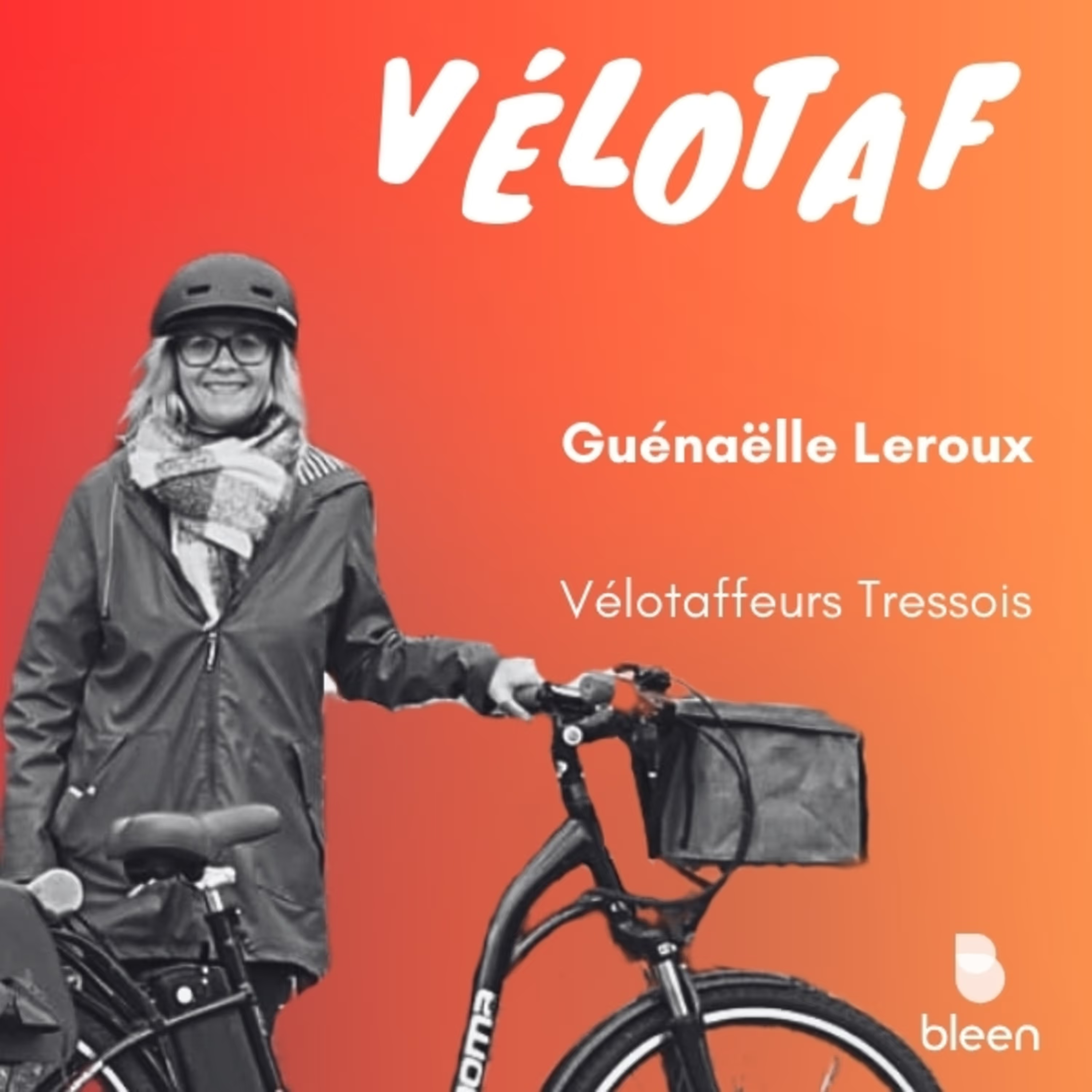
Cycling in rural areas remains marginal: in the Coteaux Bordelais community of communes, the cycling modal share caps out at 1%. Yet 60% of journeys in France are under 3 kilometres, and rural and semi-rural areas make up 80% of French territory. Guénaëlle Leroux founded the Vélotaffeurs Tressois in Tresses, a commune of 5,000 residents in the Gironde, to prove that everyday cycling is possible outside major cities. Her commute: 11 kilometres one way across the Coteaux Bordelais hills, 22 kilometres a day on an electric bike.
“60% of our journeys cover less than 3 km. That’s completely abnormal. We’ve become extremely lazy.”
Why rural areas resist cycling
In major cities, congested roads and parking have pushed local officials to invest in cycling infrastructure. In rural areas, that problem does not exist: getting around by car stays easy and fast, with parking everywhere. Officials do not see cyclists and conclude there is no demand. The reverse is true: building infrastructure is what creates cyclists.
The main obstacle cited by residents is not lack of interest but fear. Guénaëlle consistently hears the same reply: “What you’re doing is great, but I’m too scared.” The statistics confirm it: between 60 and 80% of French people say they would like to use a bike for shopping or the commute to work. The block is infrastructural, not cultural.
Cycle commuting as comfort: a change of perspective
Guénaëlle started out cycling on fine days, and the habit took hold from there. Concrete benefits did the rest. Journey time is predictable, whatever the traffic conditions. The sense of letting go is real: no more staring at Google Maps to check for jams. Half an hour of cycling in the morning generates positive hormones, energy and a good mood that carries through into the office. The evening ride works as a decompression between the working day and family life.
“When I arrived by car, I was often very worked up. I’m in a completely different state of mind when I get to work in the morning by bike.”
On the rare days she goes back to the car, the feeling of being trapped in traffic returns immediately. The electric bike has made the daily commute workable despite the hills of the Coteaux Bordelais.
The school bike bus: making journeys safe without infrastructure
Without safe cycle tracks, waiting for infrastructure to arrive amounted to doing nothing. The Vélotaffeurs Tressois set up a bike bus: an organised convoy where children ride two by two, with volunteer parents at the front and back. Three routes cover distances of 1 to 2.5 kilometres. On stretches without cycling infrastructure, parents stop traffic to let the convoy through.
The success is immediate. The children ask for it, social ties form between families, and the town centre breathes more easily in the morning without the stream of cars in front of the school. Beyond mobility, the bike bus addresses child inactivity: children become active participants in their own journey, build awareness and learn to work together.
“When you see their smiles at the end, that’s the best reward there is. They’re delighted and they ask for this bike ride.”
Local advocacy and concrete results
The association has built up a range of complementary actions. An annual cycling festival (30 participants the first year, 50 the second) with a secure 5-kilometre circuit through Tresses. Mechanics workshops to demystify maintenance. Cycling courses for children with real road signs (stop signs, give-way signs, roundabouts). Portraits of women and men cycle commuters to show it can be done, with detailed routes and practical tips. Group cycle commuting: riding to work together.
Advocacy with the town hall has paid off. After a presentation to the town council setting out the benefits of the concept, the commune of Tresses adopted a blanket 30 km/h speed limit. The association, a member of the FUB network, communicates regularly with the local authority to flag dangerous spots and suggest improvements to signage.
Convincing local officials: six months to build trust
The reception at the town hall was not immediately enthusiastic. Officials wondered whether the association was too combative. It took six months of dialogue and proof through action to build trust. The community of communes, on the other hand, welcomed the initiative from the start, with a cycling plan having launched around the same time.
Guénaëlle’s message to future founders of rural cycling associations is direct: do not wait until you have a lot of people. She started with three or four. Having an official structure, with a constitution, a committee and a name, gives the group standing with local officials. Volunteers follow once the results are visible.
Children, tomorrow’s adult cyclists
Getting children onto bikes from a young age serves three purposes. Tackling inactivity: children no longer take part in their own journeys, dropped off by car morning and evening. Building positive memories tied to cycling, which will make the move to cycle commuting easier in adulthood. And raising drivers with empathy: a child who has cycled in traffic will understand, once behind the wheel, what a cyclist feels when overtaken too closely.
“All these children will be us tomorrow. This awareness needs to be built from the youngest age.”
The episode comes against the backdrop of the death of Paul Varry, a cyclist killed by a driver in Paris. A reminder that cyclist safety depends on the ground-level work carried out by volunteers like Guénaëlle, commune by commune.