The episode in detail
Cycling schools and school mobility: a societal issue
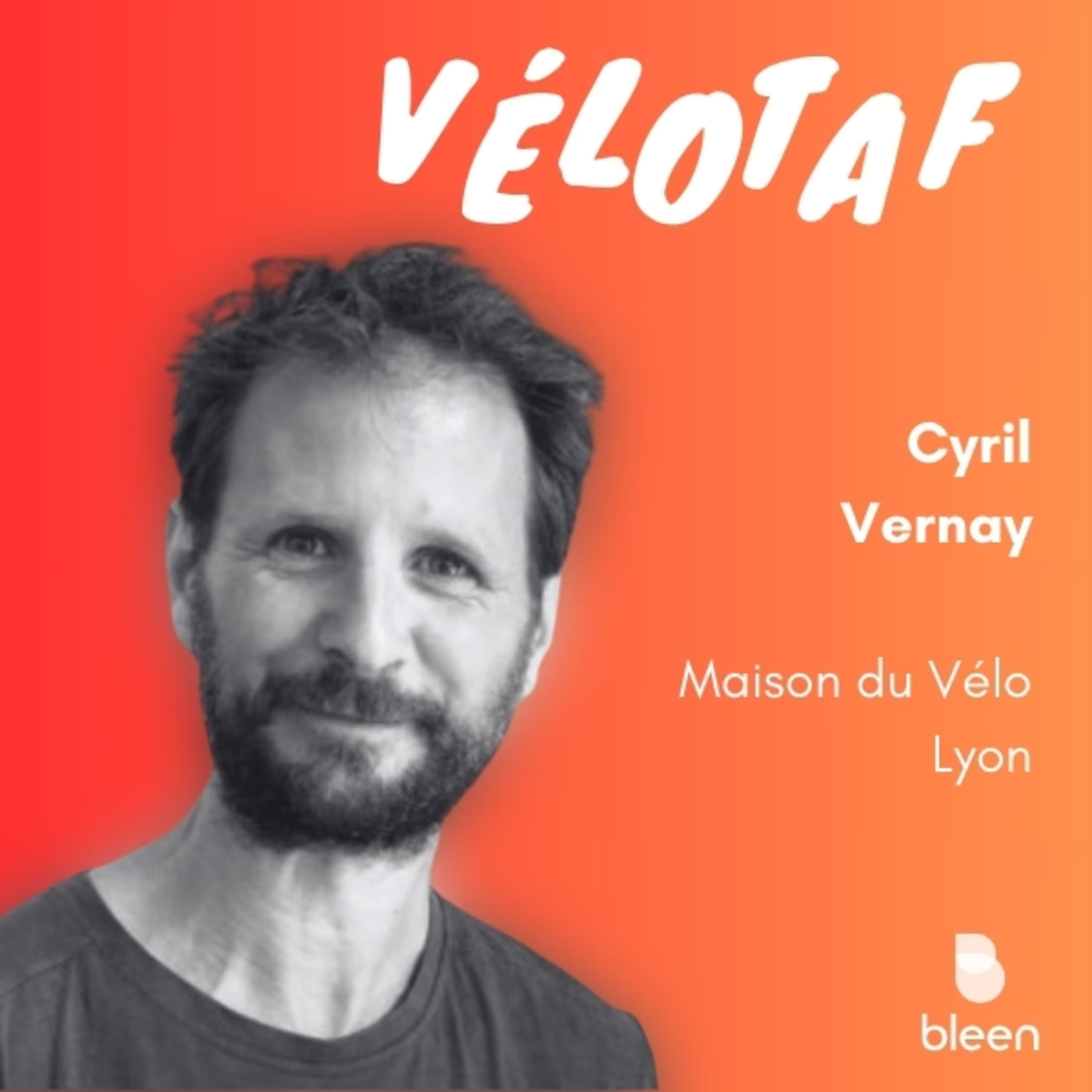
School-age children make up 23% of the population and account for 14% of motorised trips in the Lyon area, in the form of accompanying mobility: adults driving children by car. Cyril Vernay, school mobility officer at the Maison du Vélo de Lyon, works to develop cycling among children and their families across a metropolitan area of 1.5 million people. His conviction: the bike is more than a mode of transport, it is a tool for independence that widens what a child can do.
“What drives cycling is the smile at the finish. That’s what makes you want to get back on the bike the next morning.”
Maison du Vélo de Lyon: 20 years of expertise by audience
Founded in 2004 under the name Pignon sur Rue, the Maison du Vélo de Lyon employs around ten staff, half of whom are qualified instructors for on-road cycling training. What sets it apart is an organisation structured by audience (schoolchildren, employees, the general public, people in social integration schemes) rather than by type of activity. This approach builds detailed expertise in the practices of each group and goes beyond explanations that rely solely on infrastructure.
The association works mainly with the Métropole de Lyon (responsible for secondary schools, roads and mobility) and the city of Lyon. Since 2020, a Green-led local executive has considerably sped up cycling infrastructure projects and the launch of an institutional cycling school, a long way from the volunteer-run association model of the early days.
Savoir Rouler à Vélo: ambitions and limits
Savoir Rouler à Vélo (‘knowing how to ride a bike’), launched as part of the 2018 national cycling plan, aims to train 800,000 children to cycle independently in traffic. The programme has three blocks: bike handling, learning and applying traffic rules in a safe setting, then practice in open traffic. A minimum of 10 hours, from the first year of primary school to the first year of secondary school.
On the ground, reality is more complicated. In Lyon, 80% of primary school pupils were already following a 10-session cycle, but limited to bike handling, without real traffic. The programme’s 17 partners (FFC, mountain bike instructors, FUB) don’t all share the same goal: some aim for sporting practice, others for urban mobility. The contradiction is clear: instructors are asked to bring children to a level that the urban environment and the lack of family cycling practice make hard to reach.
“When you take 15 children and put them on bikes, you very quickly spot the child who has already ridden with their parents compared with all the others. The abilities are completely different.”
No utility cycling without leisure cycling first: the role of parents
Cyril’s central hypothesis: utility cycling requires prior leisure cycling. Commuting by bike or attending a cycling school cannot be improvised. You need to have already ridden for pleasure, in a relaxed setting, before you can handle the time pressure, clothing and safety demands of daily mobility.
Access to outdoor leisure activities and sport, however, is socially determined. Children who arrive at Savoir Rouler à Vélo with family experience become capable quickly. The others are discovering everything: the road surface, vehicles, sharing space. The Maison du Vélo has therefore developed a “family cycling” course at the Parc de la Tête d’Or: two two-hour sessions to teach parents how to ride in the city with a child aged six or over.
Social inequality and bike ownership among children
A survey conducted with the CNRS and the University of Lyon 2 reveals counter-intuitive data. The rate of bike ownership among children is higher than expected, even in working-class households. But it declines from nursery school to the end of lower secondary school, instead of rising. The drop is sharp in families where neither parent owns a bike: without parents who cycle, children’s cycling stops once they leave the playground.
Another finding: working-class families buy more new bikes (at Decathlon) than second-hand ones or bikes from community self-repair workshops. Not all the reasons have been identified yet, but the pattern is measurable. And the more financially comfortable parents say they are, the more capable they feel of accompanying their child on a bike in traffic.
“The rate of bike ownership among children collapses completely in families where neither parent has a bike. It makes sense: there’s no children’s cycling without parents’ cycling.”
Training adults to give children freedom
The lever for action is clear: train the adults who work with children. Parents, youth workers in community centres, teachers. Savoir Rouler à Vélo is not enough on its own, because children cannot cycle without adult supervision before secondary school. The ultimate stage of a ‘cycling career’ is not riding fast, but being able to guide a six-year-old through urban traffic: managing someone who can’t see over the cars, doesn’t know the highway code, and reacts unpredictably.
The Métropole de Lyon is making progress on the issue. A call for projects provided bikes to five secondary schools to develop educational activities. If Cyril had a magic wand, he would make bikes available to teachers in every secondary school in France, a measure that would cost very little but would change things.
“Build cycle paths and cyclists will come, that’s entirely true. People who already cycle will come. But there is a real need to support those who don’t cycle yet.”