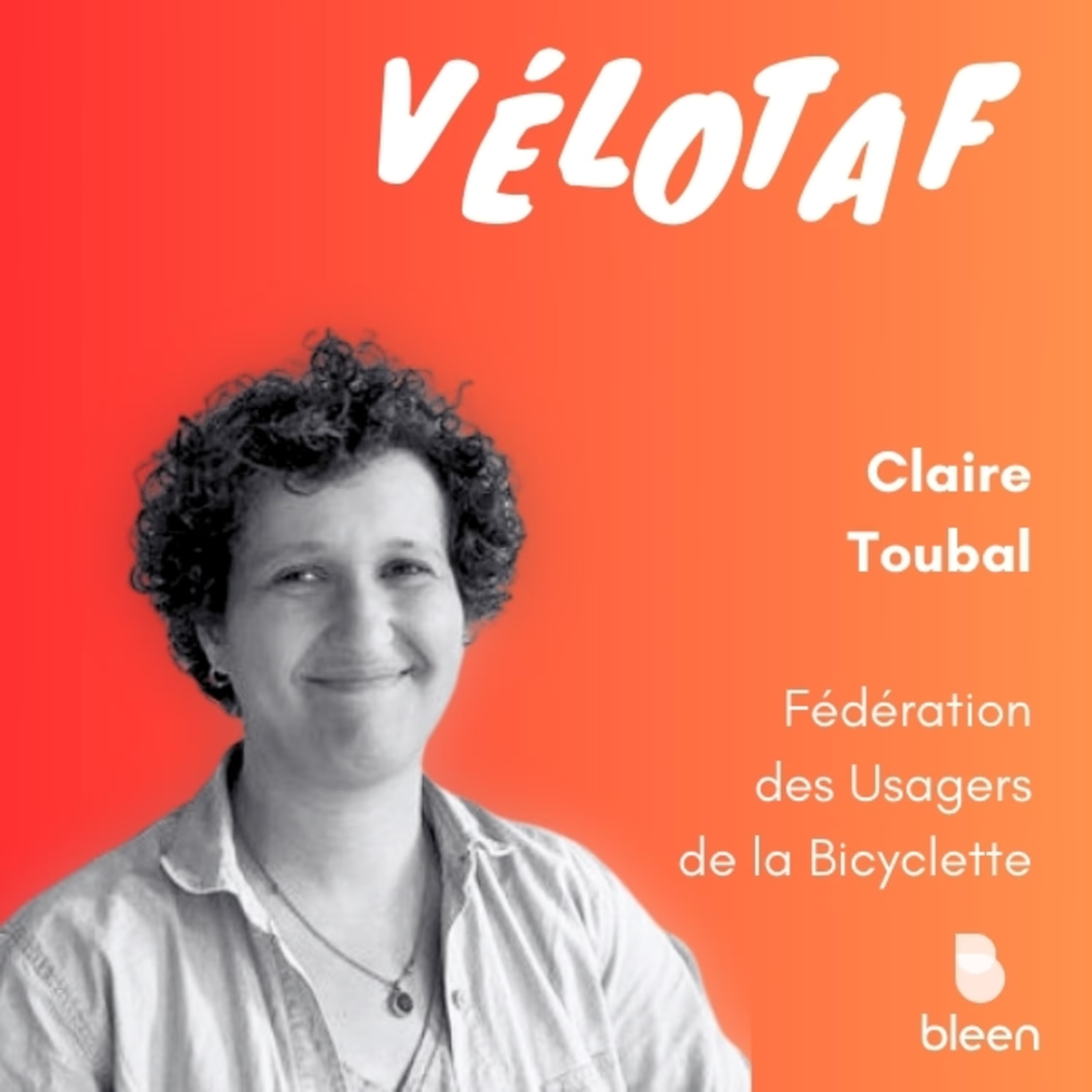
The episode in detail
The FUB: 45 years fighting for urban cyclists
The Fédération française des usagers de la bicyclette was born in 1980 in Strasbourg. The starting idea, put forward by Jean Chaumien, one of the founders: a handful of isolated cyclists on the road struggle with cohabitation alongside motorised vehicles. They needed to unite to defend their rights and ride safely. The same person created the first cycling school and the FUB, in the same year. Today the federation brings together around 500 urban cycling associations across France.
“We’re only two or three blokes on bikes on the road, and we don’t get on well with drivers of motorised vehicles. We should unite to defend our rights.”
From Heureux Cyclage to the FUB: Claire Toubal’s path
Claire Toubal started out in bike self-repair workshops. A volunteer in Strasbourg, then an employee in Pantin, in the Île-de-France region, she also sat on the board of Heureux Cyclage. At 26 or 27, while looking for a job in the cycling world, she landed a role at the FUB coordinating the cycling school network. The move was not straightforward: the two organisations had different orientations, Heureux Cyclage rooted in popular education and reuse, the FUB gaining momentum through Certificats d’Économie d’Énergie (C2E) programmes.
Génération Vélo: teaching children to ride
Génération Vélo is a C2E programme run by the FUB to support the wider rollout of the Savoir Rouler à Vélo scheme (Ministry of Sports and Ministry of Education). The programme co-funds 50% of the cost for local authorities that set up bike-learning sessions in schools, for children aged 6 to 11. It also trains instructors able to run these sessions.
The scheme has deployed 16 regional coordinators across France, acting as the link between local authorities, instructors, schools and the Ministry of Education’s services. Claire took part in designing the programme and managed the co-funding side with the 16 coordinators in the field.
“What goes on behind the scenes is enormous. Ten hours of cycling lessons for kids looks simple on paper.”
Road safety: a role the associations had been asking for
The road safety officer role at the FUB is only a year old. Safety had never left the federation’s sights, it drives both cycling infrastructure work and training, but no role had been dedicated to it exclusively. The trigger: the 2022 General Assembly in Reims, where the associations responded to the FUB’s 2030 vision by saying it lacked an explicit safety component.
Claire’s role covers two areas: pulling together expertise (academic research, field feedback, programme data) and turning it into training, through the ADMA programme (Académie des Mobilités Actives), and into policy advocacy. The Objectif Employeur Pro Vélo programme confirmed the urgency: safety is the number one issue when convincing employers to encourage staff to cycle to work.
Road violence: the Paul Varry turning point
The killing of Paul Varry in Paris triggered unprecedented mobilisation within the cycling community and beyond. The FUB launched the Stop Violence Motorisée platform to collect testimonies. The recurring pattern: cyclists insulted by drivers who tell them they have no business being on the road. Denying someone their place in public space is already a form of violence.
Claire identifies two mechanisms. The first is a lack of understanding: a driver who has never cycled in a city does not grasp what a close pass means for a cyclist with no protective shell around them. The second is structural, documented by psychosocial studies: a car creates a feeling of home extending into public space, which generates aggression.
“If the driver has never cycled in a city, they don’t realise. The sense of danger is at its highest for the cyclist. But on the other side, it’s a lack of understanding.”
The male dimension of road deaths
In 2023, 84% of those presumed responsible for fatal accidents were men. Yet men do not make up 84% of society. Claire points to a social value placed on risk-taking linked to how boys are raised. This bias endangers drivers and every road user around them, cyclists and pedestrians first.
Vision Zero: beyond individual behaviour
French road safety policy focused for a long time on individual behaviour: seatbelts, airbags, bans on phone use and drink-driving. These measures have brought deaths down sharply since the peak of the 1970s. But 2,500 to 3,000 deaths a year on French roads remain unacceptable.
Vision Zero, championed at European level and by the Ministry of the Interior, proposes a holistic reading: infrastructure must account for human error from the design stage, speed remains the number one factor in deaths, and vehicles must be regulated, including the trend towards heavier and heavier SUVs. The FUB and CEREMA back this approach.
“Road deaths are not inevitable, and there is nothing normal about them. Respecting each other and sharing the road means allowing everyone to avoid tragedies.”
Cycling as a lever to rethink the city
Claire sees Savoir Rouler à Vélo as more than a training programme: it is a first introduction to cycling that shapes how children imagine it. Cycling becomes a pretext for questioning urban planning. If riding 40 km to see an ophthalmologist makes no sense by bike, the city itself may no longer be built to a human scale.
“Cycling, in the end, is almost a kind of pretext for rethinking the city and bringing it back to a human scale.”