The episode in detail
Vélonomie: repairing your own bike to ride free
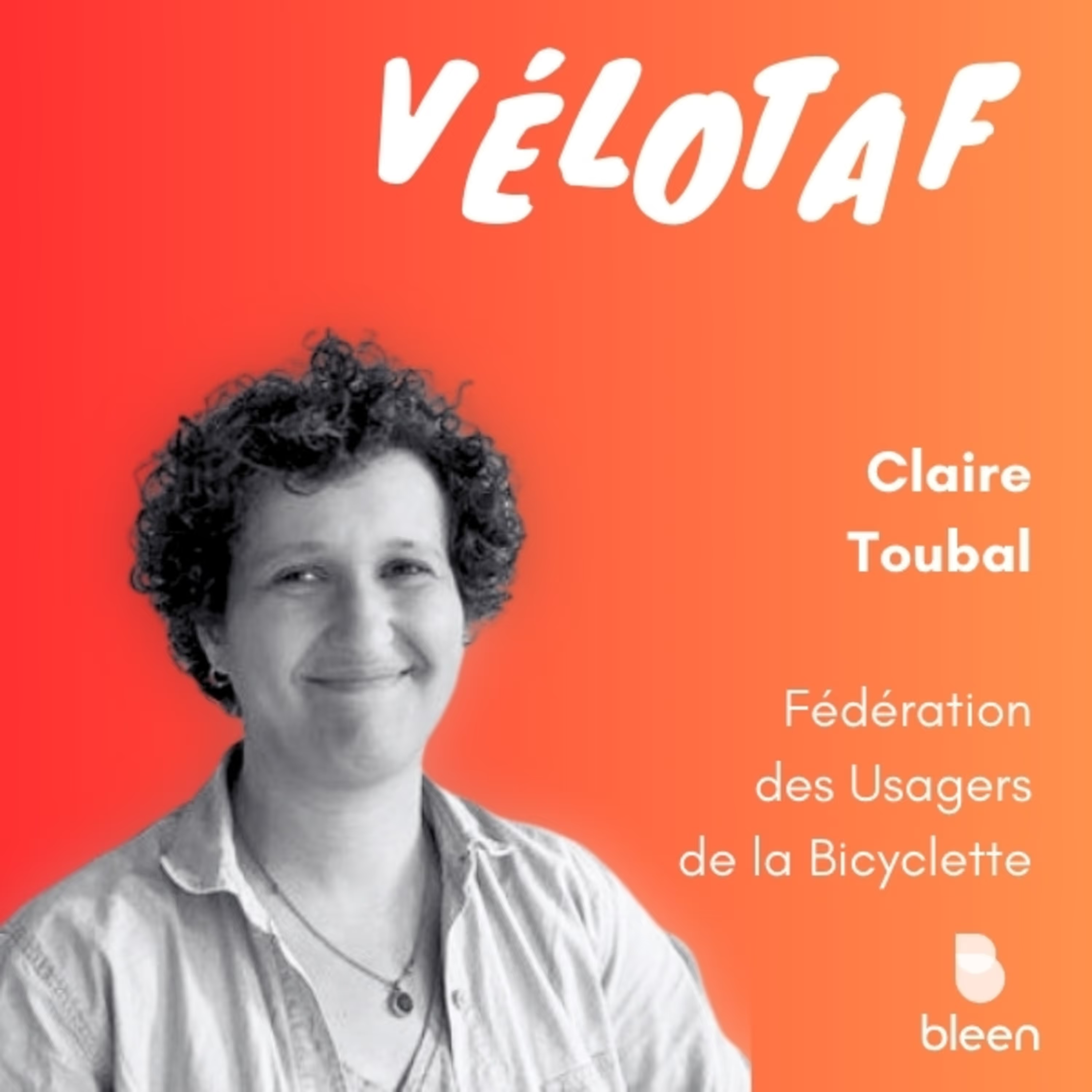
Vélonomie means independence on a bike, the ability to repair and maintain your own machine. Claire Toubal, now road safety officer at the FUB (Fédération française des usagers de la bicyclette), discovered this practice in a bike self-repair workshop in Strasbourg. The principle is simple: in a self-repair workshop, volunteers, and sometimes paid staff, provide tools and parts, and guide visitors so they can repair their own bike. No one repairs it for them: the goal is passing on the know-how.
“We are at a moment in human history where we are surrounded by huge numbers of objects we have no grasp on at all. The bike is one of the rare objects around which we organise collectively to give people back that power and that ability to act.”
From Bretzel to Cyclo-officine: two workshops, two cities, the same spark
Claire came to Strasbourg for a master’s at Sciences Po, with no mechanical experience. Her first bike cost her 30 euros, bought at a bike swap. Breakdowns soon led her to the Bretzel workshop, where a volunteer named Michel taught her to fix her first puncture. From there, she became a volunteer herself, then got involved in sessions reserved for women and gender minorities and the steering committee.
After graduating, she headed to Paris and the Cyclo-officine in Pantin (Seine-Saint-Denis). Same model, same philosophy, in a different city. Claire then joined the Heureux Cyclage board as a volunteer director, before joining the FUB in June 2020, first as training officer, then on Génération Vélo, and, since September 2023, on road safety.
538 bike self-repair workshops in France
France’s oldest self-repair workshop is turning 30. Based in Saint-Étienne (Les Bikers), it was followed by “Un petit vélo dans la tête” in Grenoble. In 2005-2006, France had around fifteen workshops. The Heureux Cyclage network’s map now lists 538, spread across the whole country, including rural areas where growth is picking up speed.
“Self-repair workshops are not a sideshow anymore. They are a genuine pillar of cycling’s growth in France. And it’s not just me saying it, it’s ADEME too.”
ADEME’s bike services survey confirms that people who use self-repair workshops are more likely to become regular cyclists. The reason: mastering your own bike removes the dependence on setbacks (a puncture, a misadjusted derailleur) and stops the machine gathering dust in the cellar. For local authorities, it is also the cheapest bike service to fund.
Heureux Cyclage: three pillars for emancipation through cycling
Heureux Cyclage, the national network of self-repair workshops, rests on three pillars: repair, reuse and popular education. With more than 200,000 members combined across its member workshops, the network also supports the spread of new workshops through practical guides, volunteer regional contacts and local coordination groups called “clavettes” (present in Paris, Grenoble and Lyon).
Heureux Cyclage also runs a strong campaign on emancipating women through bike mechanics. Mechanics is still seen as a male domain, even though it only requires hands and a brain, as Claire points out.
Reuse against waste: an average lifespan of 7 years
The average lifespan of a bike in France is 7 years, one of the lowest in Europe. Self-repair workshops fight this waste through reuse: salvaging parts from unrepairable bikes (brakes, brake pads, pedals), sorting them, and putting them out in self-service crates. Visitors swap their worn part for a salvaged one, without buying new.
“Reuse means continuing the life of an object. It is a far more virtuous practice than recycling.”
Claire insists on the distinction: recycling melts down and remakes, reuse extends. Bikes from the twentieth century are still on the road today thanks to this logic of continuous maintenance.
The workshop as a social space: teaching, trust and collective bonds
A bike self-repair workshop is more than a garage: it is a social space with a catchment area of around 100 km, where you see the same faces and build bonds. Claire describes her own early experience: never having repaired anything, managing to adjust her drivetrain, and feeling real pride.
Teaching sits at the centre of it. At Bretzel, a game called “white gloves” illustrates the philosophy: you put on white gloves and guide someone through their repair. The winner is whoever’s gloves stay cleanest, proof that they guided without doing the job for the other person.
“A self-repair workshop is also a lesson in self-confidence. When you show up having never repaired anything, and by the end you have managed to adjust your drivetrain, there is a small burst of pride that feels good.”
From volunteering to a career: cycling as a life choice
Claire had not planned to work in cycling. Having graduated in sociology and anthropology in Paris, she joined Sciences Po Strasbourg for a further degree. Cycling “hit” her along the way. What kept her there: the concrete nature of local grassroots action, the link with local authorities, and the political dimension of mobility.
Her path shows that volunteering in a self-repair workshop can open up a career. From Bretzel to the FUB, each step built expertise recognised across the French cycling world. A trajectory that is a reminder: cycling is also a sector that hires and trains people, beyond its role as a means of transport.