As Nelson Mandela once said, ‘Education is the most powerful weapon you can use to change the world’. Does this quote resonate with you? If so, you’ll love our article!
Frescoes have profoundly transformed the way we raise awareness, educate and mobilise people on sustainability issues. In just a few years, we’ve created five of them : the Medical Waste Fresco, the Tech Fresco, the Greenwashing Fresco, the Inclusion Fresco and the Consumption Fresco. Our guiding principle? Turning knowledge into action.
In this article, we'll help you understand what a 'Fresco' is, grasping its principles and purpose, and then we’ll share our method for learning how to create your own.
In this article:
- What is a ‘Fresco’?
- Why create new ‘Frescoes’?
- How to create your own ‘Fresco’: Our method at Bleen
- Our tips for bringing your ‘Fresco’ to life
- Conclusion
1. What is a ‘Fresco’?
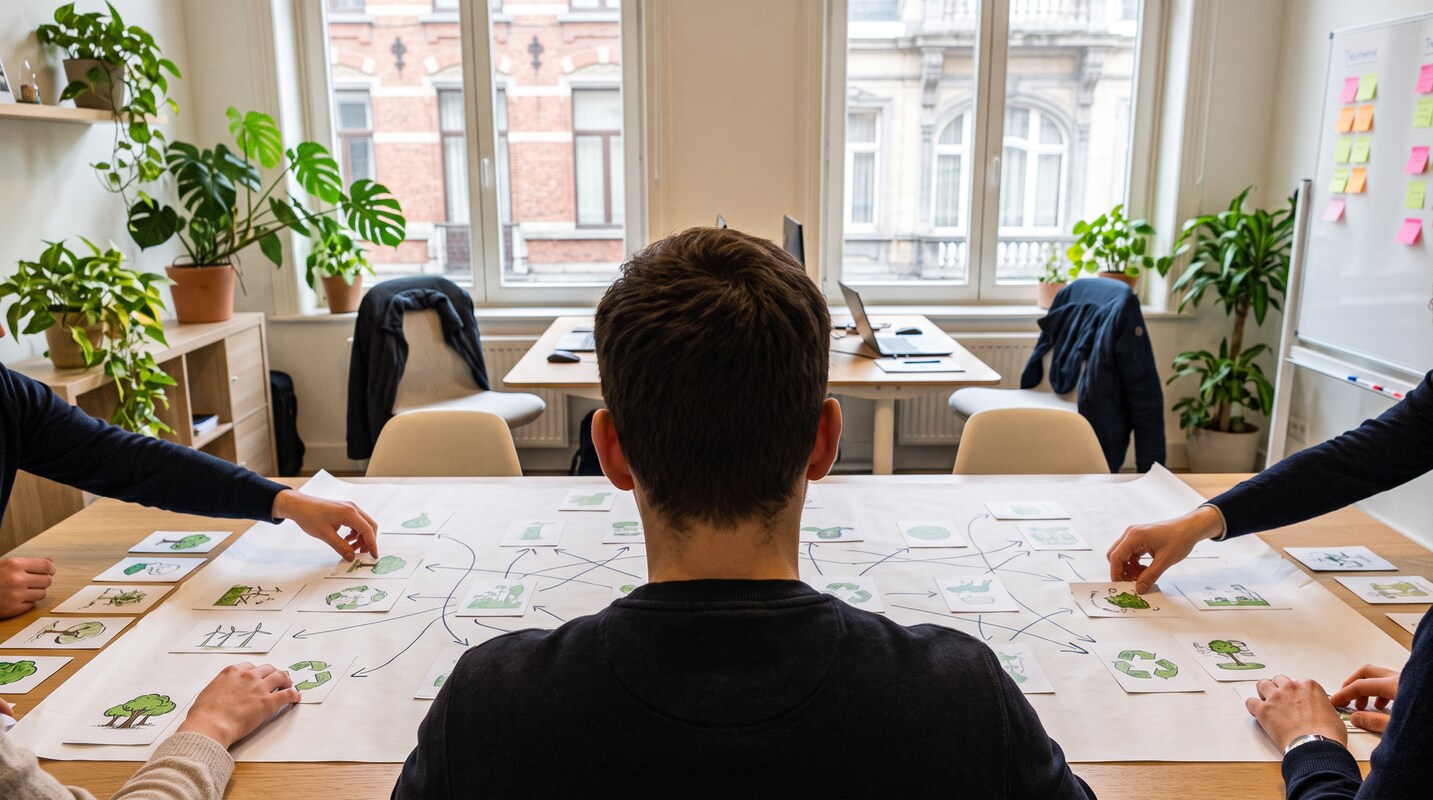
A ‘Fresco’ is a collaborative and creative serious game: simple without being simplistic, scientific without being off-putting, and educational, designed to help people understand a social issue.
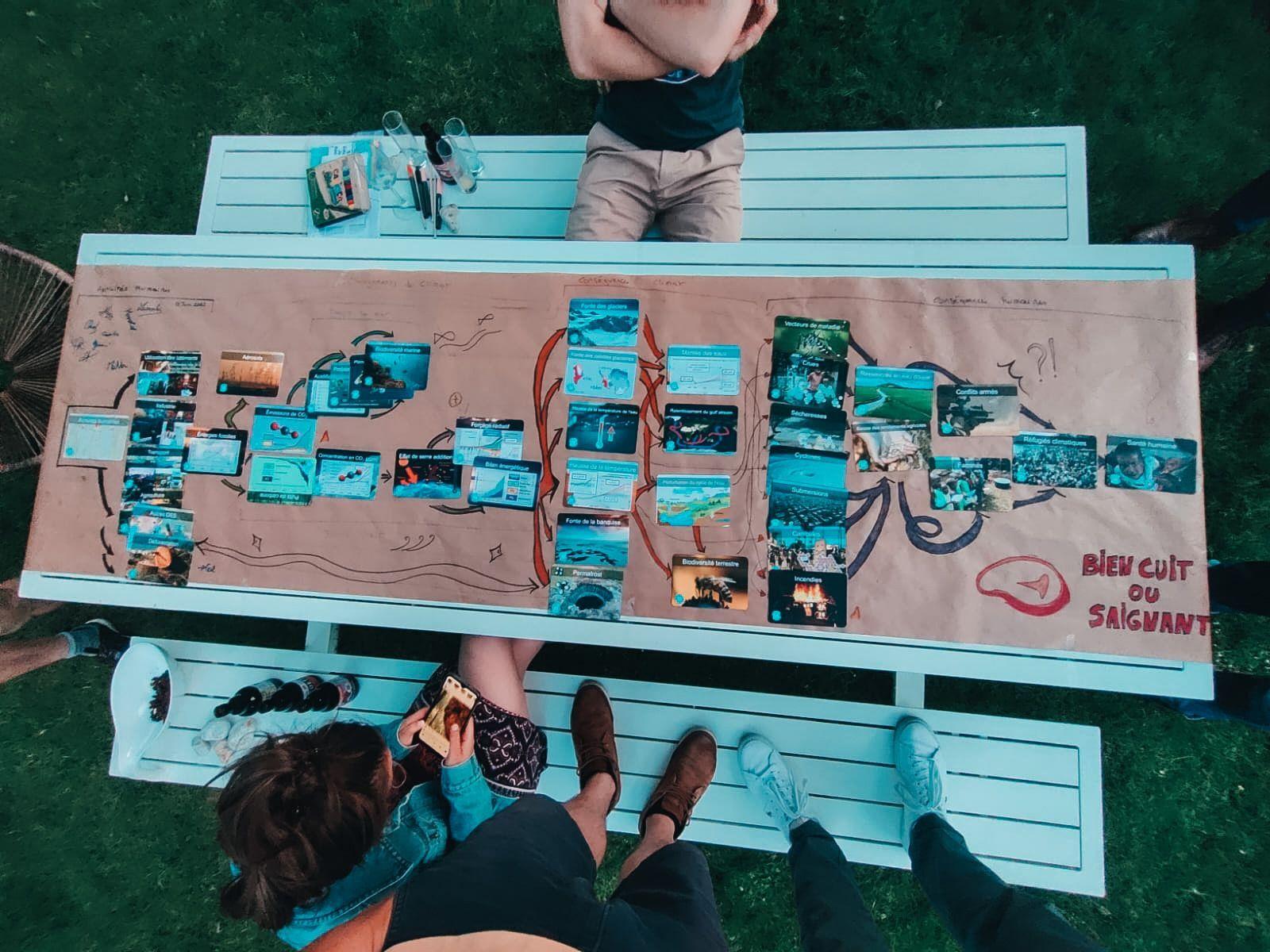
By playing card games in teams, you explore a theme, its causes, how it works, its consequences and the solutions. You go through stages of understanding, creativity, debate and discussion.
You may have heard of the Climate Fresk. It was created in 2017 and is a fun, collaborative three-hour workshop designed to help people understand climate issues and take action.
But it’s not the only one! There are now over 200 similar frescoes and workshops around the world (in 167 countries), bringing together several million participants!
Frescoes are based on three key principles:
- Collective intelligence
- Visual cards designed for educational purposes
- A fun and participatory approach
The aim of a fresco is to create a collective experience that makes complexity accessible, encourages discussion and develops a systemic understanding of the issues.
Indeed, the aim is not to impart knowledge but to encourage reflection and foster discussion among participants. With the help of the facilitator, participants build their understanding of the subject through the discussions and connections they make between the different cards:
At Bleen, our frescoes have brought together more than 5,000 participants.
2. Why create new frescoes?
When we want to create a new fresco, one obstacle can hold us back:
But what’s the point? There are already so many frescoes!
Yet we never say there are too many books or too many podcasts. Every topic deserves its own medium so that it can be made accessible and understood by different audiences. In that sense, the fresco is simply a visual, participatory and dynamic way of sharing knowledge and fostering collective intelligence.
It was this realisation that led us to create new themed frescoes, such as the one dedicated to the challenges of responsible consumption. Faced with a subject that has rarely been addressed in this way, the idea came naturally: to create an educational tool that helps participants understand the mechanisms of overconsumption and identify ways to take action towards more responsible choices.
Now, you might be thinking: ‘Easier said than done’.
But where do you start?
Our approach to creating frescoes at Bleen
Having created several frescoes, we have developed an approach that has proved particularly effective: here’s our 10B method.
1. B for… Benchmark
We always start by analysing what already exists. First, we check whether there are any frescoes on similar themes. We identify which formats work, which gameplay mechanics are the most engaging, and the limitations of existing tools.
2. B for… Budget
Creating a narrative game takes time. Research, card design, testing, pilot sessions, graphic design, printing: every stage requires resources. It is therefore essential to estimate the budget and level of investment required right from the start. This often takes us at least 50 to 100 working days.
3. B for… Browse
In our frescoes, we aim to combine scientific rigour with an element of fun. That is why we carry out a research phase, which allows us to build a solid knowledge base on the subject. This stage involves consulting reference sources: scientific reports, institutional publications, official statistics, sector-specific studies and academic research. Resources such as the IPCC, IPBES, the FAO or national statistical bodies often provide a solid foundation for the content of our frescoes.
4. B for… Brainstorm
During this phase, we generate as many ideas, concepts and causal links as possible. The aim is not simply to create mind maps: these must be interconnected. We also ensure that the mind maps lend themselves to discussion: there’s nothing better than a format that encourages dialogue!
5. B for… Blueprint
This is where the fresco takes shape. Here, we define the overall structure of the workshop, the progression of the session and the learning sequences. Each set of cards must have a specific function and contribute to a clear understanding of the subject. This stage defines how participants will piece together the intended structure and understand the logic behind it.
6. B for… Beta testing
No fresco is perfect first time round. It needs to be tested in real-world conditions! That’s why we recommend testing it with several groups. This stage enables us to identify areas of confusion (poorly worded or ambiguous cards), logical issues (links that aren’t intuitive, issues with overall coherence) and facilitation difficulties (discussions that don’t develop as expected). It allows us to fine-tune the fresco to make it understandable, logical and engaging.
7. B for… Balance
As mentioned earlier, creating a fresco involves research that draws on a wide range of scientific sources. But be careful: too much information confuses participants, whilst too little undermines credibility. Our challenge? To strike the right balance. We do this by having the fresco tested by a diverse range of people (not just those already committed to the cause: we seek the views of those who are more critical or less aware of the issues involved). This step enables us to ensure that the fresco remains accessible and relevant.
8. B for… Build
Form is just as important as content. We firmly believe that the quality of the materials directly influences the participants’ experience. That is why, during this phase, we design the cards, lay out the materials and prepare the facilitation resources.
9. B for… Bundle
Our frescoes aren't just a set of cards. To make them easier to roll out, we create resources for those who'd like to facilitate them: a facilitation guide, training materials, tracking tools, FAQs, additional resources… The aim? To ensure a consistent experience, regardless of who's facilitating.
10. B for… Bravo
Hooray, our game is ready! This final stage is often the most satisfying. But be warned: a game is never completely finished… Our games are constantly evolving: we take participants’ feedback on board and update the content of the cards (by creating new cards based on the latest available knowledge on the subject).
You now have a few ideas to get you started on your own fresco!
However, you might be wondering: 'That's all well and good, but how do I go about facilitating a fresco properly?'
4. Our tips for facilitating your fresco
Let’s start at the beginning.
1. What is the facilitator’s role?
The facilitator ensures psychological safety: they make sure everyone feels respected and uphold an atmosphere of trust and active listening.
They make space for diverse voices: they give everyone a chance to speak, including the most reserved participants, and deal with situations where one person dominates the conversation.
The facilitator is also a catalyst for action: they help the group turn insights into actionable ideas that can be applied at different levels.
2. Best practices
- Build trust: set the ground rules for collective intelligence and encourage participants to make mistakes so they can learn more effectively. We recommend starting with an ice-breaker.
- Value diverse perspectives: encourage everyone to contribute. Take a back seat and ensure that no single person monopolises the discussion.
- Keep things moving: provide a clear structure for each activity to avoid overly lengthy discussions and refocus the debate where necessary.
- Energise the group: ask open-ended questions to stimulate reflection, reignite discussions or spark creativity.
- Stay positive: maintain a fun and engaging approach so that participants can enjoy themselves.
- Reinforce learning: summarise the key messages and review what has been learnt after each section.
3. Once the fresco is over, what next?
The facilitator shares the key messages that recur throughout the fresco. These are the ideas the participants should take away with them. It is therefore important to emphasise each point and take the necessary time to discuss it.
Don't forget to gather feedback! Feel free to ask your participants for their views: what worked well, what could be improved, what they enjoyed, what they've taken away from the workshop, and what they plan to do next…
After running the fresco, send a follow-up email to share resources on the topic (videos, podcasts, books, tools) and encourage participants to spread the word about the fresco.
Conclusion
As you can see, frescoes are an educational and interactive tool that helps create a space for dialogue and collective reflection, while encouraging engagement and concrete action.
We hope this article has inspired you to give it a go!