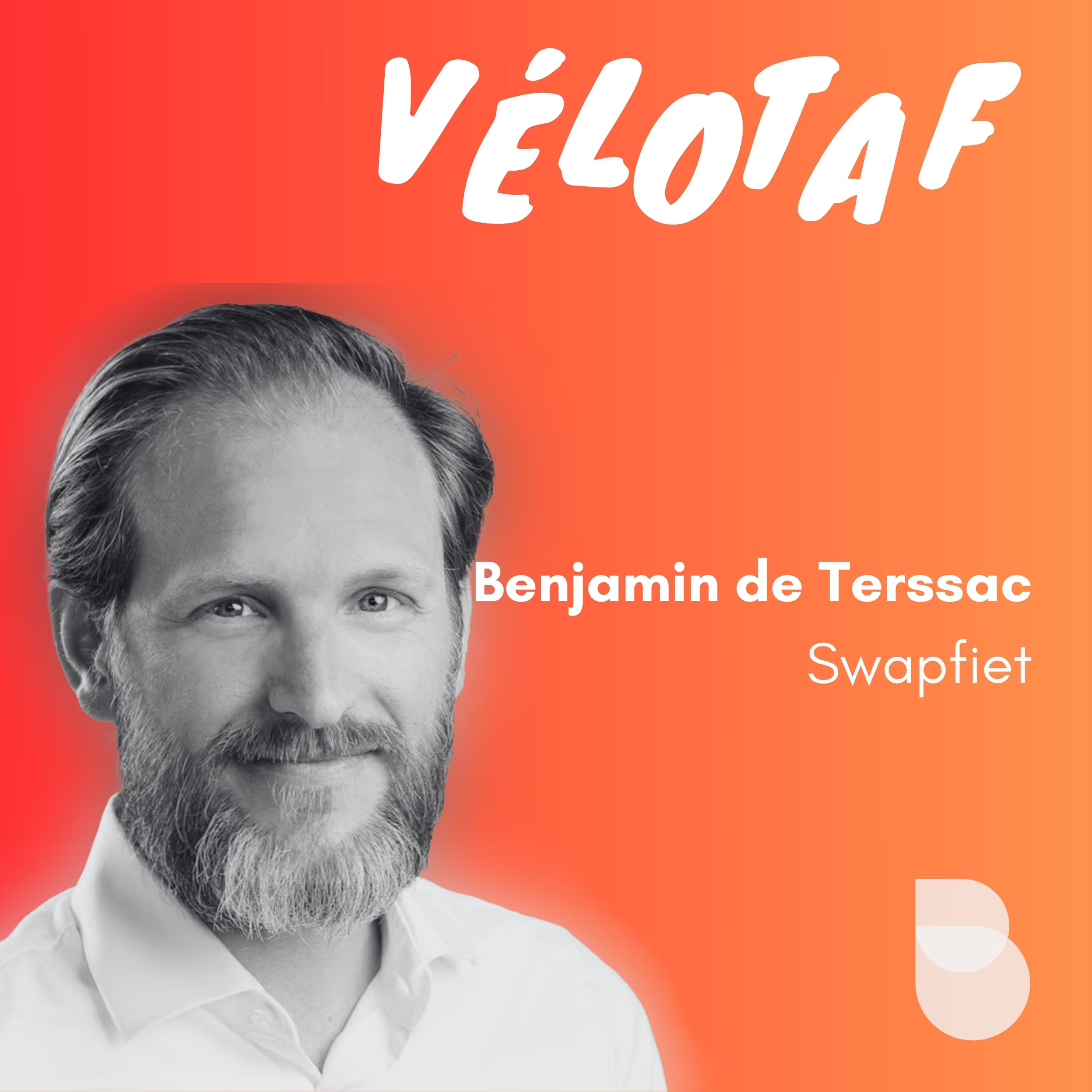
The episode in detail
Swapfiets: a bike subscription to remove the barriers to bike commuting
Swapfiets is Europe’s first bike subscription service. For a monthly fee starting at 12.90 euros, the user gets an urban bike with repairs, maintenance and theft insurance included. If a problem comes up, Swapfiets fixes it or replaces the bike within 48 hours. No upfront investment, no long-term contract, cancellation possible each month with 30 days’ notice. Benjamin de Terssac, General Manager for Southern Europe and the UK, presents the model in this episode of the Vélotaf podcast. The Dutch startup operates in more than 70 cities and 9 European countries, with 250,000 users since its launch in 2014.
From Dubai to Amsterdam: converted to bike commuting
Benjamin spent 10 years in the Middle East between BNP Paribas and Accenture, covering 250 kilometres a day by car between Dubai and Abu Dhabi. A road accident marked a turning point. Back in Europe, he settled in Amsterdam with his wife. Neither of them was a cyclist.
“We said to ourselves, I don’t know if the bike is for us. So maybe we’ll rent a bike at first. We’ve been Swapfiets subscribers for 4 years and we’ve never bought a bike.”
Four years on, the bike has become their almost exclusive mode of transport: 12 to 15 kilometres a day, morning and evening. Benjamin credits his good health to this daily physical activity, in direct contrast with his years of sedentary car use in the Emirates. He’d rather make the most of the banks of the Seine when he’s in Paris than be shut in the metro.
Swapfiets’ circular economic model
Swapfiets doesn’t sell bikes. The company stays the owner of the vehicle and has an interest in making it as durable as possible. If a bike needs replacing after a year, Swapfiets bears the cost. This circular model aligns the company’s interests with the product’s longevity. The range includes four bikes: a single-speed model at 12.90 euros, a 7-speed Deluxe at 14.90 euros, a Power One electric bike at 49.90 euros (80 km of range) and a Power Seven at 75 euros (145 km of range).
“We don’t guarantee you’ll love the bike, but we do guarantee everything else.”
The offer is 90% aimed at private customers, but a business option also exists: employers can fund a fleet or reimburse part of the subscription through the sustainable mobility allowance. Swapfiets is also preparing in-store test drives and a 30-day satisfaction guarantee.
Amsterdam vs Paris: two cycling cultures light years apart
In the Netherlands, the bike’s modal share reaches 40 to 45%. In Paris, it caps out under 3%. Benjamin identifies a cultural gap above all: in the Netherlands, the bike is the default mode of transport, not an alternative. Everyone is a cyclist at some point, which creates a natural mutual respect between road users.
“Everyone gets around by bike here. It’s really not a cliché.”
In France, the two main barriers identified by a study of 4,000 people are parking and theft. Many customers come to Swapfiets after having one or more bikes stolen. The subscription shifts that risk to the company. The weather, often cited, is actually a false problem. In Amsterdam, Benjamin rides all year round with just a K-Way and rain trousers he uses four or five times a year. The Dutch app Buien Alarm forecasts rain down to the neighbourhood.
Erasmus students as ambassadors for bike commuting
Expansion into southern Europe rests on an unexpected lever: exchange students. In Barcelona, the best sales weeks coincide with the arrival of German and Dutch Erasmus students. They already know Swapfiets and become natural ambassadors among their local classmates.
“If we start with students, once you’ve started getting around by bike during your studies, it’s a habit a young professional will carry on into the job market.”
In the Netherlands, Swapfiets is built directly into the university enrolment process. The company also develops partnerships with cycling schools and trains its own mechanics through an apprenticeship programme, with 200 to 300 mechanics across Europe. In France, Swapfiets operates in Paris, Toulouse, Nantes, Strasbourg and Lyon. In Belgium: Brussels, Antwerp and Ghent.
Changing mindsets to make urban cycling mainstream
For Benjamin, making bike commuting mainstream rests on three fronts. First, keeping cyclists safe through dedicated infrastructure and greater respect from other road users. Second, financially encouraging soft mobility, through businesses and local authorities. Third, anchoring the bike as a natural mode of transport, not a militant practice. His best bike-commuting memory: riding home through snow in Amsterdam, with no cars at all in the streets, only bikes. The point of no return.