The episode in detail
From daily bike commuting to creating UWinBike
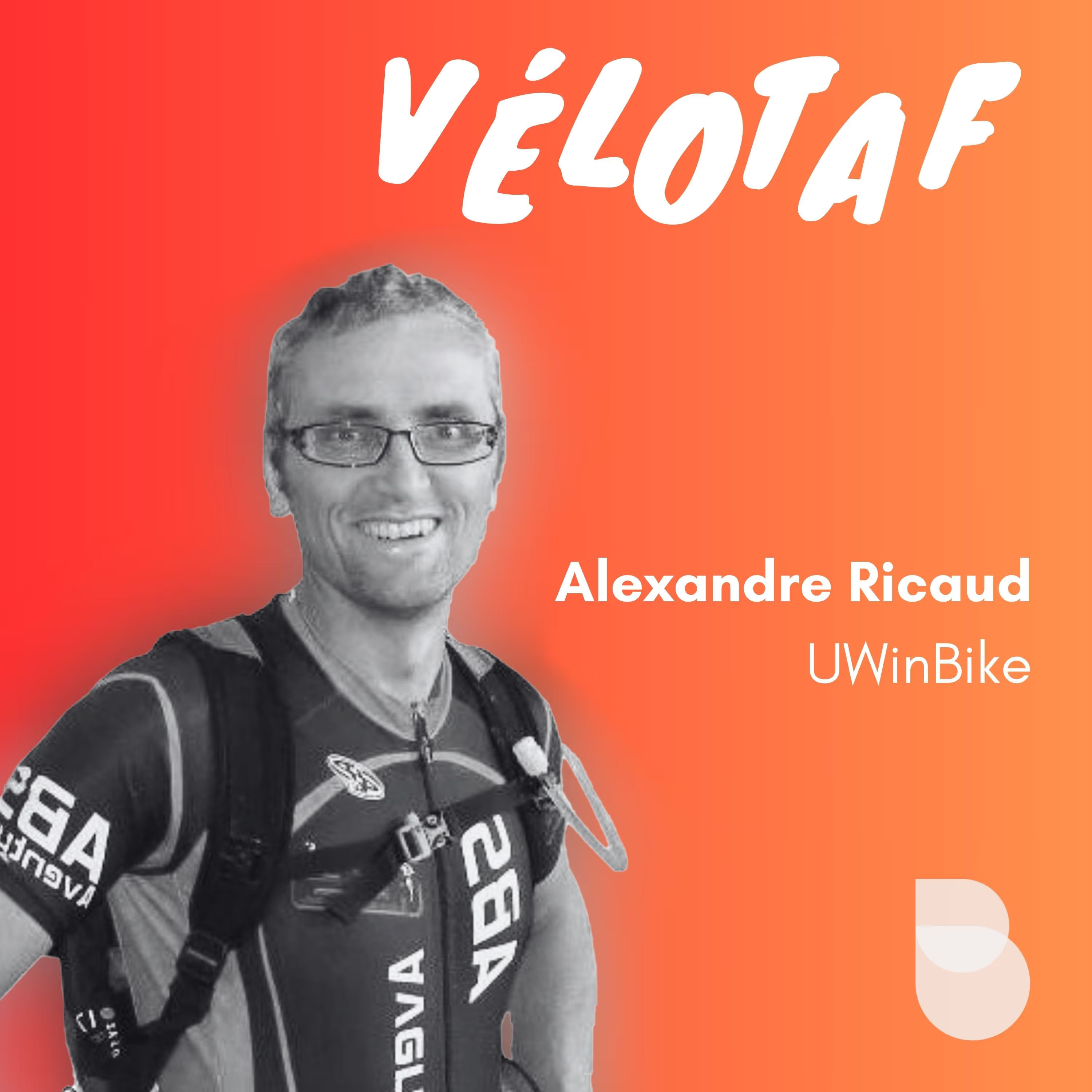
Alexandre Ricaud has been cycling between home and work in Toulouse for 16 years. An engineer at Airbus, he has clocked up around 60,000 kilometres of bike commuting on an 11-kilometre route. This personal experience fed a conviction: the bike works as a mode of transport for commuting, but a tool was missing to prove it. In 2015, during COP21, France launched the bike mileage allowance (IKV), meant to pay cyclist employees 25 centimes per kilometre. The problem: how do you verify that an employee actually pedals? The state proposed a declaration on one’s honour. Alexandre saw a gap and an opportunity. Toulouse-based companies approached him to create a genuine proof of pedalling. UWinBike was born from this concrete need.
The sustainable mobility allowance: an effective but optional law
The bike mileage allowance (IKV) was replaced by the sustainable mobility allowance (FMD), which was widened to include carpooling and raised from 200 to 600 euros a year. The numbers speak for themselves: in companies that had adopted the IKV, the number of bike commuters jumped by 69%. Yet the law remains optional. Few employers set it up of their own accord.
“People, the population, are waiting for a financial incentive to start bike commuting on a wider scale.”
Alexandre argues for making the FMD mandatory. He believes this measure could take the bike’s modal share in France from 3-4% to 9-10%, in line with the targets set by the state for Paris 2024. A critical mass of cyclists would then shift the political balance of power and speed up investment in infrastructure.
How UWinBike certifies bike commuting journeys
UWinBike offers three services. The first is proof of pedalling: the platform identifies the mode of travel (bike) and characterises the purpose of the journey (commuting). The employee generates a monthly proof to give to their employer in order to claim the sustainable mobility allowance. The second service: bike commuting challenges, individual or by team, open to an entire community or reserved for a single company. Saint-Quentin-en-Yvelines ran an inter-company challenge through the platform. The third service is the connection to Ecomode, a Toulouse-based platform that rewards travel that is an alternative to solo car use with a points system that can be converted into goods or services.
“We know how to prove the mode of travel and characterise the purpose of the journey. It’s the combination of the two that gives us a quality of data that didn’t exist before.”
In 2021, UWinBike had 1,500 registered users, more than 80,000 kilometres logged, 8,000 journeys and 15 tonnes of CO2 saved compared with driving.
From local and regional authorities to companies: the many uses of bike data
Local and regional authorities have two distinct needs. As employers, they use UWinBike to manage the FMD for their staff. As administrators of a territory, they lack reliable data on bike mobility. UWinBike aggregates and anonymises data at several levels: company, intercommunalité, département, and region.
“Local and regional authorities need reliable data that they don’t currently have, to measure active travel in their territory.”
The platform is used in Toulouse, Montpellier and the Paris region, and is expanding into Strasbourg and Lyon. Winner of the ‘Ma solution pour le climat’ (‘My solution for the climate’) competition run by the Occitanie region, it has also won tenders with Tisséo (the transport authority for Toulouse) and Île-de-France Mobilités.
Bike commuting in Toulouse: heat, rain and kit
Toulouse presents climate challenges that are the opposite of those in the north of France. In summer, the heat brings on sweating. Alexandre is lucky enough to have showers at his workplace. For those without them, he recommends using an electrically assisted bike on maximum assistance in the morning, then reduced assistance in the evening to get some exercise.
“There’s no such thing as bad weather, only bad kit.”
Over 16 years, Alexandre has cycled in temperatures ranging from minus 15 to plus 40 degrees. Truly heavy downpours remain rare. The outdoor thermometer is his main tool: down to the degree, he knows how to dress. He rides a gravel bike, a bike derived from cyclocross, tough enough for the city and fast enough to cruise at 30 km/h. He is firm about a sturdy lock fixed to the frame, a helmet (non-negotiable despite the debate), and lights suited to winter.
Making the FMD mandatory to reach critical mass
For Alexandre, promoting bike commuting means combining several levers: making the sustainable mobility allowance mandatory, improving cycling infrastructure, tackling bike theft, and developing bike-train-bus intermodality.
“If we wait for cycling infrastructure to be perfect, it won’t happen for years. Getting people onto the existing network will have a positive effect on everything else.”
UWinBike is part of La Vélo Vallée, a network of bike industry players in Occitanie. Alexandre recommends Morio, a Toulouse-based start-up specialising in connected anti-theft solutions. Its ambition remains European: the name UWinBike was chosen in English after interest came in from Italy. Since the solution is entirely digital, it can be rolled out anywhere, with no geographical constraints.