The episode in detail
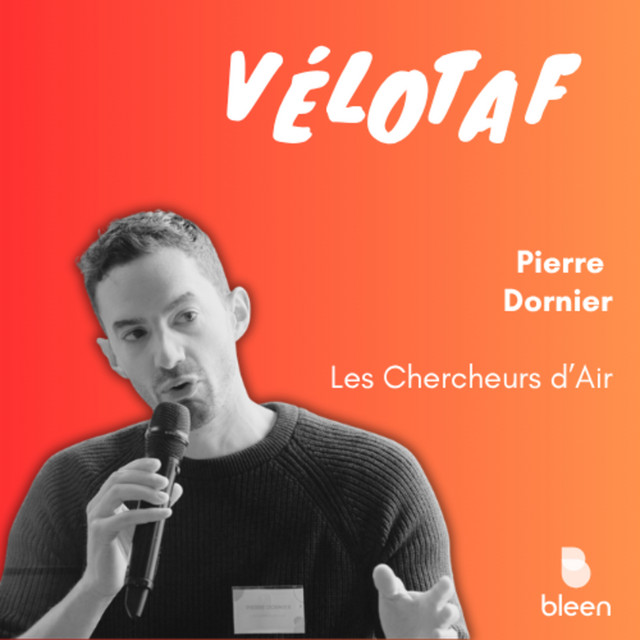
Pierre Dornier founded Les Chercheurs d’Air after the Dieselgate scandal of September 2015. Living in Brussels, he asked himself a simple question: what am I breathing? Looking for the answer online, he found that information on air pollution was nowhere to be had, then incomprehensible once found: old websites, jargon, acronyms. His association now measures air quality across the Brussels Region, puts it into plain language, and goes after elected officials to obtain concrete measures.
Brussels, eighth most polluted European city for nitrogen dioxide
The Brussels Region has 1.2 million inhabitants across 160 square kilometres, and featured in the European top 10 for nitrogen dioxide, a toxic gas that causes asthma among other things. The ranking dates from 2018 or 2019, as the guest points out himself.
Road traffic emits 40% of that nitrogen dioxide in the Brussels Region, which makes it the leading source. For PM2.5 fine particles, those no more than 2.5 micrometres in diameter, road transport accounts for 22%, roughly a quarter. Between 2018, the year the low emission zone came in, and 2024 or 2025, nitrogen dioxide concentrations fell by more than 30%.
On a bike you breathe less air pollution than in a car
This is the most counter-intuitive point of the episode, and Pierre Dornier states it without reservation.
“It matters to say that you are less exposed to air pollution when you travel by bike than when you are in your car, for two reasons.”
The first is exposure time: on a bike you get out of polluted spots faster, starting with traffic jams, where a car can sit still for thirty minutes or an hour on rue de la Loi. The second is the cabin. The air turns in a loop and the pollution stays there, while it comes in through the ventilation system without difficulty. The bodywork protects against rain and wind, not against particles. Even stuck in a jam, a cyclist has a large volume of air around them, so breathes lower concentrations.
Canyon streets concentrate air pollution
“If I am on a street with a lot of traffic that is also tall and narrow, what we call canyon streets, with several storeys of façades on each side, like a canyon in nature, there is an even greater chance of breathing high pollution concentrations, quite simply because air moves less in these canyon streets.”
The association’s measurements give a telling example. Avenue Louise carries heavy traffic, but its width lets the air disperse: levels there stay high and dangerous to health, while remaining proportionally lower than on rue de Mérode, in lower Saint-Gilles, where a narrow roadway and tall façades trap the emissions. The determining factor is the geometry of the street combined with the traffic. The type of building says nothing on its own: between two blocks on a dead end with no traffic, Pierre Dornier reckons there is not much of a problem.
Pollution also starts in the living room
Pierre Dornier separates two worlds. In poor countries, cooking and heating inside badly ventilated homes produce black carbon and fine particles breathed at point-blank range. In rich countries, indoor air is mainly a matter of chemical products. One source comes up in the exchange, suggested by the host and confirmed straight away by the guest: candles and scented sticks.
“It really is as if today you sat down in the living room, or in the toilet, and smoked a cigarette.”
A candle loaded with chemical compounds meant to smell of woodland fruits is probably far worse than a beeswax candle, which will not smell of much. For birthday candles, his answer comes in two words, that’s fine: the problem comes from the ones burned all the time to scent a flat. The principle stays simple, burning something produces pollution.
Traffic evaporation, explained with a circle
The received idea is that cars pushed out of a centre go and pollute the outskirts. Pierre Dornier takes the reasoning apart with a circle. Home to the north, work to the south, crossing impossible. Going around costs about thirty minutes, cycling across saves ten. After a few months of grumbling, some drivers discover other modes and do not come back. That is the traffic evaporation mechanism.
The low emission zone is not contested by residents
The opposition comes from elected officials, not from the population. As far as he knows, no large petition and no large citizen mobilisation has taken place against the scheme, and he cites as a marker an ongoing PTB petition that has stayed at around a thousand signatures. In London, protests against the ULEZ expansion also stayed very small.
“If you look at the figures, 56% of Brussels households do not have a car. So the majority of the population is already not affected by the low emission zone, because it does not have a car.”
The ban on petrol and diesel cars more than ten years old, expected on 1 January 2025, was pushed back by two years through a regional ordinance. Les Chercheurs d’Air challenged the text alongside the Ligue des droits humains, the Fédération des maisons médicales and BRAL. The Constitutional Court ruled in their favour and annulled the ordinance. The ban will now apply from 1 January 2027, which Pierre Dornier sums up as a year lost.
The bicycle, means of transport of the working classes
Pierre Dornier accepts from the outset that part of the social criticism of the low emission zone is well founded, and he answers it with income-based exemptions and with social leasing, where you use a vehicle for a few years before buying it or changing it, after three years for example. He points out that the bicycle started as a workers’ means of transport, and cites a survey run in France by the Ligue contre le cancer showing that working-class groups hold it in high regard. His fairness argument comes down to one image: on a pedestrian street, earning a thousand or ten thousand euros a month changes nothing, nobody gets through.
53% of public space for cars, 1% for bikes
The report the association published in September measures the priority actually given to each mode, rather than the priority written into the highway code.
“On 53% of public space, cars have priority, on 38% of public space, walking has priority, pavements for instance. Public transport, on the other hand, has priority on only 3% of the territory, even though it moves as many people each year as cars, and for bikes, only 1% of the territory is set aside.”
The distinction matters. On a cycle street, the cyclist keeps their place in theory, then moves aside as soon as an impatient car arrives behind them. On chaussée de Haecht in Schaerbeek, the tram sits blocked because the cars are queuing, and for a bus, two cars in front of it are enough to cost it ten minutes without anyone risking the slightest fine. Asked what cycling means to him, Pierre Dornier answers on four levels: rational, because it is faster most of the time, economic beyond argument, ecological since a bike emits almost nothing, and emotional. On that last point his honesty stands out: riding in Brussels is nothing like peaceful, there are moments when you feel in danger and moments when you are in danger.