The episode in detail
Paris, a laboratory for the cycling transformation
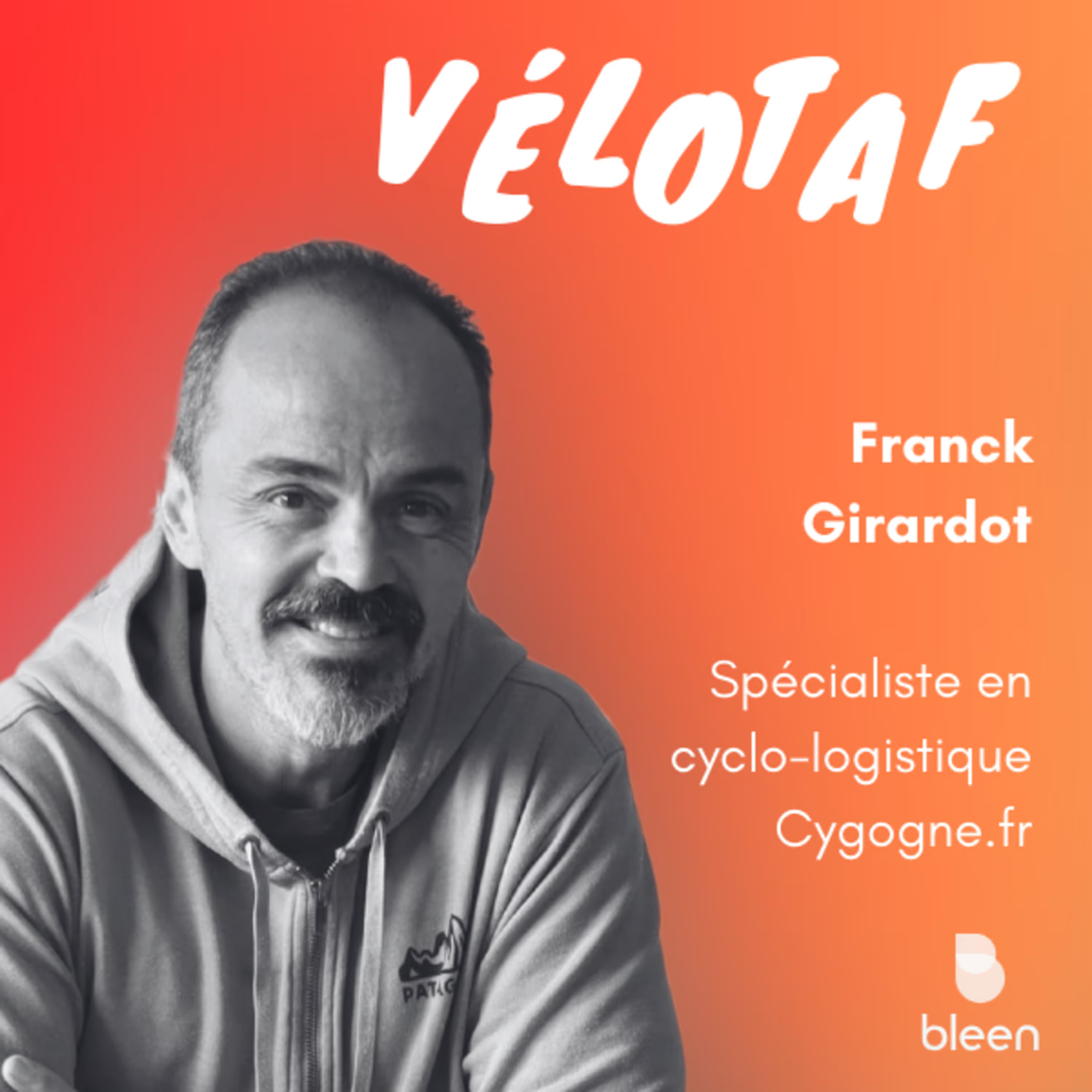
Franck Girardot watches Paris changing through a perspective shaped by his experience in cycle logistics. The capital has become a cycling city after years of transformation driven by officials who held their line despite strong opposition. Several factors accelerated this: lockdowns, the Olympics, sustained political will. The result is tangible, even if the environment isn’t yet fully safe for families with children.
“When you manage to hold a political line that isn’t necessarily popular for years, you can turn the unimaginable into reality.”
The comparison with Brussels is stark: cobblestones, tram rails and poorly adapted roads exclude around 80% of the potential cycling population. Without safe spaces, only committed cyclists ride, not the masses.
Cycle logistics against the limits of urban consumption
On current volumes, 80 to 85% of deliveries in city centres could theoretically be handled by bikes or very light vehicles. But the transport industry expects delivery volumes to double by 2050. The equation then becomes impossible: delivering twice as much with vehicles ten times smaller would require hundreds of thousands of bikes on the roads.
“There’s no way forward without reducing volumes. If we want to live better in cities, we need to consume less.”
Franck points to a total absence of thinking about reducing volumes at trade shows such as CITEL. Every logistics decarbonisation strategy assumes consumption will keep growing. In his view, without reducing flows, cycle logistics will solve nothing: car congestion will simply be replaced by cycle congestion.
The rebound effect of e-commerce and the invisibility of delivery
E-commerce amplifies the problem. Franck cites the example of a Brussels pick-up point installing fitting rooms: for one shirt bought, three are ordered and two returned. Every round trip generates extra logistics flow.
The core of the problem is the disconnect between the act of buying, smooth, virtual, instant, and the physical reality of delivery. Franck recounts delivering 250 champagne flutes by bike across Paris, from Neuilly to Beaubourg. Only on seeing the goods did the customer realise how they would get to the delivery point.
“The whole act of buying is so virtualised that the awkward questions never get asked: how are these things actually going to arrive?”
His conviction is that delivery costs should be made visible, even if the retailer then decides to offer them for free. Transparency about the real cost would change buying behaviour.
How cargo bikes are changing: from two-wheel carriers to near-motorised vehicles
The classic cycle logistics setup relies on the two-wheel cargo bike, 80 to 100 kg of load, fitted with a light trailer such as a Flexi-Modal runner, for a total of 200 to 250 kg. Beyond 300 kg, bike components reach their limits: transmission, braking, reliability under intensive use of 12 to 16 hours a day.
The new generation is arriving with self-powered trailers such as the Cariole, 250 kg unladen, 15,000 euros against 2,000 for a runner, tricycles with powerful motors, and parts drawn from motorbikes rather than bicycles. Pedalling becomes insignificant to the driving force.
“We’re going to offer bikes that practically ride themselves, with an enclosed cab. We’re moving into something else entirely.”
To meet the 50,000 to 100,000 couriers expected by 2030, vehicles accessible to non-cyclists will be needed. The trend points towards covered, semi-autonomous machines, whose environmental impact remains lower than a lorry’s but far higher than a traditional two-wheel cargo bike’s.
The car as a cultural symbol: the invisible brake
Franck identifies a factor often overlooked: the role of culture in car dominance. Hollywood, American television series from the 1970s and 1980s, and advertising turned the car into a marker of social status. He draws a parallel with cigarettes, made desirable to women through Bernays’s campaigns despite an initial lack of interest.
As long as the big car remains synonymous with social success, the bike will stay marginalised. The shift will come through fiction: films, series and novels that build a positive image around the bike. This is precisely what Franck is doing with his crime novel Vélo Cargo.