The episode in detail
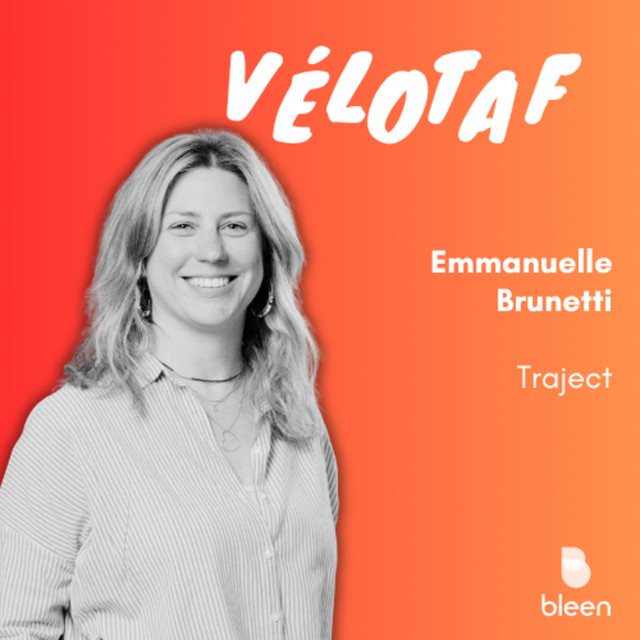
Emmanuelle Brunetti runs the Brussels office of Traject, both a research firm and a mobility consultancy, founded in 1992. Trained as an urban planner, she arrived from the south of France fourteen years ago and has worked on corporate mobility for nearly thirteen years, with teams that combine engineers, sociologists, urban planners and economists. She sums up the job in a way that goes beyond technical skills: “We like to say we’re change managers.”
What blocks mobility change in companies
Staff objections are almost always the same: it’s too complicated, I have to drop off the kids, public transport isn’t good enough, cycling is dangerous. Alongside these barriers comes simple unawareness. Many employees do not know what services run near their home or workplace.
Behind all this lies the mental cost of change. Taking the car requires no thought, switching modes requires one.
“The biggest component of our projects is the human being. And obviously, the human being is the most complex part, because people run largely on emotion, and emotion isn’t rational at all.”
Comfort, an argument not to dismiss
Emmanuelle Brunetti accepts these reservations as legitimate. Yes, it rains. Yes, on the train, you’re surrounded by other people. She rejects any argument that denies these realities and prefers to shift the comparison: an hour spent in traffic is an hour of life lost, whereas an hour on the train can be spent working, reading or sleeping. Comfort remains personal, and some people will always experience their car journey as better. That is part of the picture.
The incentives that work
She warns upfront not to expect dramatic results in the short term. The first incentive is financial. A company that spares its employee from having to front a 1,200-euro-a-year train pass has an immediate effect, especially on those watching their spending. The second is educational: on-road cycling training turns fear of cycling into competence. In her view, someone who agrees to this kind of training has already covered three quarters of the distance.
The third rests on repetition, and it’s the one companies get wrong most often.
“One-off actions are useless. If you run a mobility action once a year, fine, you’ve ticked the mandatory box in your company travel plan, but behind that, people fall back into their usual habits for the rest of the year.”
Corporate mobility has changed status in thirteen years
At the start, projects were run with only the mobility contact person, never crossing paths with management, and the team often sensed the project would end up shelved. Today, the brief sometimes comes from management or HR directors. The subject has become an argument for attracting and retaining staff, particularly with younger generations.
The electric bike has shifted the practice
For a 5-kilometre trip within Brussels, many people now see cycling as an ordinary means of transport, with no sporting dimension.
“Today you have completely ordinary people cycling to work because it’s a means of transport, and it’s not even about doing sport, it’s just about getting from point A to point B.”
The electric-assist bike has multiplied this practice by removing the objections around hills and sweating. Bike parking and the bike allowance have become established as standard. Emmanuelle Brunetti also corrects the narrative around time savings: what people are really after is control over their journey time, the certainty of arriving when planned.
Building a mobility culture
“Mobility needs to become a real subject, on the same level as a marketing strategy. You need a mobility strategy. It has to carry the same weight.”
The method she advocates comes down to a few points. Appoint a mobility manager and give them real time, not five minutes here and there. Support people individually, because no one questions twenty years of habits alone. Work over the long term. And tell a positive story rather than a message of constraint, leaning on colleagues who have already switched rather than on a memo from management. Needs also differ: an organisation of a thousand people and one of a hundred do not call for the same setup.
She adds a requirement for courage. Sometimes strong, unpopular decisions have to be accepted, such as trimming the number of car parking spaces. But what she describes as most effective in mobility is the moment of rupture: an organisation moving from the outskirts to central Brussels and losing parking spaces. At that moment, habits get renegotiated all at once. She immediately notes the limit, not everyone can set up right next to the central station.
Brussels, nineteen municipalities and parked cars
The Brussels Region combines the status of a city-region, nineteen municipalities each with its own mayor and its own vision, and daily flows of commuters from Wallonia and Flanders. Since 2020, cycling infrastructure has multiplied rapidly, a side effect of the health crisis. The city’s shift to a 30 km/h zone has made cohabitation between active modes and cars markedly more pleasant. One observation remains, which she states bluntly: Brussels’s public space is very heavily occupied by parked, unmoving cars close to 95% of the time.
The company car, the system she would abolish
Asked for one single wish, she answers directly: scrap Belgium’s company car system, which she considers unfair. The scheme encourages people to live further away and drive more. She qualifies this immediately. Some live far away because Brussels property is very expensive, others because they want a house, and some have no alternative to the car at all. The mobility budget exists as an alternative, and she expects it will gradually reduce the number of company cars.
On the disappearance of the private car, she stays measured. She would like to say it will be gone in thirty years, then corrects herself: thirty years is tomorrow, and ten years even more so.