The episode in detail
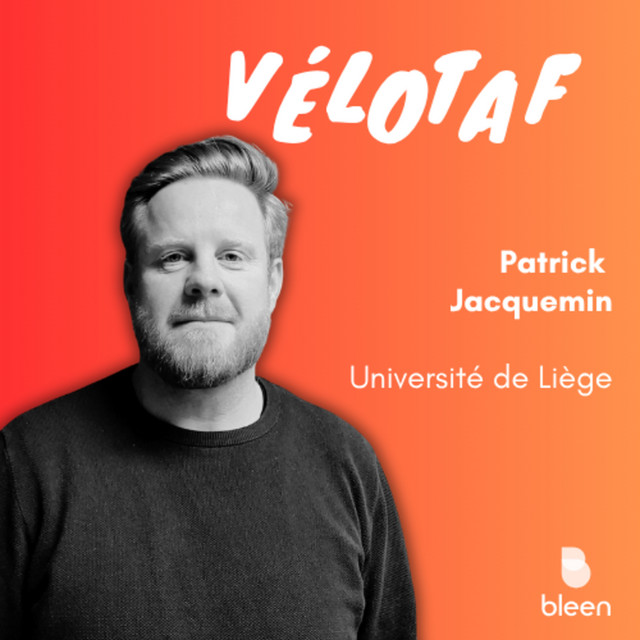
Patrick Jacquemin is mobility manager at the University of Liège, after more than twenty years in the bicycle sector. Maison des cyclistes de Liège, Pro Velo, ASBL Empreintes, the Ciney municipal cycling plan, the Pro Velo board, the Coursier Wallon cooperative: his career covers nearly every angle of the subject. He holds a conviction that awareness campaigns often ignore, and it comes from his own surveys.
The environment barely motivates anyone
“That’s what surveys generally show, the environmental angle comes up rarely, it’s really about efficiency, perhaps even more so in cities.”
What gets people on a bike is efficiency and time saved. He sees it often on the 3-kilometre hill he climbs on a standard bike to get to work: the people who overtake him and chat with him each give a different reason, getting back into sport, saving time, carving out a break. The climate almost never comes up.
Entered the profession by chance, stayed twenty years
He landed his first job at the Maison des cyclistes de Liège by dropping off his CV on his bike, and because the person first hired, back from abroad, did not have the right papers. A part-time Rosetta contract, bike workshops at a night shelter, cycling tourism, then cycling education at Pro Velo with the cyclist’s certificate in the fifth and sixth year of primary school.
Next came school projects at Empreintes in Namur. Octopus, where a pilot class maps its routes with coloured wool threads in one class hour, later used to identify danger spots and raise them with the municipality. This kind of work showed some parents there was no pavement to school, simply because they were parked on it. Then Génération Tandem Scolaire, which paired primary pupils with secondary school mentors, on routes validated with parents and the police.
Mobility manager at a four-campus university
ULiège is spread across Arlon, Gembloux, Liège city centre and Sart-Tilman, the last of which accounts for 75% of activity. Like any Belgian employer with more than a hundred staff, the university runs a mobility survey every three years. The role covers infrastructure, showers, lockers, the bike workshop, parking, mileage reimbursement and internal events.
The latest survey brought in around 400 written comments, from people explaining they would happily do things differently but cannot manage it. A trend the team notices more and more.
“People think they have to come on foot, by bike or by bus, so they apologise for coming by car because they have no other option, when that is not our goal at all.”
Convincing without preaching
That is where his rule of thumb comes from. The environmental argument is heard and well known, to the point of making those with no choice feel guilty. He aims instead for an inclusive message and refuses to stigmatise the drivers among his staff.
“Telling people to cycle doesn’t work, but once they have got past that mental barrier themselves, that’s when we can go and get them, I’d say.”
The method is to multiply the schemes on offer, to be there the moment someone becomes ready. In Liège, tram works in the city centre and the floods gave an unexpected push: cars could no longer get through, neither could buses, and people took up cycling.
The mentoring scheme that didn’t catch on
The university set up a scheme where volunteers accompany a colleague for three days. About thirty people put themselves forward, a map was created, two forms are all it takes. Result: four requests since the launch. Patrick Jacquemin says it plainly, it doesn’t work, even though the few participants come away delighted and the scheme costs nothing.
A Teams group, by contrast, brings together nearly 280 people, and the team deliberately lets colleagues answer each other rather than supplying every answer itself.
What a mobility manager does after hitting a ceiling
“At the university, we’re reaching a ceiling, so the people who were somewhat convinced, I think we’ve reached them, and now we have to turn to a different audience, and for that we’ll need other methods and other messages.”
Current tools are practical and sociable: a mobility week in September, a mobility spring, Strava challenges with cinema tickets and hampers as prizes, a mug for anyone who comes by bike. The university pools its themed weeks with the CHU and the Liège Science Park, five activities per partner, fifteen in total.
The mistakes municipalities keep making
“For me, the mistake is not wanting to touch the car too much, whereas at some point, if you want to give space to bikes, you have to rebalance things and take back some space from the car. And on that, generally, the administrations are willing, but the politicians are not.”
He adds two common flaws. The Walloon Region sets sound targets, but some municipalities feel bound to follow them even when they do not fit their territory: with steep terrain and residents living more than 40 kilometres away, setting a target of 5 or 10% cyclists becomes difficult. The second flaw is funding prestige before usefulness, charging points before cycle tracks, appearance before efficiency. The municipal cycling plan remains, in his view, the right entry point, both for the methodology it offers and for the subsidies it unlocks.
Secure parking, the blind spot of cycling in Wallonia
The priority he names is at home, not on campus. In Gembloux, more than half the students have access to secure bike parking where they live. In Liège, it’s one in three. Campuses can have every secure parking spot and every shower going, if the bike sleeps outside at night, none of it follows through. A dissertation, answered by half of Wallonia’s municipalities, looks specifically at bike parking in student digs. A third of students and two thirds of staff members own an electric bike, equipment you do not leave just anywhere.
Bike counters installed by the Walloon Region and the City of Liège give the clearest answer in the whole picture: where new infrastructure goes up, counts shoot up. Asked about a cycling Wallonia in 2035, he describes a continuous utility network and cycle expressways, with better-equipped cyclists covering growing distances. His message to decision-makers focuses on one specific point, keeping subsidies for cycling infrastructure in place. The RAVeL network has done its job for tourism, what comes next plays out on everyday journeys.