The episode in detail
Learning to ride a bike as an adult: a massive, underestimated need
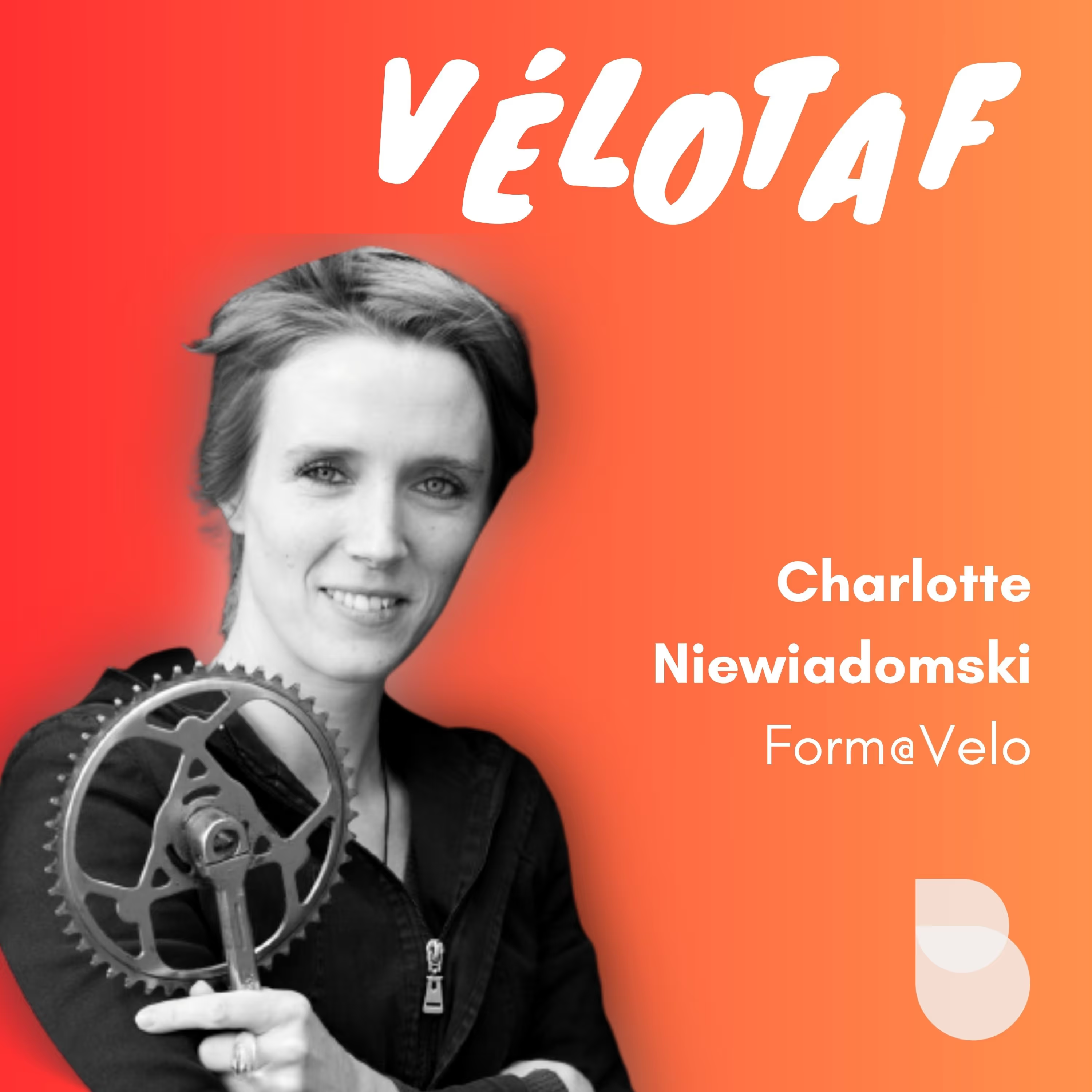
Charlotte Niewiadomski is a bike mobility educator in Dunkirk. Her path illustrates something many people overlook: millions of adults cannot ride a bike or do not dare to cycle in town. Cycling schools exist to fill this gap, with progressive courses that start from complete beginners and go up to advanced urban cycling. The programme covers the highway code for cyclists, safe road positioning and basic bike maintenance.
“The bike is a very simple solution to multiple complex problems, and we need to use it. There’s really nothing else to it.”
Charlotte trains children as well as adults and teenagers. Her organisation, Forma Vélo, offers a safe practice area with suitable bikes. The goal does not stop at learning to pedal: it is about making people independent in their everyday journeys.
From social work to the bike: when integration happens through mechanics
Before setting up Forma Vélo, Charlotte spent twelve years at Secours Catholique working against exclusion. In 2006, in a day centre in the 17th arrondissement of Paris, she set up the Vélocypède workshop with a volunteer. The idea: collect abandoned bikes, repair them with people in extreme hardship, and put them back into circulation.
“L’Heureux Cyclage estimated that 1.5 million adult bikes are thrown away in France every year. That’s adult bikes alone, we’re not even talking about children’s bikes.”
The project grew in Clichy-la-Garenne in 2011 under the name BicyclAide, a work-integration workshop based on bike repair. Three permanent staff, a dozen people on an integration pathway, reuse, second-hand sales and self-repair workshops inspired by the Dynamo model in Nancy. Charlotte then turns the association into a SCOP (société coopérative, a workers’ cooperative), to secure the business model while keeping democratic governance.
The cycling school: learning to ride a bike at any age
The heart of Charlotte’s current work is training. In Dunkirk, she is building a full cycling school. The courses cover balance for beginners, riding in town for cyclists who lack confidence, the highway code specific to cyclists and basic mechanical maintenance. New cycling signs and infrastructure remain largely unknown, even to people who hold a driving licence.
Charlotte also works with companies. Her conviction: bike commuting is a powerful lever. An employee who starts by cycling to work ends up using the bike for errands, taking the children around, sport. By encouraging bike commuting, a company produces a domino effect across the whole range of its employees’ journeys.
“Once you start coming to work by bike, you do it for other trips too. I strongly believe in the lever effect companies have.”
A woman bike commuter for 20 years: leading by example
Charlotte has been cycling since 2002. In Paris, she went from the 11th to the 17th, from the 10th to the 13th, faster than by metro. Before the bike, she got around on rollerblades, until she discovered the limits of combining rollerblades with the metro (skating in socks through the corridors is neither practical nor hygienic). She has never bought a new bike. All her bikes came from reclaimed sources, first out of economic pragmatism, then out of environmental conviction.
“Becoming aware of time and space again is great. It’s a completely different perception of life.”
Raised by parents without a car in Paris, Charlotte never had a car culture. This lack of a car reflex, combined with a strong social sensibility, naturally led her towards the bike as a tool for change. Her best bike-commuting memory: riding at night between Gravelines and Dunkirk, headphones on, singing at the top of her voice on the cycle track.
Changing mindsets: between optimism and reality
Charlotte sees a real but non-linear shift in cycling habits. The 2019 strikes, the first 2020 lockdown, the rise in petrol prices in 2022 each triggered waves of new cyclists. But behaviour remains paradoxical: everyone recognises the climate emergency, few change their travel habits.
“The COPs keep coming one after another and then what actually happens, honestly? We’ve hugely grown polluting modes of transport and today that’s not reversing.”
For Charlotte, the solution starts with children. She proposes putting balance bikes in every nursery school, a modest investment that instils bike culture from the youngest age. The Génération Vélo programme, which builds cycling proficiency, goes in this direction. But there also needs to be compulsion: banning vehicles from overtaking cyclists in town, requiring regular training for drivers, rethinking urban planning to bring homes and workplaces closer together. The political courage to make these decisions is still lacking.