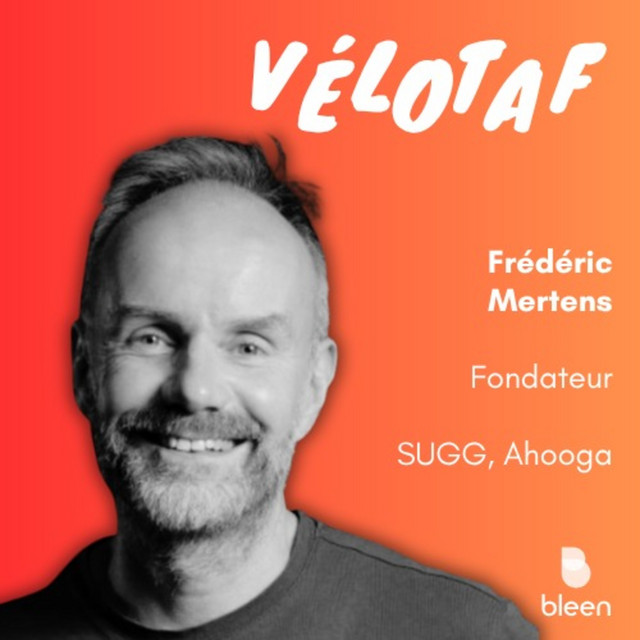
The episode in detail
Frédéric Mertens spent his whole career in software before he started designing bikes. On 2 November 2014 he decided to build them: first Ahooga, which he left in 2020, then Sugg, set up in the spring of 2021, whose compact bike rolls on 16-inch wheels and never folds. His design method starts from the reasons that keep people off a bike in town, taken one at a time.
From software to bikes: 2 November 2014
His career was built in software, in a job that was both technical and commercial and could send him to Zimbabwe for a week, to Vietnam the next, then to Nicaragua or Spain. Ten years of travel, fascinating ones; the flying much less so.
“Mea culpa, I have to admit that I did a lot of damage to the atmosphere and the planet with my previous job.”
He gives a precise date, and comes back to it during the conversation: 2 November 2014, the day he told himself that what he wanted to make was bikes. In the company of around 600 people he left that year, five came in by bike, as he remembers it. They were seen as brave, sometimes as suicidal. He thinks the same company would count a quarter today, without being able to check since it has disappeared.
What drives him goes beyond the product. He builds bikes to calm the street down, so that children play in it and ride to school, so that a conversation on a pavement is not drowned out by an engine.
“Mobility is a moment of sharing public space.”
Ahooga, a bike designed against four barriers
Before drawing anything, he looked for what holds people back from cycling. The weather, which he sets aside by pointing out that the bike is used most in the Netherlands and Denmark. The terrain, which electric assistance flattens. Storage, because mobility, as he puts it, is also immobility. Theft, the fourth and last item on his list. Out of those four barriers came a light electric folding bike, meant to go up to the flat rather than sleep in the street.
The half-range bet
Electric bikes at the time all carried 500 Wh, enough to cover 70 to 80 kilometres. He made a bike that offers half that range.
“I did not understand why people absolutely wanted to cover 70 km when most trips are under 5 km.”
The reasoning comes down to two figures: about ten kilometres a day, one charge a week. The bike that comes out of it is far lighter. Industry professionals told him range was among the first questions asked in a shop. The bike found its buyers anyway, among older riders as much as young ones. The first electric folding bike weighed around 15 kilos, its non-assisted version around 11, two figures he gives from memory.
Learning frames in Lyon, then in England
He could neither draw nor build a frame. He learned to draw, took a mechanics course in Lyon, classes from 9am to 4pm and workshop from 4pm to 9pm, then frame building in England with the master welder from Moulton. Stuck on a Friday on the down tube of a folding frame, he found the answer the next day: two parallel tubes, with the rear wheel tucking in between them. The design would be patented.
The rest of the story he tells against himself. As a very young teenager he pestered his parents for a year to get a Raleigh Grifter he had ridden on holiday on the Belgian coast. Years after drawing his own frame, he saw one again in England: the down tube was already a double tube. He does not know whether he copied it without realising.
Sugg, the compact bike that does not fold
He left Ahooga in 2020 after a falling-out, and the three partners sold 100% of the company that same year. Sugg was set up in late March or early April 2021, but production only started in November 2022, after a year and a half of waiting on parts.
“A year and a half with no income, no production, no sales. You have to be patient.”
The first compact bike drops the folding mechanism. A folder is still awkward to handle and gets wider once folded; on a bike that is already small, pulling in the saddle, the handlebars and the pedals is enough to store it in a hallway. Sixteen-inch wheels, balloon tyres to take the cobbles, steel frame. The frames come from the Czech Republic, a choice he owns as political and idealistic. The name comes from his mother’s, a surname that was going to disappear from Belgium for want of being passed on.
The electric compact bike born of a theft
His wife’s electric bike disappeared at the ULB. For her, getting around Brussels without electric assistance is not conceivable: the non-assisted compact bike had become too elitist. Two things then happened at roughly the same time. He had his batteries made close to home, first in Brussels and now in France, and a newsletter about the Fairphone 5 gave him the principle of modularity, nothing fully integrated. The electric version of the compact bike came out of that, and probably sells four times more than the non-assisted one.
The catalogue has run to around twenty colours; sixteen are left for now.
A compact cargo bike that fits in a hallway
Shown a few days before the recording at the Bike Brussels show, the Sugg cargo takes the geometry of the compact bike with 20-inch wheels. The lengthened rear carries two children, the front takes an extending, folding platform, and the handlebars fold, so that a cargo bike can also be stored in a hallway. Load quoted at over 200 kilos, a Bosch Cargo Line motor quoted at 100 Nm, carbon belt, oversized rims, tyres, stand and brakes. The point of that oversizing is how long it lasts: avoiding a brake pad change every three months, as happens elsewhere.
The bike industry since 2022
Covid blew demand open: twice as many bikes were needed, twice as many repairs and twice as many mechanics, and supply did not keep up. Then everything stopped, the stock stayed, and the sector has been going through a very hard stretch since 2022. Repair is holding: in Flanders, bike mechanic is listed as a shortage occupation. He defends in passing the public money spent during that period, whose after-effects he finds it normal to carry today.
His advice to anyone hesitating comes down to a length of time: two weeks of trial, no more, with a good lock, proper rain gear, a colleague if possible, and several routes tried out. The rest comes from the conviction that made him leave his job in 2014.
“Childhood dreams are a serious thing, you have to take them seriously, and I think the world would be a lot better off if everyone did the job they would have liked to do as a child.”