The episode in detail
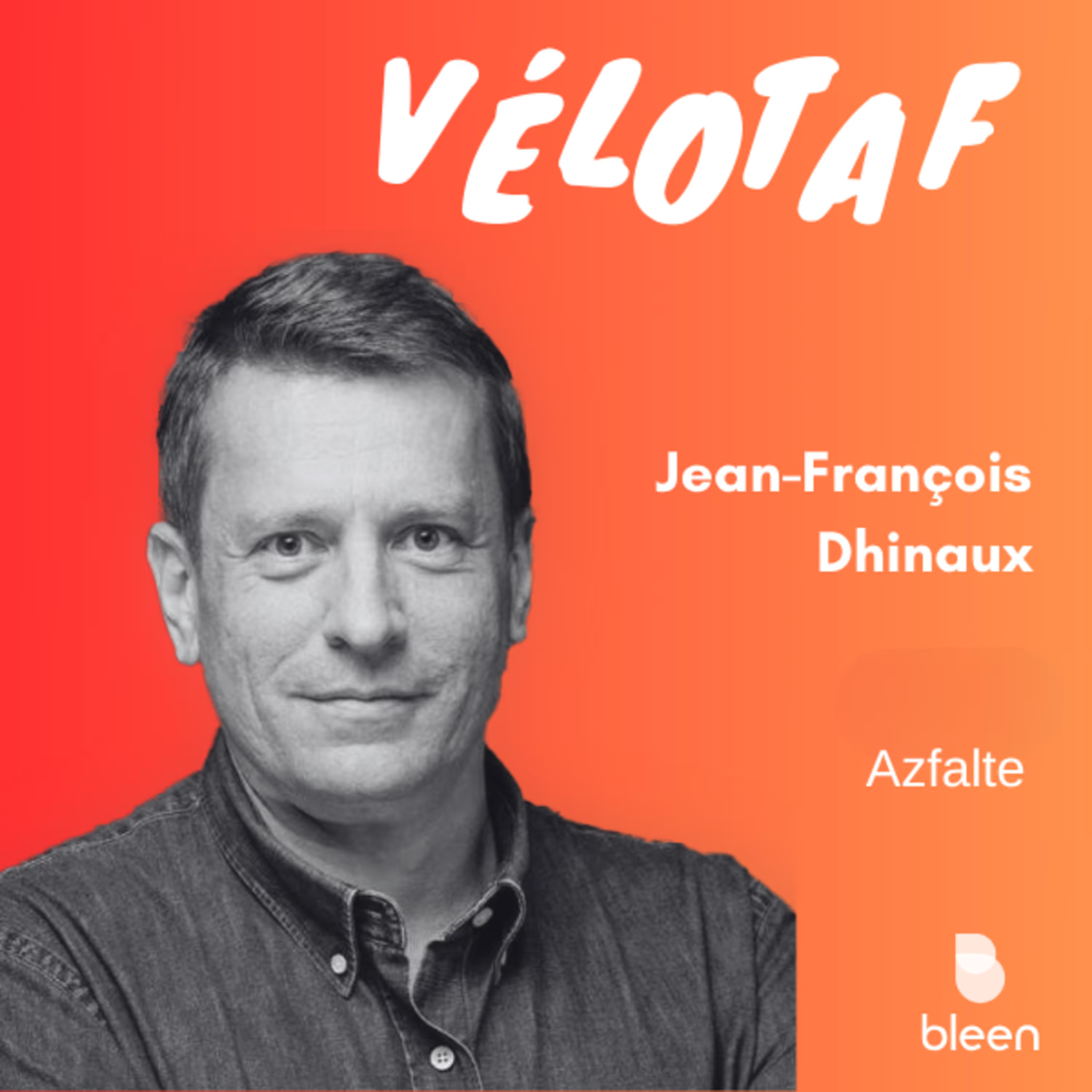
Jean-François Dhinaux, founder of Asphalt
Jean-François Dhinaux is over 50 and has five entrepreneurial ventures behind him. Before cycling, he worked in digital, distribution, mail order, then investment. He advised Michel Leclerc (founder of Decathlon) on his personal holding company and co-ran the ViaID fund (Mobivia/Norauto/Midas), which specialises in new mobility. That’s where he discovered the potential of everyday cycling, notably through the rollout of the new Vélib’ in Paris, the largest bike-share system in the world. In September 2020, he founded Asphalt to develop company bikes in France.
Covid as the trigger
Jean-François had the project in mind for several years, fed by watching the German market, where company bikes were already counted in the millions. But the culture of everyday cycling didn’t exist in France. The first easing of lockdown changed everything: the temporary cycle tracks were packed as soon as they opened, and people discovered that cycling to work wasn’t complicated at all. It was the moment to launch Asphalt.
“When you go back to cycling every day, even for a few days, you realise it’s not complicated. You avoid the traffic jams, you get a moment to decompress. And you get a taste for it again.”
Company bikes: a B2B market taking shape
Asphalt doesn’t sell bikes to individuals. The customer is the employer. The company provides a bike, often electric-assisted, that the employee picks from a catalogue. The employer covers all or part of the cost. The employee gets a maintained bike, insured against breakage and theft, with road safety training included. In France, tax schemes allow exemptions on social charges and state subsidies, which reduces the cost for the employer while offering a substantial benefit to the employee.
The B2B market didn’t suffer the same bubble as post-Covid bike retail. Asphalt has never had a year below 2.5x growth in revenue. The real slowdown came from the Ukraine crisis in early 2023, when large corporations froze every non-essential project. Six months later, budgets were released and growth resumed.
“That pause was very hard to live through. But looking back, it’s the best thing that happened to us. We went from a start-up to a profitable, sustainable business.”
65% of urban car trips are under 3 km
The figure is set out at the start of the episode. 65% of car trips made in French cities are under 3 km. Jean-François isn’t talking about sport cycling or leisure cycling. He’s talking about a mode of transport for trips of 1 to 10 km, where a car makes no sense. The electric-assist bike has made this switch accessible to people who would never have considered bike commuting otherwise.
“The bike isn’t a sport. It’s a way of getting around. And it’s the most suitable one when I need to cover between 1 km and 10 km.”
Why go through the employer
The commute dictates the main mode of transport. Five days out of seven, whichever vehicle is ready to go first in the morning is also the one used at weekends. If that’s the bike, it ends up used for shopping, taking the children around, everyday errands. Jean-François describes a virtuous circle: some people end up choosing their children’s school or their employer based on how accessible it is by bike.
The employer also has a legal safety obligation covering the commute. Paradoxically, setting up a company bike programme protects the business better than simply encouraging employees to cycle in on their own equipment, which is often poorly maintained and comes with no training.
“The worst thing for a company is to hand out a bike allowance and see employees turn up on bikes that aren’t maintained, that have had their speed limiters removed, with no training. That’s where the risk lies.”
France, 40 years of catching up to do
In Germany, 12% of daily trips are made by bike. In France, it’s between 3 and 4%. The gap goes back to the 1970s: France chose an all-diesel path and left the bike out of its urban planning. The Netherlands, at the same time, made the opposite choice, even though its cities were more car-clogged than French cities. In Germany, cycling culture was kept alive from childhood: children cycle to primary school. In France, that still isn’t the norm.
Covid restarted the momentum, but infrastructure isn’t keeping up fast enough. The cycle tracks built today are saturated almost immediately. That’s the bottleneck: the demand is there, but urban infrastructure is lagging behind.
A business for enthusiasts, not a plan to get rich
Jean-François quotes an old bike seller: “If you want to get rich, don’t build your business around bikes.” Delivering a company bike means delivering a bike, a helmet, a vest, accessories, each with its own sizes and colours. Unlike a car, a new bike goes out of tune within the first few weeks. It’s a mechanical object that needs close follow-up. The market is cyclical, margins are thin, and passion is the only fuel that lasts over time.
Asphalt joins a European group
To reassure large employers who hesitate to commit to a five-year-old start-up on contracts running at least three years, Asphalt has joined a European group of company bike operators. The goal: to offer the strongest proposition on the French market, with critical mass and a presence in several countries. Asphalt already partners with Ayvens (formerly ALD Automotive), the world’s leading car leasing company, running the bike side of their offer.
“In Germany, when a company doesn’t offer any support for getting a bike as part of its package, it doesn’t look good as an employer brand. That’s what we hope to build in France.”
An economic model that rewards use
Asphalt reverses the logic of car leasing. Where a company car penalises going over the mileage limit, Asphalt wants the employee to ride as much as possible. The more the bike is used, the less it costs. If the bike isn’t used, it’s taken back. The idea runs counter to financial logic at first sight, but it attracts committed employers and builds volume, which remains the real driver of profitability.
What to take away
Jean-François Dhinaux shows that the company bike is no longer an HR gadget. It’s a lever for changing mobility habits, provided it goes through the employer rather than the consumer. The commute is the entry point: once the bike becomes part of everyday life, it changes how people shop, get around and think about their life choices. Jean-François’s advice: try it for a week, not a day. And start in September, not January.