The episode in detail
From strategy consulting to second-hand bikes
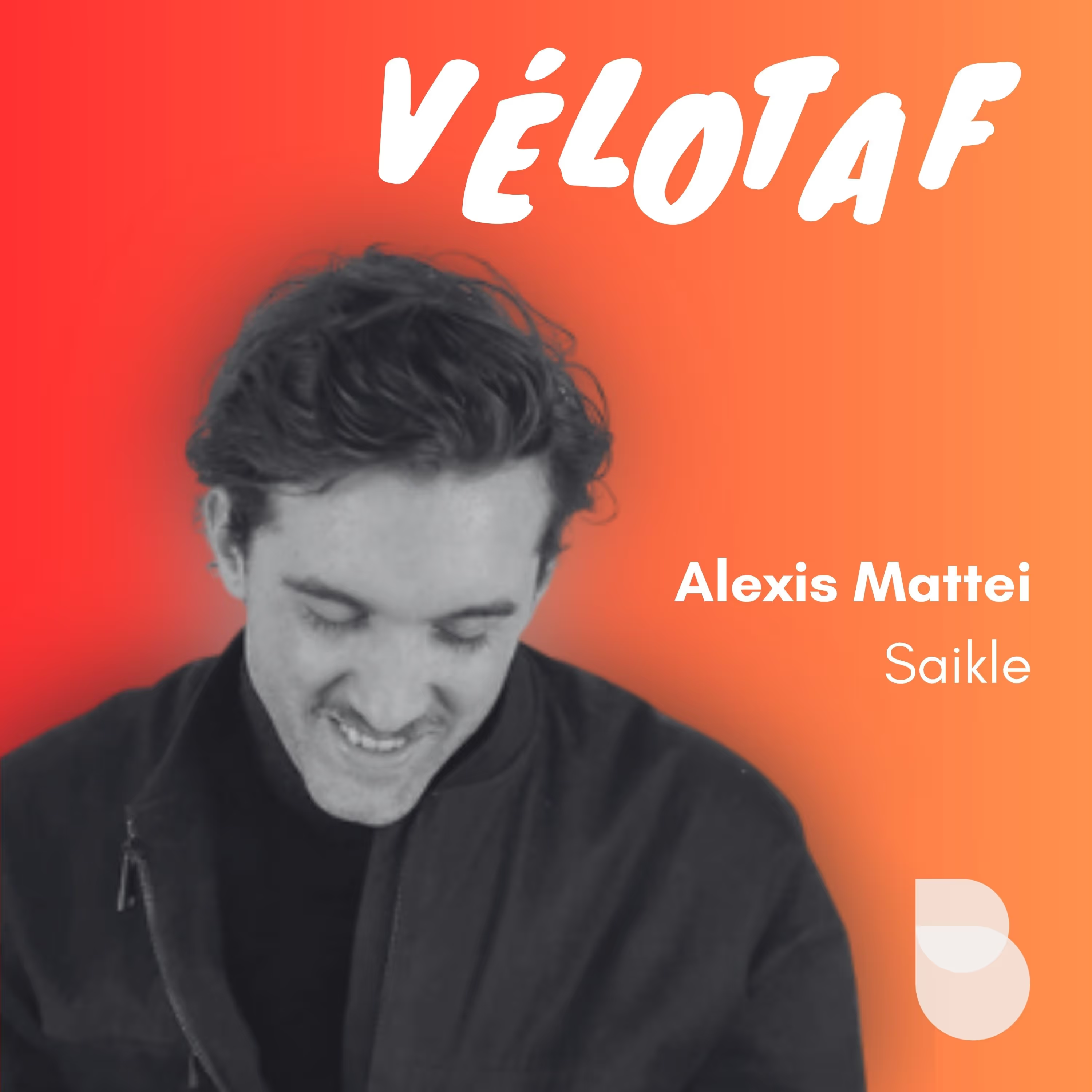
Alexis Mattei comes from the world of design and digital transformation for large companies. During the first lockdown, he watches demand for bikes explode around him and starts assembling bikes at home, in his 40 m² Paris flat, with a bike stand and online tutorials. His friends ask him to help them navigate Le Bon Coin to avoid the pitfalls: stolen bikes being fenced, identity scams, hidden defects.
“Two million bikes are scrapped every year in France. A large proportion could be upcycled, reused. And yet, they end up scrapped.”
This is how Saikle was born, a platform for selling second-hand bikes co-founded with Jean, positioning itself as a trusted third party between artisan sellers and buyers.
Saikle: traceability and reassurance on second-hand bikes
Saikle’s positioning rests on three pillars: authenticity, traceability and reliability of the object. The platform works with a network of partner artisans, enthusiasts who hunt for, restore and sell verified bikes.
Saikle is also exploring blockchain technology to create a certified life history for each bike: an (anonymised) history of owners, repairs carried out, and component changes. The aim is to trace the complete history of a second-hand bike to reassure the buyer, like a car service record.
“We’re working on a certified life history for the bike using blockchain technology, which lets you trace back through the bike’s owners.”
The bike, the ultimate low-tech object
For Alexis, the bike embodies the low-tech philosophy: a simple object, almost unchanged since its invention, capable of replacing energy-hungry technologies for transport and leisure. It is not a black box. You can build it, maintain it and repair it yourself.
“The bike is the ultimate low-tech object. It can serve as transport, as leisure, replacing hugely energy-hungry technologies. We do better with less.”
His own discovery of bike commuting in Paris surprised him: he started taking detours past the illuminated Opéra in the evening, turning his commute into a moment of pleasure. The bike also changed his relationship with leisure, with early rides out to the Chevreuse valley at weekends.
Structuring a reconditioned bike sector in France
France has no industrial bike reconditioning sector, unlike Germany or the Netherlands, where factories turn out several thousand reconditioned bikes a day. The French model rests on a myriad of small artisans, each hunting for and restoring bikes on their own.
Saikle takes part in the Cycling Tech initiative, a trade body being set up that brings together bike tech players to structure this sector. The five-year ambition: to become the distribution platform for an organised reconditioning sector, capable of delivering both quality and volume.
Choosing a second-hand bike well
Alexis’s main advice to buyers: do not go by the lowest price alone. A bike priced under 100 euros on a classifieds platform almost always has a problem with quality, weight or reliability. Poor components make climbs painful, creating discomfort that eventually puts people off cycling altogether.
“I see people who spend a lot on their home décor, their clothes, and turn up on bikes that are wrecks. It’s dangerous.”
Buying second-hand remains good value compared to new, but you need to look at the quality of the components, the weight, how light it is (key for urban use) and how comfortable the saddle is. His only indispensable tool: a crank (bike multi-tool) and a spare inner tube in his bag.
Making the bike accessible without moralising
Alexis is firm on one point: promoting the bike must not become moralising. Many people live in areas with no cycling infrastructure, as in Corsica, where a woman living in Ajaccio pointed out that it is impossible to ride safely in a city of 60,000 people.
“We must not polarise around these issues. We need to raise the alarm, take positions that are sometimes a bit radical to wake people up, but we must not be moralising.”
For him, the first stage of the rocket is still infrastructure. The second is cultural: giving access to the bike to people who do not currently benefit from it, whether for financial or geographical reasons. And to reach the general public, what’s needed is massive, regular access to the major media, which the bike sector still sorely lacks.