The episode in detail
From a student project to 50 shared bike trailers in Brussels
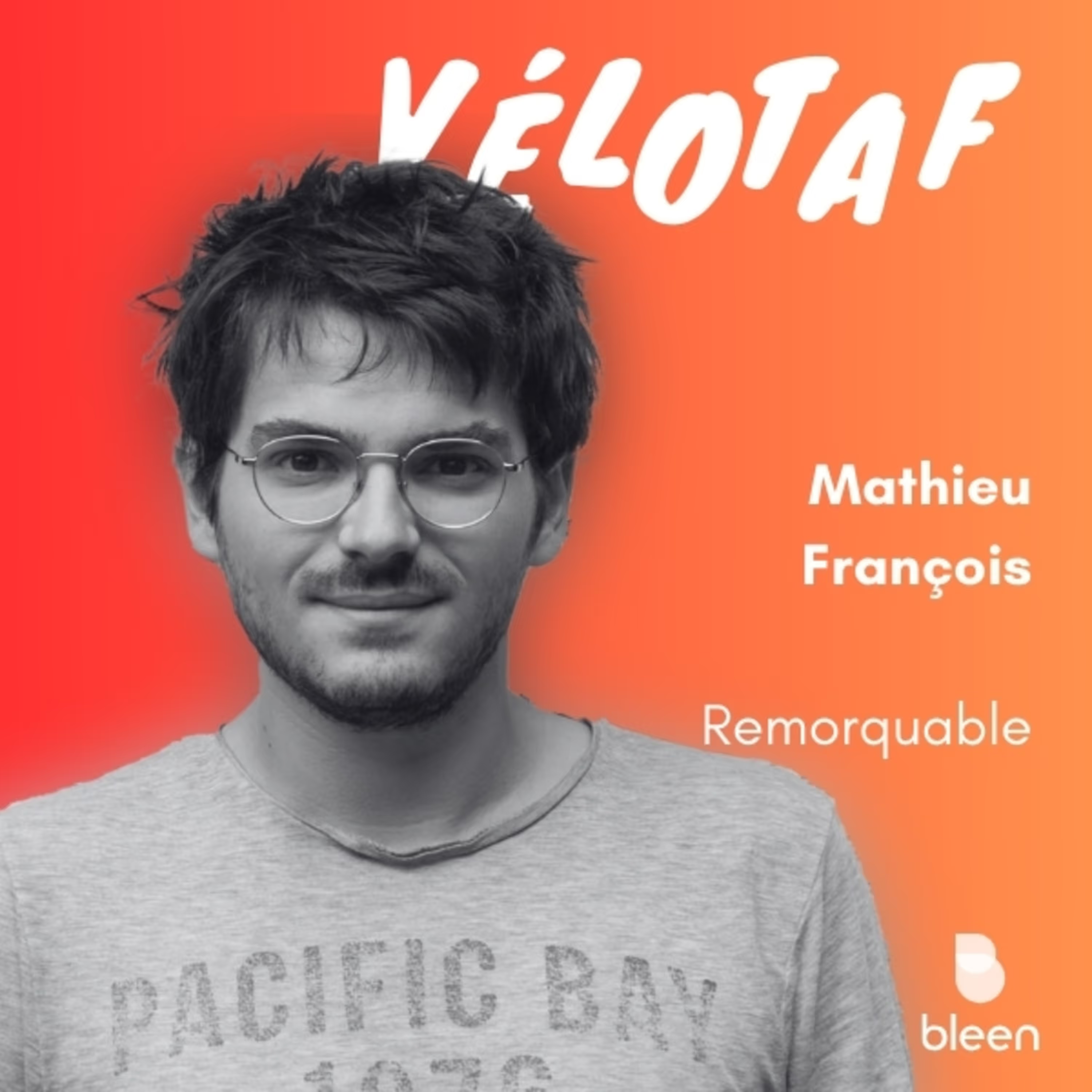
Remorquable began with a group of ULB students who won the Stéphane-Essel grant with a simple idea: build a bike trailer for Brussels and share it on campus. The starting observation fits in one sentence: a trailer is very useful, but nobody needs one every day. The sharing model was the obvious choice.
The concept took on another dimension in 2021, when Remorquable secured funding from the Cargobike project, a European programme run in partnership with Bruxelles Mobilité. In three years, the association went from one homemade trailer to a fleet of 50 locally built trailers, with 26 active loan points across the city and more than 600 bookings in 2023.
“A bike trailer is very handy for carrying all sorts of things, but nobody needs one every day. The idea was to make one available at a fixed location.”
Trailers built in Brussels and released as open source
Every Remorquable trailer was built on-site, at the Tournevie workshop, a shared tool library based in Brussels. Hélène, a former theatre set builder who retrained after Covid, oversaw the construction of 40 trailers on her own. The design is deliberately craft-based: a steel frame, a wooden platform, two cargo bike wheels and a hitch rod.
The association publishes its trailer plans as open source. Mathieu François puts it plainly: a bike trailer is not complicated, and if others want to reproduce the model elsewhere, all the better. The only outsourced elements are the wheels, the CNC cutting of the wood panels and the rustproof paint, done in Antwerp.
“We share the open source trailer plans online. If it can be replicated elsewhere by other people, all the better.”
Renting a trailer: how it works day to day
The system runs on a subscription. Users sign up online, pay an annual fee of 40 euros, then book an available trailer at one of the network’s loan points. The loan points are hosted by partner associations, shops or institutions, provided the site is secure and closed at night. After several trailers were stolen while left on the street, the association tightened its storage criteria.
The hitch fixes onto the rear wheel hub, with a system compatible with most bikes. An attachment costs 8 euros and stays permanently on the bike. Mathieu François does not hide the fact that pulling a loaded trailer up Brussels’ hills takes some motivation. The journey takes two to three times longer than cycling alone. But the trade-off is real: no car rental, access to cycle paths and parks, and immediate independence.
“What you lose in comfort, you gain in independence. That’s the whole point of the bike trailer.”
The unusual trailers: workshop, pizza, karaoke
Beyond loans, Remorquable also runs mobile events with a fleet of specialised trailers. The most used is the bike workshop trailer, which can carry 200 kilos of equipment: a workbench, workshop stands, tools, inner tubes and cables. The association travels around Brussels to offer repairs or participatory workshops where people learn basic bike mechanics.
The range does not stop there. A photo trailer takes portraits with bellows film cameras and develops the pictures on-site in a mobile darkroom. A games trailer carries board games, badminton and pétanque for use in parks. A kitchen trailer carries dishes and cooking plates. And the newest addition, the pizza oven trailer, uses a rocket stove system built from recycled barrels to cook pizzas outdoors.
“We also have a karaoke trailer. It’s as daft as that, but it actually works really well.”
Winning over drivers: Remorquable’s real challenge
With around a hundred active members and 600 bookings a year, Remorquable has proven that the model works. But Mathieu François admits the project remains a niche product. Its user base is mainly made up of cyclists who are already convinced, willing to put in the extra effort of pulling a trailer around the city.
The association’s ambition goes beyond that circle. The goal is to replace some car trips, particularly for house moves within the city. Most moves in Brussels happen within the city, over short distances, with modest volumes. For these uses, the bike trailer is a credible alternative to van hire. What remains is to simplify the user journey until it is as smooth as that of a shared e-scooter.
“The hardest part is winning over people who use their car. That’s what we want to do: replace at least some of the cars in Brussels.”