The episode in detail
Ski’s carbon footprint: transport outweighs the lifts
The carbon footprint of a ski trip breaks down in a counterintuitive way. Transport accounts for 50% of the total footprint, an average that hides considerable differences: a skier flying in from Brazil emits a huge amount, but a resident of Grenoble who drives ten times a season can emit more than a Parisian who comes just once. Food comes second at 8% (raclette and fondue, often served with meat). A pair of skis accounts for around 7%. Ski lifts, often singled out as the problem, make up only 2% of the footprint, or 1.4 kg of CO₂ out of roughly 50 kg for a day, thanks to largely decarbonised electricity in France.
“For the ski area, we’re at 1.4 kg out of 50 kg for a day. That’s 2% of the footprint of skiing. Not much.”
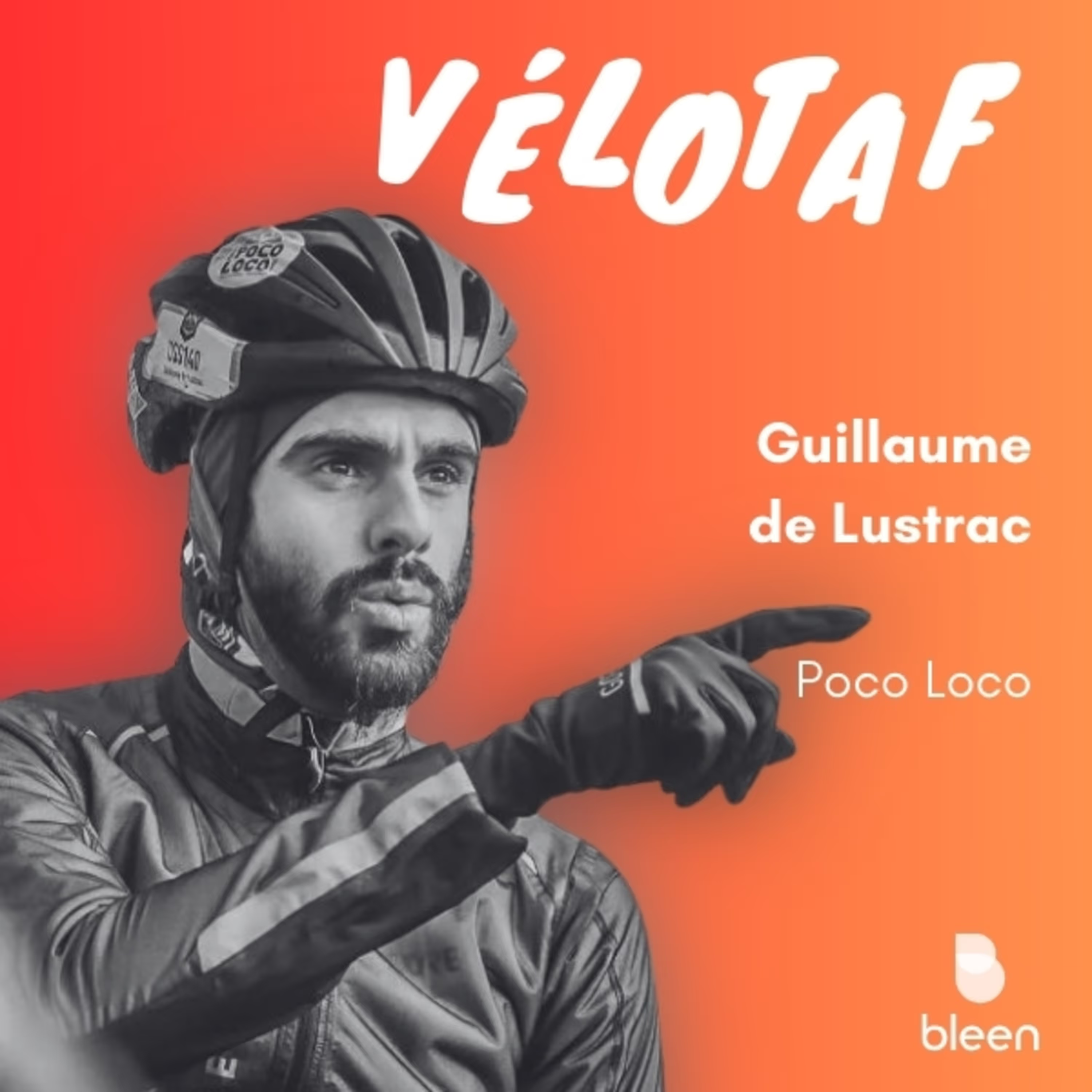
Guillaume de Lustrac cycled to all 300 French ski resorts, covering more than 9,000 kilometres, to document these realities. His tour of the resorts led to the documentary ‘Nouvelles Pistes’ and the podcast of the same name.
Artificial snow: the triple threat of water, electricity and temperature
Every French ski resort uses snow cannons, except one in the Vosges. Artificial snow depends on three resources: water, electricity and cold. All three are under threat. The Alps already show average warming of +2.3°C. Météo France’s 2050 projections show that many resorts will no longer get sub-zero temperatures in January.
Water is a ticking time bomb. Investigations have found that some resorts draw illegally on reserves. Several managers admitted off the record that they first needed to ‘get back within the law’. On electricity, costs have risen by a factor of 7 to 10 since the war in Ukraine. Lac Blanc, in the Vosges, has put the cost of renovating its snow cannons at €2 million, without which it cannot open. Even Courchevel, a giant of the Alps, finds itself almost in the red because of its energy costs.
“It really is a giant with feet of clay. It brings in an enormous amount of money, but alpine skiing is disappearing in a lot of resorts.”
Property: the driver and the trap for ski resorts
The economic model of ski resorts rests on property development, not on skiing itself. Town councils sell land to developers to fund infrastructure. But more housing requires more infrastructure, such as sewage treatment plants and electricity networks, which forces new property projects to launch. Tignes has more than 30,000 housing units for 2,000 permanent residents. In Megève and Courchevel, more than 90% of homes are second homes.
This model sends prices soaring and pushes locals out. If tourists stop coming, these resorts will become ghost towns. Some already are: Séuse, the Montagne de Lure in the southern Alps, Saint-Honoré 1500 near Grenoble, where the buildings and lift pylons are still standing, with no one there. Puigmal in the Pyrenees has now gone bankrupt for the second time, after four consecutive winters without snow; the indebted commune was unable to invest for ten years.
The dilemma of public service delegation contracts
Resorts delegate the running of their ski areas to companies (the Compagnie des Alpes manages Tignes, Courchevel and others). These public service delegation contracts (DSPs) are coming up for renewal, and they raise a difficult question. Replacing a chairlift costs millions and takes 20 years to pay off. Villard-de-Lans in the Vercors, whose DSP ends in 2025-2026, is asking whether investing is worth it when snow conditions are not guaranteed over that period.
The trap is the same everywhere: alpine skiing brings in more than any other activity. Mountain biking, trail running and gravel riding do not generate comparable revenue. Giving up skiing means giving up the only significant source of income. Continuing means risking bankruptcy if climate conditions worsen.
Dialogue and the Flocon Vert label: giving the transition structure
How far a resort has come in its transition can be measured by the quality of dialogue between the players involved. In some resorts, the town council, the resort operator and the tourist office do not talk to each other. The Flocon Vert label, launched by the Mountain Riders association, has the advantage of forcing everyone around the table. Several resorts joined the process for that reason alone, before even aiming for the label itself.
“There’s no such thing as anti-ski. Everyone is passionate about skiing and snow. The question is: do we have the right conditions to offer it?”
Tignes and Bourg-Saint-Maurice-Les-Arcs have already decided to stop promoting themselves outside Europe, to cut the impact of transport. Megève now uses the slogan ‘Come for the skiing, stay for life’, banking on its appeal as a place to live year-round.
What an adapted resort looks like in 2050
For Guillaume, a well-adapted resort is above all one with life all year round: nurseries, schools, shops open twelve months a year, public services that work. Remote work and the exceptional setting of the mountains could attract permanent residents, provided housing becomes affordable.
Some resorts will keep offering skiing thanks to their altitude and exposure. Others will need to find other economic drivers: crafts, services, light industry, four-season tourism. Diversification through mountain biking, trail running and hiking will not be enough on its own to offset the loss of alpine skiing. Success will depend on the ability to build a viable economic model outside the winter season.
“People who go up to the mountains, even if they don’t ski, are disappointed not to have skied. But they still enjoyed themselves. You can be happy without skiing.”
Tomorrowland, the 2030 Olympics: the diversification debate
L’Alpe d’Huez hosts Tomorrowland Winter 500 metres from the Écrins nature park. The festival brings a new audience to the mountains and adds culture to an environment traditionally built around sport. But night-time activities put pressure on biodiversity, and most of the impact comes from participants flying in from the other side of the planet, some even arriving by private jet or helicopter.
The 2030 Winter Olympics in France raise the same question. If they bank on the appeal of skiing with international reach, that is the opposite of what is needed. If they put the spotlight on year-round mountain life and local culture, they could act as a lever to speed up the transition.