The episode in detail
From Vhélio to SunTrip: discovering solar cycling
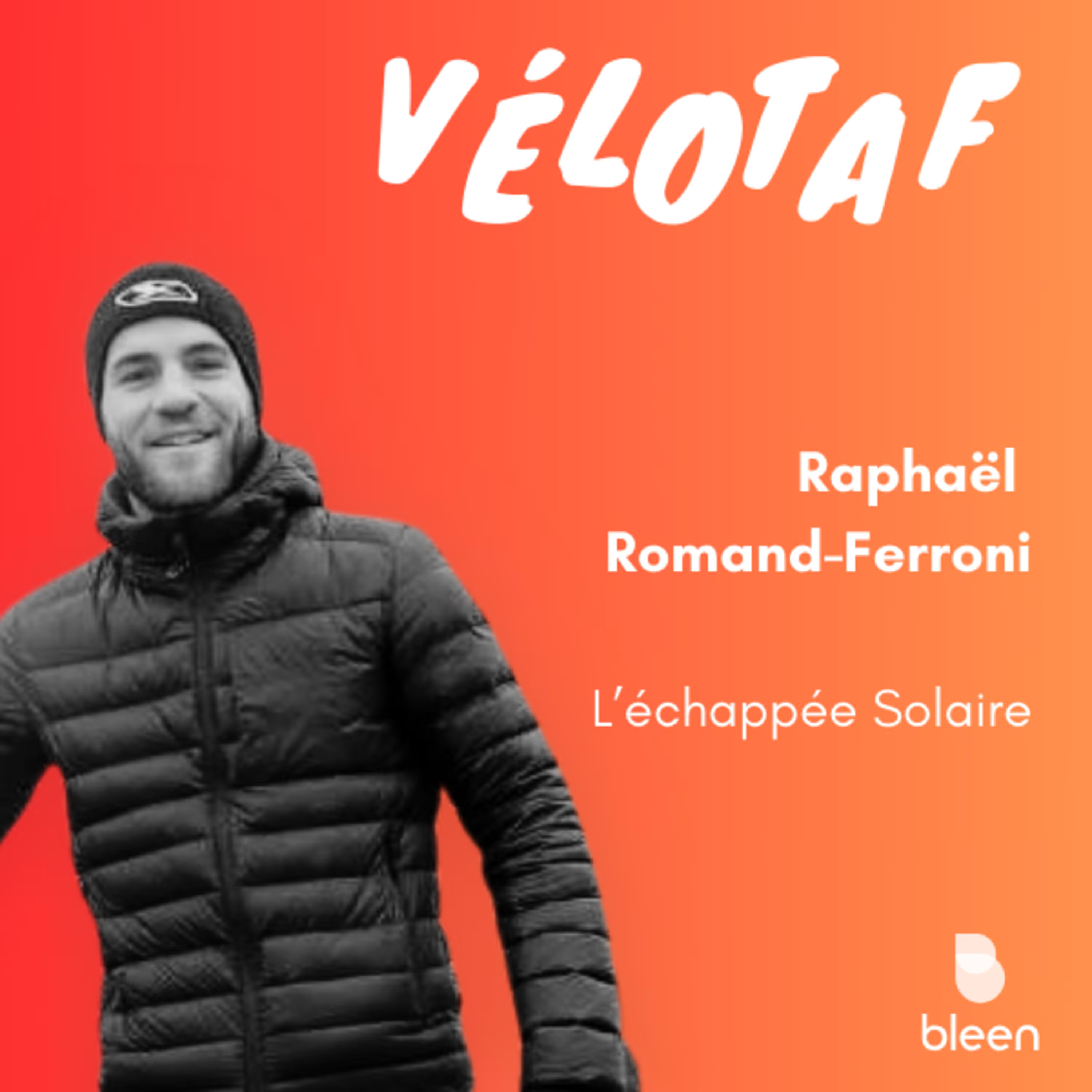
Raphaël Romand-Ferroni had never heard of solar cycling before the summer of 2024. Still on his final internship at ESSEC, he came across a France Inter podcast about the “Vélo solaire pour tous” association and its Vhélio project, a three-wheeled solar utility vehicle designed for cycle commuting. The concept fascinated him: a simple, affordable vehicle filling the gap between a cargo bike and an electric car. One thing led to another, and he discovered SunTrip, a solar bike race held since 2015, whose last major edition ran from Paris to Guangzhou. A few weeks of calls with past participants and enthusiasts were enough to turn curiosity into a concrete project: cycling from Paris to Cape Town on solar power, 18,000 km across 24 countries.
From trike to mountain bike: adapting the solar bike to African conditions
The initial plan called for a trike, a three-wheeled recumbent bike topped with solar panels, like most SunTrip participants. Raphaël found one in the south of France and tried it out on a first ride between Aix-en-Provence and Paris in early December. The verdict was clear: the panel structure (1.60 m by 1 m, 15 kg) made the vehicle unstable, uncomfortable and too wide for the dense traffic of African cities.
“I had to change my plans quickly. Over six months in Africa, it would have been difficult to deal with a breakage if I fell to the right or the left.”
In January, Raphaël changed course: he chose a standard mountain bike fitted with a trailer carrying two solar panels. An aluminium hinge system lets the structure tilt for access to the load. More manageable, more stable, better suited to African roads.
250 watts of sunshine: energy self-sufficiency on two wheels
The final set-up uses two solar panels delivering around 250 watts of power. On a day of optimal sunshine in Africa, the system can generate up to 1,200 watts. Two batteries with a combined capacity of 1,300 watts give near-total self-sufficiency over a sunny day. The panels feed power regulators that smooth out the intermittent current before passing it to the batteries, which are themselves connected to the motor.
“On a day of perfect sunshine, I can expect to be self-sufficient. Solar power is genuinely welcome for covering 18,000 km in six months.”
A dashboard mounted on the handlebars shows consumption, speed and solar input in real time. For the motor and wiring, Raphaël relies on professionals. He handles the solar side himself: welding, building and fitting the structure. A skill picked up on his own, through YouTube videos and conversations with experienced solar cyclists.
24 countries and 18,000 km: planning a bike trip across Africa
The route follows the West African coast to avoid the Sahara, Mali and Niger, areas travellers are advised against. Across the 24 countries crossed (22 African countries plus France and Spain), none is rated a red zone by the French Foreign Ministry. Six border crossings are rated orange, including the one between Western Sahara and Mauritania, and above all Nigeria, which Raphaël plans to bypass if conditions require it.
Logistical preparation covers visas (required in most countries, sometimes issued on arrival, as in Sierra Leone or Liberia), vaccinations and the camping gear supplied by H2R Equipements. For accommodation, priority goes to staying with locals, wild camping in rural areas and hostels in big cities.
“I’m in a WhatsApp group of around 500 people, all of them currently cycling this route. It’s a goldmine of information.”
This network of cyclists provides real-time information on risks, border crossings and repair workshops available along the way.
160 solar kits for schoolchildren in Côte d’Ivoire
The charitable side of the project targets two schools in northern Côte d’Ivoire, in the Bagoué and Ouoroudougou regions: around sixty pupils in Flatiervogo and around a hundred in Canis, meaning 160 kits to distribute. Each kit includes a backpack made by Ecoplast Innov in Abidjan and a detachable solar lamp produced by Lagazel in Ouagadougou. Unit cost: 38 euros (25,000 CFA francs).
The observation behind this action: in Africa, one person in two has no access to electricity. Mobile phone penetration reaches 90%, but charging a phone can mean a trip of 50 to 100 kilometres. In the evening, without light, schoolchildren can neither study nor help with household chores after sunset.
Human-scale humanitarian work: local partners, zero imports
Raphaël first worked with SolarPak, an Ivorian company that manufactures solar bags in China. He moved away from that to favour fully local production. By bringing together Ecoplast Innov (bags, Abidjan) and Lagazel (solar lamps, Ouagadougou), he built an African supply chain, with a lower carbon footprint and a direct economic benefit for local producers.
“Humanitarian work, done in a personal way, where you’ve given yourself the means to go and contact people on the ground and build a project from A to Z, can raise other people’s awareness. Anyone can do it.”
Daily dialogue with school headteachers and regional officials allows the distribution to be adapted to real needs. Raphaël plans to stay two to three weeks in Côte d’Ivoire to organise the logistics and take part in handing out the kits himself.
Funding the project: ESSEC, local authorities and technical sponsors
The personal budget is 50% covered by institutional support: 3,000 euros from ESSEC, 1,000 euros from Clamart town council and 800 euros from the Hauts-de-Seine department. Technical partners complete the equipment: Chevalbleu supplies puncture-proof tyres, APOG the panniers, Energimobile the solar panels and H2R Equipements the camping gear.
“Solar panels are still a real cost. I was lucky enough to be sponsored by Energimobile, who fund all of that for me.”
For the 160 charitable kits, an online fundraiser has collected 2,000 euros of the 3,000 needed to produce all the bags and lamps.