The episode in detail
From Rennes to Sendai: a year without flying, 11,000 km by pedal
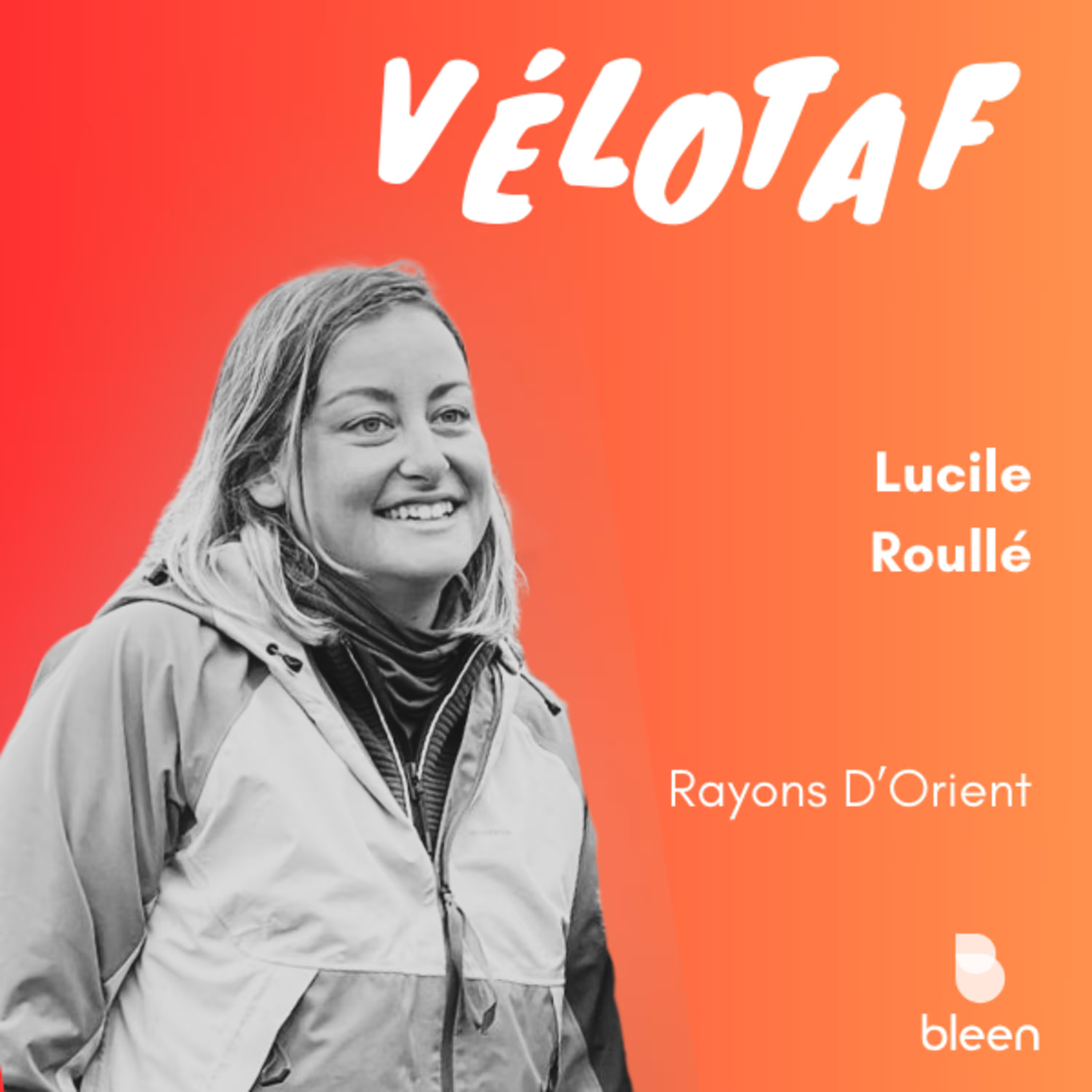
Lucile Roullé was not an adventurer at heart. A business school graduate, a career between Paris, Rouen and Caen, sports training “close to nothing”. But she had a persistent urge: to travel far and long without flying. With her partner Quentin, the environmental decision came first. If you want to go far without flying, you need to travel for a long time. That was the equation.
To plan their route, Lucile made a box with “dream trip recipe” cards. Each of them filled in their own (countries, modes of transport, challenges). The compromise between their two visions set the framework: a month per country, trains and buses to reach Central Asia, then cycling to Japan. From Rennes to Sendai via Uzbekistan, Tajikistan, Kyrgyzstan, China, Laos, Thailand, Cambodia, Vietnam, Korea and Japan.
“We don’t want to go fast. We just want to go far. And we have time. Not once, after the first 2,500-metre pass in Kyrgyzstan, did I ask myself whether I was going to do it.”
Long-distance cycling is accessible. Uzbekistan is the proof.
Lucile is clear: she had no physical preparation before leaving. Her training began in Uzbekistan, a flat country that served as a warm-up. Distances increased gradually, from 40 km a day in Italy to 90 km a day in Central Asia. Tajikistan and Kyrgyzstan added elevation gain. China, between Sichuan and Yunnan, took them up to 4,700 metres above sea level.
Lucile’s core message: long-distance cycling is not an extreme sport reserved for athletes. It is a gentle effort when done well, when you have a full day ahead of you, and when you are looking for discovery rather than performance.
“I had no physical training. My lifestyle wasn’t exactly healthy. But I wanted it. And the good thing about cycling is that it’s a fairly gentle effort when you do it right.”
Travelling without flying: the logistics of trains, buses and ferries
Reaching Uzbekistan from Rennes without flying took a month and a few days, including a three-week stop in Tbilisi for Russian and Chinese visas. The rest: a string of trains (Paris, Lyon, Geneva, Zurich, Budapest, Bucharest, Istanbul), a 24-hour bus when the Turkish train refused bikes, then a route through Georgia, Russia and Kazakhstan. In total, around ten days of actual transport.
The return followed the same principle: a ferry from Korea to Vladivostok, the Trans-Siberian to Moscow, then a string of European buses and trains to arrive in time for Christmas. Every border was a negotiation. The rules on bikes on trains vary from country to country, and often from one conductor to the next.
Weather, typhoons and the climate reality seen on the ground
Lucile and Quentin crossed every season at what travel guides would call the wrong time: winter in Central Asia, the monsoon in South-East Asia, cold in Japan and Korea. An online tool confirmed they were “in the red” for every country. They accepted this: travelling without flying means going through the seasons, not avoiding them.
In Vietnam, the thermometer read 52 degrees. Quentin got heatstroke. They rode through areas devastated by Typhoon Yagi three weeks after it hit. In Cambodia, a pepper plantation was losing between 8% and 30% of its yield every year from lack of water, in the middle of the rainy season.
“We cried on our bikes in Vietnam. We can stop and get an air-conditioned hotel. The people who live there just have to adapt. They have no other choice. That’s what we wanted to see through this trip.”
Life as a couple on a bike: each their own pace, each their own road
Before they left, friends and family were not gentle: “This is going to be a real test for your relationship.” Lucile and Quentin had never lived together day to day in ten years as a couple. Cycling solved the equation: they spent half the day alone, each at their own pace, each in their own thoughts. In the evening, tasks fell into place naturally (Quentin cooks, Lucile pitches the tent).
The story ended with a mutual marriage proposal in Sendai, facing the Pacific Ocean. Both had planned the same gesture at the same moment, without discussing it beforehand.
“We realised we would never have the same speed or the same pace. Cycling is a perfect way to keep a moment to yourself during the day. It actually strengthened our relationship.”
“Sobriberté”: restraint plus freedom
It’s the word Quentin coined to describe their travel philosophy. Environmentally conscious travel is neither dull nor restrictive. It opens up a dimension of travel that flying has made people forget: meetings under a shelter during the monsoon, cyclotourist communities on WhatsApp, autumn colours in Japan when everyone else is waiting for the spring cherry blossoms.
Lucile does not want her adventure to be intimidating. You do not need a year, and you do not need to go so far. Italy, France, Turkey is four days away by train. The message is simple: if the urge is there, the rest follows.