The episode in detail
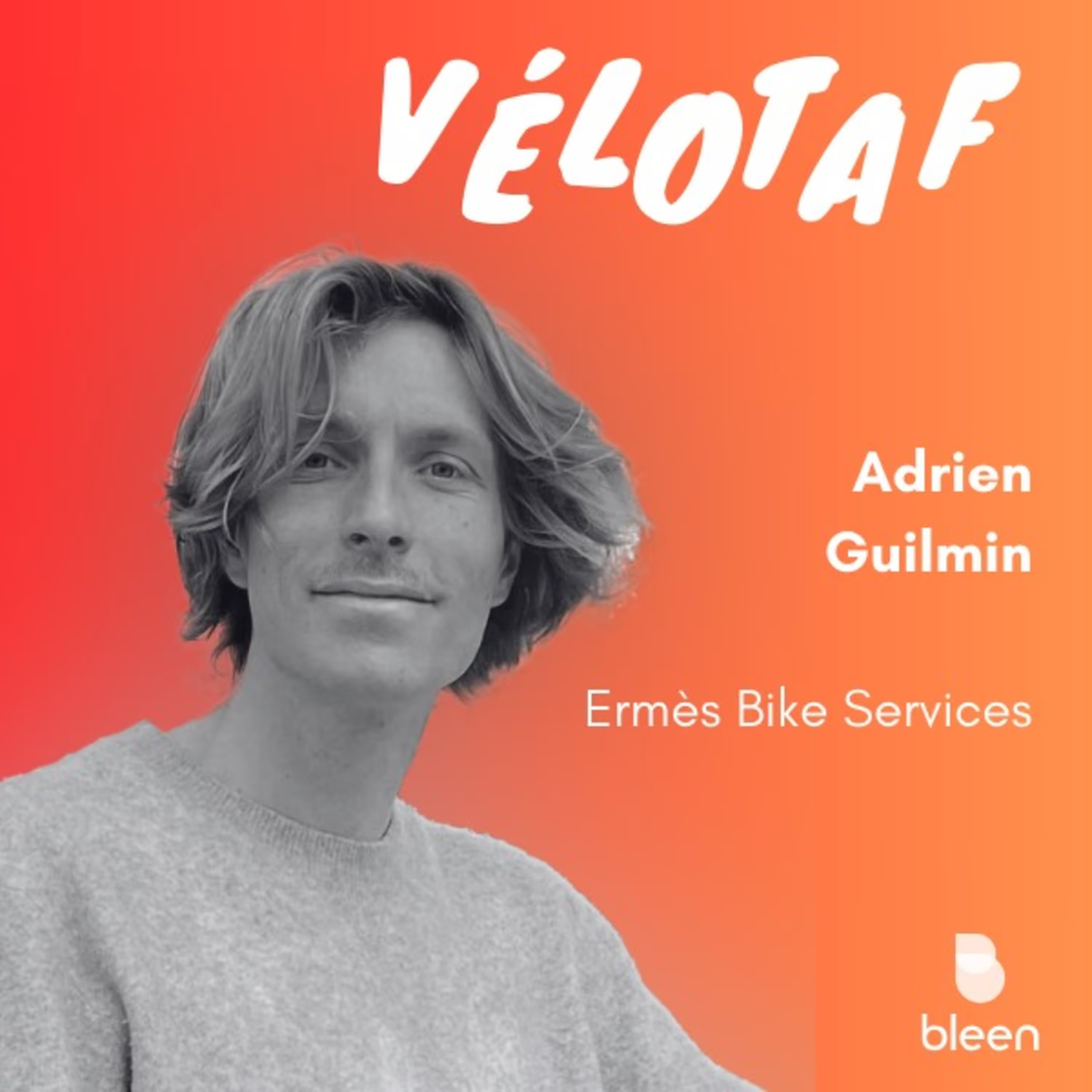
Adrien Guilmin: from bike commuting in Brussels to ultra-endurance racing
Adrien Guilmin is 34. He grew up in Marche-en-Famenne, in the Belgian Ardennes, and has lived in Brussels for ten years. Cycling entered his life as an outlet: concentration difficulties, a lot of energy to channel, and the bike as a way to stay still. He started as an occasional cyclist during his studies, then a sportsman at Decathlon, and gradually lengthened his distances. Today he rides through Brussels every day on a Dutch Oma Fiets and takes part in bikepacking and ultra-endurance races around the world.
Cycling in Brussels: the most logical way to get around
Adrien does not know Brussels’ tram or bus lines. In ten years, he has not needed them. The bike is faster than a car in the city, parks anywhere, and benefits from one-way exemptions and right turns on red lights. For him, the advantages of a car come down to staying dry and being able to listen to the radio. Not enough to justify driving for two kilometres.
“Give me a list of advantages that long for using a car. I don’t see one.”
The Covid trigger and the Silk Road Mountain Race
It all started with a YouTube video: the documentary “Wild Horses”, about the Silk Road Mountain Race, 1,800 km across Kyrgyzstan. Adrien buys a cyclocross bike during lockdown and decides to ride 24 hours straight from Brussels. The experience turns into a disaster: not enough water, a dead GPS, a freezing night on a church porch in Givet. 400 km and a lesson in humility later, he signs up for the Silk Road the following summer. His first real bikepacking race.
“It wasn’t hugely positive. But after a few days of recovery, I told myself there was a way to improve certain things to make the experience much more enjoyable.”
Five bikes for five uses
Adrien owns an Oma Fiets for the city, an old Peugeot for trips to the bar (“if it gets stolen, I’ll have lost 50 euros”), a road bike for tarmac, a gravel bike for mixed terrain, and two mountain bikes: a carbon one for performance, a custom titanium one for bikepacking. The titanium frame supports up to 130 kg of payload, absorbs impacts better than carbon, and suits demanding races where breaking a frame in the middle of a mountain is not an option. At 1.96 m, Adrien had this mountain bike built to his exact geometry, because at 18 hours a day in the saddle over several days, every millimetre of position matters.
Bike commuting as invisible training
Every kilometre on the 20 kg Dutch bike, in the December rain in Belgium, is a kilometre banked. Not pure training, but mental and physical conditioning. Telling yourself “it’s raining, it’s cold, I’m going anyway” prepares you for nights in the Balkans or mountain passes at 3,500 metres in Kyrgyzstan. In return, ultra racing makes the daily commute obvious: after riding three days without sleep, getting on a bike to go to the office no longer takes any willpower.
Training to last: zones, strength work and intervals
Adrien rides between 10 and 20 hours a week depending on the season. For a long time, he racked up kilometres in zone 1 and zone 2, base endurance. Two changes altered his approach. First, strength training: a physiotherapist explained that his muscles had grown faster than his tendons and ligaments. Two to three sessions a week, a programme reviewed every six weeks, and his knee and neck pain disappeared. Second, intervals in zone 4 and 5, to develop fast-twitch muscle fibres. The result: more power on technical climbs, more versatility, and better resistance to cramps over long distances.
“Your muscles grew quite fast compared with your joints. It’s a bit like having very developed legs with tendons that don’t keep up.”
Mindset: everything passes
Breakdowns happen. The urge to throw the bike into a river in the Balkans is real. Adrien’s technique: sit down for ten minutes, breathe, close his eyes, and accept there is only one choice, moving forward. His hardest moments: nightfall (knowing hours of riding in the dark lie ahead) and the early morning between 5.30am and 7.30am (the body demanding a reset after a sleepless night).
What he has learnt: the hardest moment is temporary. Exactly like the moment of intense happiness at the top of a mountain pass at sunset. Happiness cannot keep growing forever. So you recharge when things are beautiful, and keep going when things are hard. Small wins, kilometre by kilometre, do the rest.
“The most negative moment is only momentary, just like the moment of intense happiness. And that keeps things in perspective.”
Nutrition and sleep during a race
Adrien eats every hour, in small amounts. A beep on the GPS reminds him. A stomach that digests continuously beats the heavy digestion of a large meal that diverts energy from the legs. His trio: carbohydrates (fruit pastes, bread), protein and fats (peanut butter, bars), and two or three emergency gels. His go-to: Snickers bars, “the holy grail” for the sugar, peanut and protein combination. Hydration: water, Coke and Aquarius as needed, plus salt tablets to help the body retain water.
For sleep, on races lasting two to three days, he tries not to sleep the first night. After that, power naps of 20 to 25 minutes, like Vendée Globe skippers. On longer races, he sleeps three to four hours a night, preferably just after sunset, and gets up around 2 or 3am to be active during the coldest hours.
MacGyver in Morocco
His worst ordeal: a 10 cm nail in the rear tyre during the Atlas Mountain Race in Morocco. The nail goes through the tread and comes out through the sidewall. The plugs hold on one side, not the other. Two days stopping every two hours to reinflate and patch it up. The final fix: a sewing needle, thread and superglue bought at a village bazaar. An unsightly “blob” on the tyre sidewall, but one that holds until the finish. His lesson: always carry an extra 150 to 250 grams of repair kit. A few cable ties and some fishing line can save a race.
“If you tell yourself ‘I’m going super light’, you risk finding yourself in the middle of nowhere with nothing to fix things.”
What to remember
Adrien Guilmin sums it all up in one sentence: “Everything comes to those who wait.” Patience, humility in the face of the elements, self-knowledge. Ultra-endurance cycling is not reserved for an elite. His advice: take any bike in good condition, a backpack, and go. The Belgian Ardennes, the Semois valley, the German Eifel are a few hours away by train. No need for the best equipment in the world. Just the wish to go a little further than usual.