The episode in detail
A TV control room on two wheels: the bold gamble from RTBF’s Lab
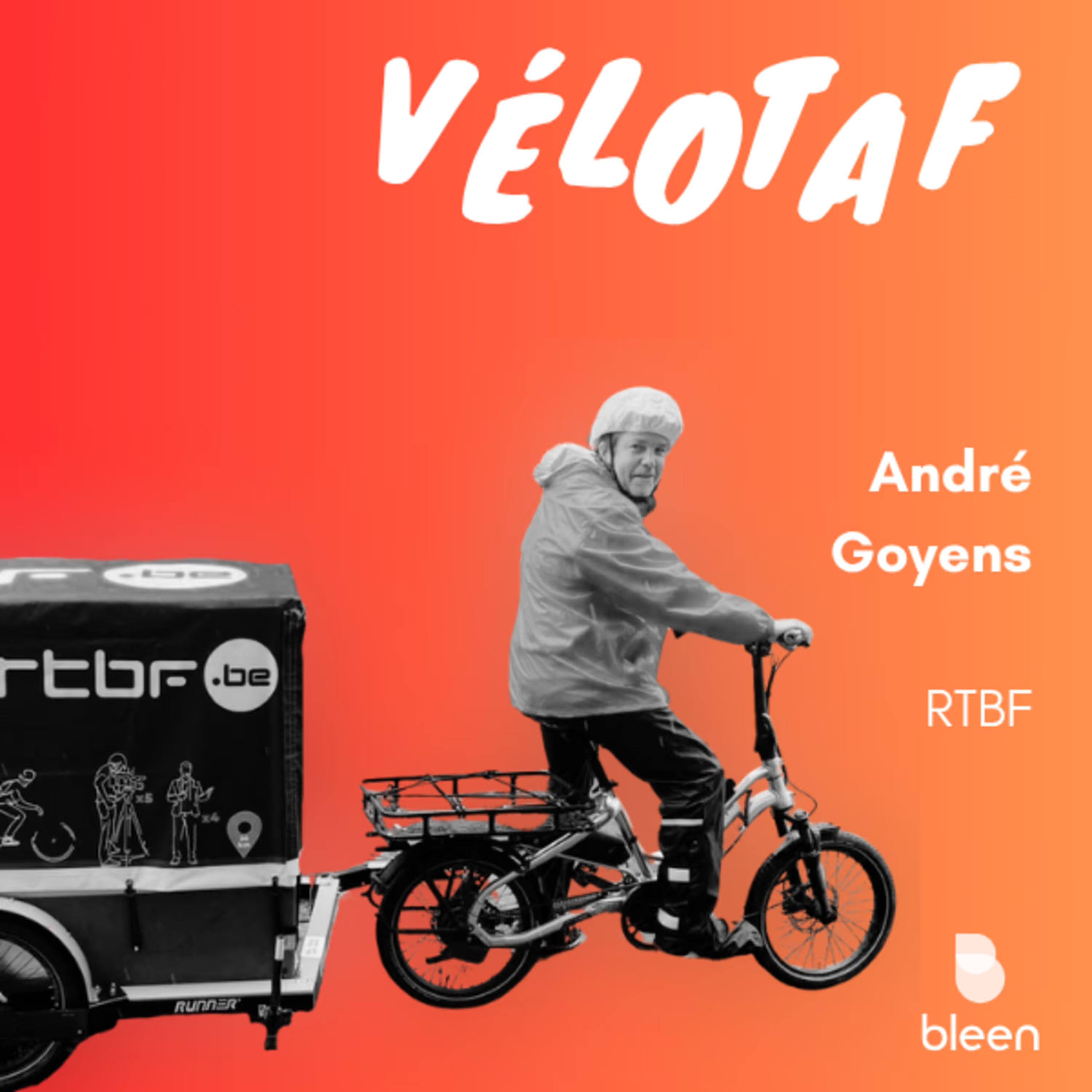
André Goyens joined RTBF 31 years ago, as a cameraman. Vision mixer, all-round technician, he has held nearly every image-related role at French-speaking Belgium’s public broadcaster. When the Production Lab was set up, just before Covid, he jumped at the chance. His mission: find production solutions that are lighter, more mobile and use less energy.
The trigger came from a challenge set by a colleague coming out of lockdown: how do you produce a live programme from a location a car cannot reach? The Lab team first tried a cargo bike, but the machine made users who were not used to it uneasy. Then, at an Urbike demonstration, they spotted a bike trailer. The idea took shape: load the trailer not with bikes, but with flight cases full of production equipment.
“We said to ourselves: we’re not going to load this trailer with bikes. We’re going to put in flight cases and pack all our equipment to get to our shooting location.”
The Green Control Room: from cardboard prototype to broadcast production
The first version was homemade. The team shaped the workstations out of cardboard, tested the layout, and adjusted the ergonomics. A second-hand container fixed to the trailer solved the problem of fragile equipment. Inside: a sound desk, a vision director’s station, an intercom to the camera operators, two 1,000-watt batteries and a solar panel built into the lid.
The result: energy autonomy of up to 10 hours, a set-up time of under 5 minutes once the circuit breaker is switched on, and a multi-camera set operational in under 40 minutes. All of it approved to ride on cycle tracks while towing around 140 kilos.
“As soon as we flip the circuit breaker and the batteries kick in, it takes under 5 minutes to be configured. For a multi-camera set in broadcast mode, that’s a remarkable set-up time.”
Faster than a truck, cheaper, more agile
At the Brussels Book Fair, the Green Control Room proved its worth. The team had the set for only two hours to produce 45 minutes of programming. With a standard truck, they would have had to run hundreds of cables and take up much more time. With the bike and trailer, set-up and breakdown are so fast that covering two or three different locations in the same day becomes possible.
The concept works on a caravan logic: the towing bike can be used for other things while the control room is deployed. The technician can go and fetch extra equipment, catering for the team, or head to another point in the city. Bruxelles Mobilité has also validated the project, confirming that across Brussels and its outskirts, a bike will always be faster than a car.
“We’re in caravan mode. The tractor, the bike, can be used for something else. We have more freedom than with a dedicated truck.”
From the Amsterdam trade show to the 20 km of Brussels
The European Broadcasting Union (EBU) invited the team to present the Green Control Room at the IBC trade show in Amsterdam. Getting it there raised a challenge: no bike-and-trailer space could be booked on the train, and a barge was too complicated to arrange. In the end, an electric van lent by a partner made the trip. Over three days, visitors from Asia photographed the installation by the thousand, and questions poured in from everywhere. The team was clear: no patent filed, take the idea, improve it, come back to us.
At the same time, the Lab’s bikes were used during two editions of the 20 km of Brussels. Fitted with live cameras, they allowed real-time mixing from the Reyers studios. The bike is not limited to towing a control room: it becomes a mobile filming tool in its own right.
The obstacles: theft, weather and habits
André does not hide the obstacles. The main one: theft. Camera operators are reluctant to leave an electric bike loaded with broadcast equipment unattended. With a battery-powered angle grinder, any lock gives way in 5 to 30 seconds. Weather is the second obstacle: sending a team out on black ice for breaking news is not an option. And roadworks in the city regularly create unexpected access problems.
The third obstacle is cultural. The tool exists, users are satisfied, but by default, when the truck is available, many still choose the usual comfort. Urban riding courses with local non-profit organisations have been set up to remove this barrier.
“By default, you don’t gravitate towards this mode of production. The work now is getting people to feel calm, confident. It starts with using the bike itself.”
The vision: carbon quotas for every production
André dreams of a V2 of the Green Control Room: more compact, more modular, transportable behind a bike as well as in a train or a car. A mobile radio studio is already in preparation to complement the existing audio-video offer.
But his real ambition is the introduction of carbon quotas per production. If every producer had an annual carbon budget, lighter and more sustainable production methods would automatically become more attractive. In the meantime, a “carbonette”, a carbon impact calculator per shoot, is being put in place to document the concrete gains from the Green Control Room.