The episode in detail
When a former Decathlon bike mechanic becomes the voice of ecology on TikTok
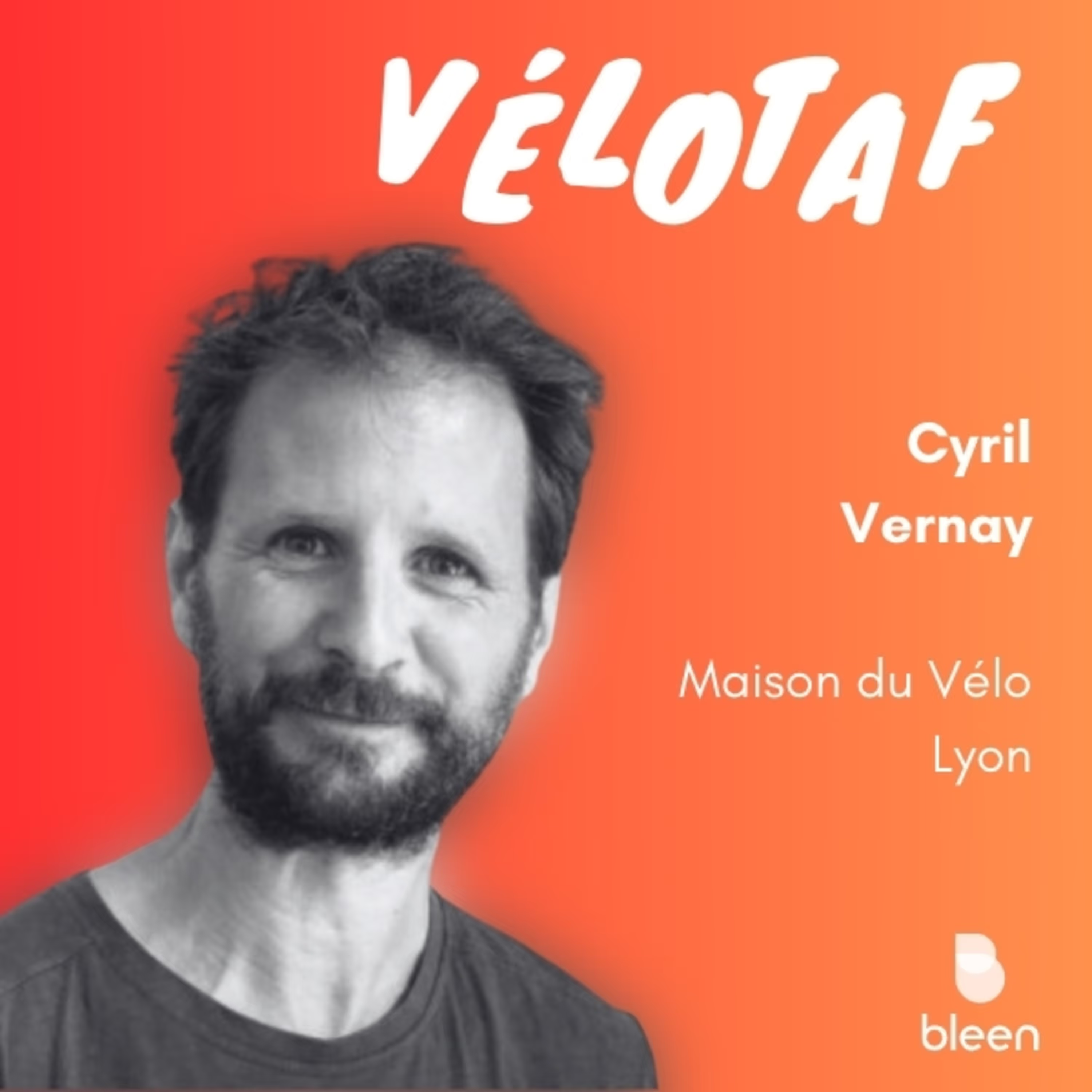
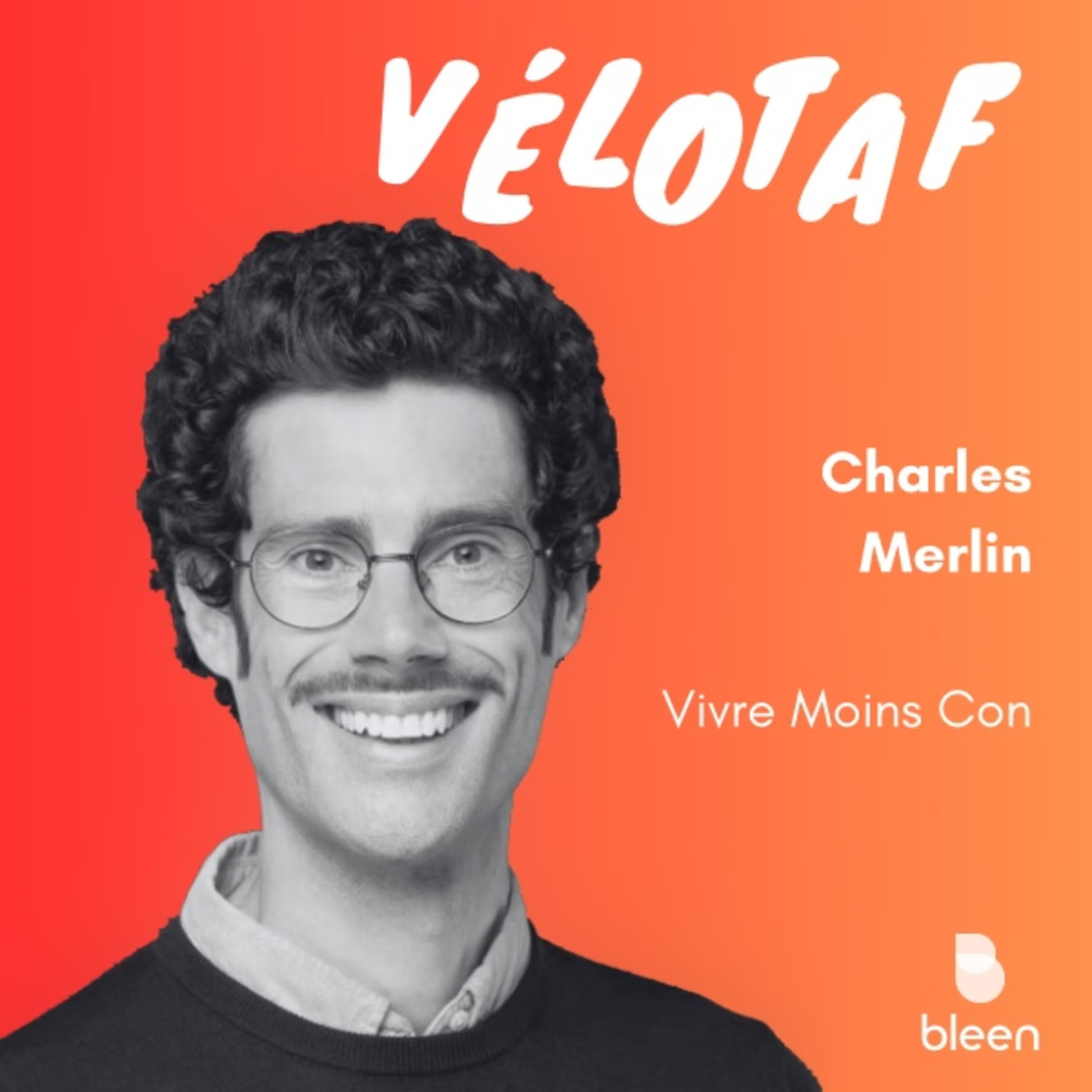
Charles Merlin spent three years repairing bikes at Decathlon, in a Paris store. In September 2022, he launched Vivre Moins Con on TikTok, then Instagram. The idea: unpack current affairs with an engaged angle, based on real press review work, cross-checked and sourced. Ecology, social justice, inequality, minority rights. Today, it is his full-time job.
His connection with cycling goes back a long way. Charles grew up in the countryside, where he spent his days on two wheels with the other children in the village. Once in Paris, he used public transport, then Vélib’, before getting his own bike. And there, a radical change.
“Having my own bike changed my life. There really was a before and an after. Vélib’ is cool, but you don’t have the same freedom. You’re always tied to the docking stations.”
Cycling in the countryside: untapped potential
Charles observes that cycling responds to supply-side policy. Cities have invested in cycling infrastructure, and users have followed. In rural areas, distances are longer, certainly. But trips of 10, 15 or 20 kilometres remain feasible, especially with the rise of electric bikes. The Netherlands demonstrates this every day: people there cycle 30 to 40 minutes morning and evening, on safe paths, set back from cars.
The problem is not the motivation of potential cyclists. It is the lack of infrastructure that would give them confidence. Without protected paths, cycling in the countryside remains seen as a Sunday hobby, not a credible mode of transport.
“I think there are people who would do half an hour, 40 minutes of cycling in the morning and evening. Just as there are people today who do 30, 40 minutes by car. You just need paths that are properly secured, well set back.”
The car lobby, a structural brake on change
Why does cycling remain so undervalued in France and Belgium, compared with the Netherlands or Denmark? For Charles, the answer is above all economic. A group of companies (the car industry, road infrastructure, fossil fuels) exerts direct influence on public mobility policy. This influence also shapes collective imagination, through advertising, film and the media.
The result: a deeply entrenched car culture. Charles recalls Emmanuel Macron’s phrase, “I love cars”, which in his view was meant to reassure both the sector’s economic interests and the powerful lobby of 40 million motorists.
“Today, triggering a shift away from car dependency towards more cycling serves the general interest. But it works against particular interests that are economic and powerful. The authorities have not yet shown enough courage.”
The Dutch example comes up often in the conversation. Charles points out that the transformation of the Netherlands was anything but peaceful: the headwinds were strong, but the governments of the time showed real political courage, convinced that the general interest demanded it.
Covid as an accelerator, public support as proof
Charles experienced this first hand at Decathlon: during Covid, footfall in bike workshops exploded. In France, a government grant (around 120 euros) allowed people to repair an old bike. Tens of thousands of bikes were sitting unused in garages and cellars. Many people took the opportunity.
The lesson is clear: when public authorities give a financial boost or invest in infrastructure, people follow. It is not a problem of demand. It is a problem of political supply.
The SUV, the new mainstream
Olivier de Schutter raises the question of the social status tied to cars, particularly in Belgium where a company car is almost automatic from a person’s first job. Charles is categorical: the SUV remains a status marker, an outward sign of wealth which he says reveals “a narcissistic flaw”.
“When I see an SUV, I’m not impressed. What I see is that these people have enough money and want people to know it. You could have cars that are almost as spacious without them being SUVs.”
Olivier qualifies this: in Belgium, the SUV has become so normalised that it is no longer even a marker of power. It has become the default model. In leasing catalogues, out of 10 cars on offer, 9 are SUVs. Supply shapes demand, and manufacturers have an interest in pushing these models, on which their margins are higher.
When children cycle to school alone, we will have won
For Charles, there is a simple indicator to measure whether a city is truly cycle-friendly: can a 10 or 11 year old take their bike and go to school alone, without their parents being afraid? On that day, the virtuous circle will be set in motion. Habits are formed in childhood. If children cycle from a young age, the following generations will follow naturally.
Olivier confirms that in Flanders, on his morning route, he regularly passes children cycling to school alone. But as soon as he enters Brussels, they disappear.
Breaking out of the bubble: entertainment as a tool of persuasion
Charles admits it plainly: his audience looks like him. Fairly young, fairly white, fairly middle-class, already somewhat politically engaged. To reach other audiences, he had to rethink his formats. His classic journalistic approach did not speak to people distant from politics.
He tried a MrBeast parody to talk about tax injustice. The result: 2.5 million views on TikTok, 4.5 million on Instagram, and, above all, comments from completely new audiences.
“If we, environmentalists and progressives, can’t reach these audiences with formats that speak to them, we will never break the sound barrier. We will never manage to step outside our own circles.”
The parallel with cycling is direct. As Bleen’s slogan puts it: “Make the transition sexy.” The rational arguments are there (health, savings, quality of life, the environment). What’s missing is the second piece of the puzzle: emotion, desire, pleasure. The right brain after the left brain.