The episode in detail
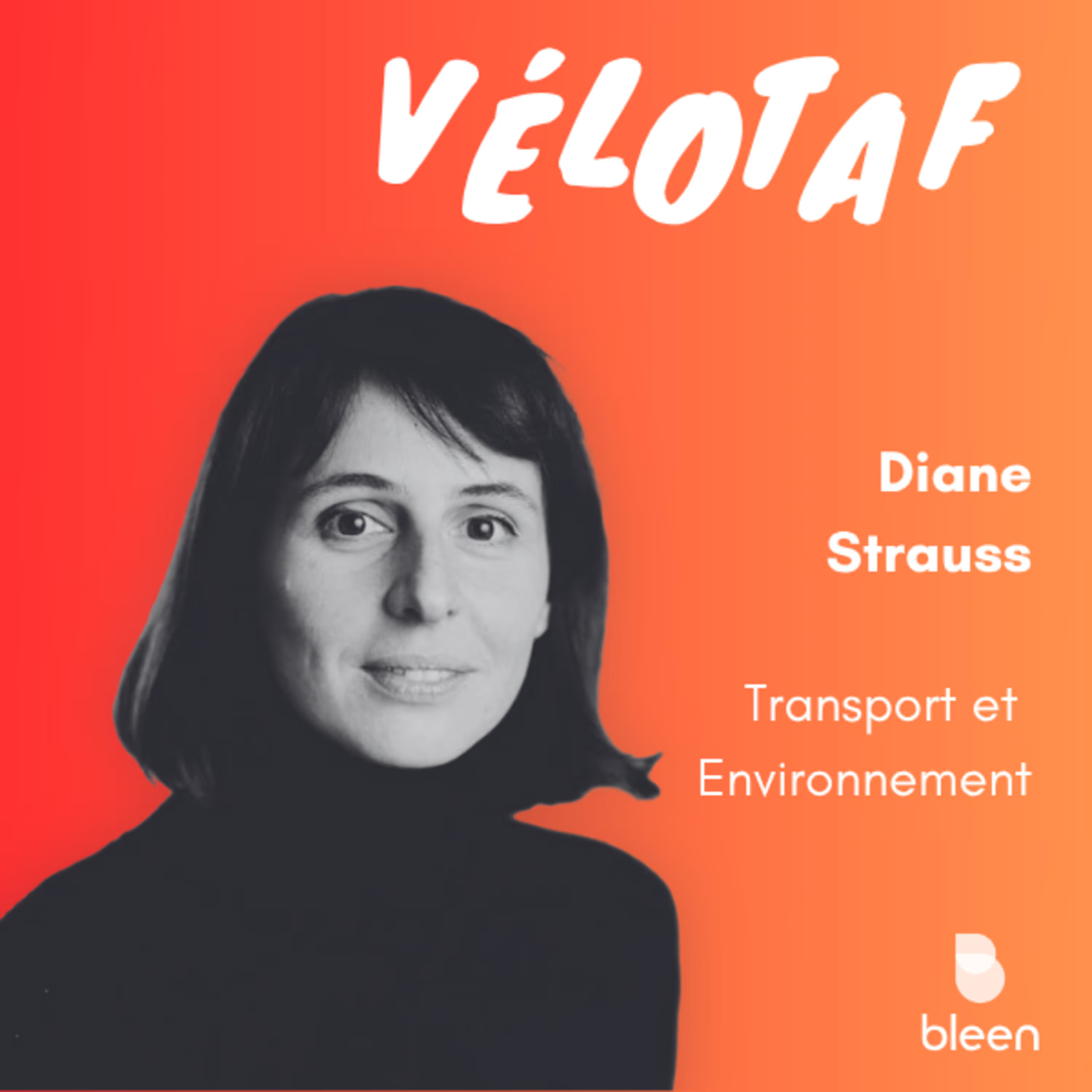
Diane Strauss, France director at Transport & Environment
Diane Strauss runs the French office of Transport & Environment, an NGO and federation of European NGOs with 80 people in Brussels and offices in Spain, Italy, Germany, the UK, Poland and Singapore. Their goal: decarbonised transport by 2050. Before working in mobility, Diane spent fifteen years in sustainable finance, between Paris, Brussels and Yale University. She is also a member of the Climate Council.
The car: a divisive but inescapable subject
In France, 6 trips out of 10 are made by car. Nearly 80% of households own a vehicle. Diane sets out the picture directly: almost all of us are drivers at some point in our lives. And for many people in rural or suburban areas, there is no alternative. Being told to give up the car feels, at best, contradictory, and at worst, like an attack.
“Households don’t have a choice. There are no electric cars on the second-hand market yet. There’s no public transport in rural areas. What do we expect from these households?”
Industrial offshoring and the SUV strategy
Carmakers have been offshoring for fifteen years, well before the shift to electric. Manufacturing in Turkey, Morocco or China costs less and protects margins. When France tried to favour local production through an eco-score, manufacturers offshored the components instead. The result: two successive waves of job losses.
At the same time, the strategy has been to bet on high-end SUVs for wealthier households. Profits tripled between 2019 and 2023. But suppliers are closing down. And sales volumes are collapsing because households can no longer keep up with the prices.
“Manufacturers tripled their profits between 2021 and 2023 compared with 2019. When they talk about a crisis, I’m always a bit sceptical.”
2035: a deadline under pressure
The EU’s 2035 target is the end of new petrol and diesel car sales. Not the end of combustion engines altogether: by that date, 70% of the car fleet on the road will still be petrol or diesel. Electric sales are rising. Renault is up 50%, Volkswagen up 80% this year. Manufacturers are widening their ranges, and models under 20,000 euros arrive in 2026.
But pressure to push back the date is strong. Manufacturers want to keep recouping their investments in combustion engines. Some political parties have made it a rallying cry. Diane sees an industrial risk in that: if Europe drags its feet, China will keep its technological lead on batteries and assembly.
“Most industry experts think that electric, if Europe puts enough resources behind it, could be an opportunity to recreate jobs in the sector.”
Social justice and “ostentatious environmentalism”
Diane cites a report on the “majority pivot of environmentalism” that describes the bike as a totem of ostentatious environmentalism. The image of city cyclists lecturing others while flying creates resentment among those who have no alternative to the car. These “left behind” groups often live a sobriety they didn’t choose: no long-haul holidays, little flying, and often a lower carbon footprint than city dwellers.
Her message to cyclists is direct: watch out for class contempt. The social anger around the transition doesn’t come from a rejection of progress, but from a lack of concrete options.
“City dwellers’ carbon footprint is often higher than that of rural populations. We’re turning environmentalism into a sort of good-living lifestyle, whether we like it or not.”
Three criteria for a credible alternative
For people to give up their car, the alternative has to meet three conditions: it must be cheaper, safer and more comfortable. Without all three, it doesn’t work. The electric bike ticks the cost box. Comfort is improving with cargo bikes and pedal assist. But safety remains the weak point, and it depends on one thing alone: infrastructure.
Diane tried cycling on a country road. Her conclusion: “I thought I was going to die, and I never did it again.” Without a protected path, there’s no modal shift.
Infrastructure, infrastructure, infrastructure
The phrase keeps coming back like a refrain. Protected cycle tracks, suburban cycle routes, regional express coaches every 15 minutes with Wi-Fi and dedicated lanes, express carpool lanes. The solutions exist. The road network is dense and well built. It just needs to be used differently.
Diane recommends that regions use mobile network data to map real car traffic flows and identify the routes where bikes or express coaches would have the greatest impact. Few local authorities do this work today.
“Once the infrastructure is there, the bike is always cheaper than a car and generally far more comfortable than public transport.”
Taking the politics out of cycling
Cycling is starting to take on a political colour, associated with one side or another. Diane wants the opposite: the bike is a mobility tool, not an ideological marker. Paris transformed quickly once the political will was there. So did Strasbourg. But if cycling stays identified with one camp, it loses ground in public opinion.
The same logic applies to the car. Diane co-published a paper with the Fondation Jean Jaurès titled “Les Français, la bagnole et l’écologie: comment éviter le crash test?” to invite progressive forces to rethink their message. Less about the responsible consumer, more about structural policy.
Cargo logistics: promise and limits
The last mile in city centres is a natural fit for cargo logistics. But Diane qualifies that: delivery bikes are heavy, fast, and share the same lanes as other cyclists. Safety is also a question between cyclists. For long-distance logistics, the future lies more with electric vans and trucks, combined with limited traffic zones (LTZs) reserved for decarbonised vehicles.
What to take away
Diane Strauss offers a clear-eyed view of mobility. No simplistic car-versus-bike stance. The transition rests on three levers: electrifying company fleets to feed the second-hand market, investing in cycling and public transport infrastructure, and no longer asking households to solve a structural problem with their own individual means. The bike has a central role on trips under 20 km. But it will only play that role if the paths exist, if they’re safe, and if the discourse around it stops being divisive.