The episode in detail
Mieux se Déplacer à Bicyclette: France’s oldest cycling association
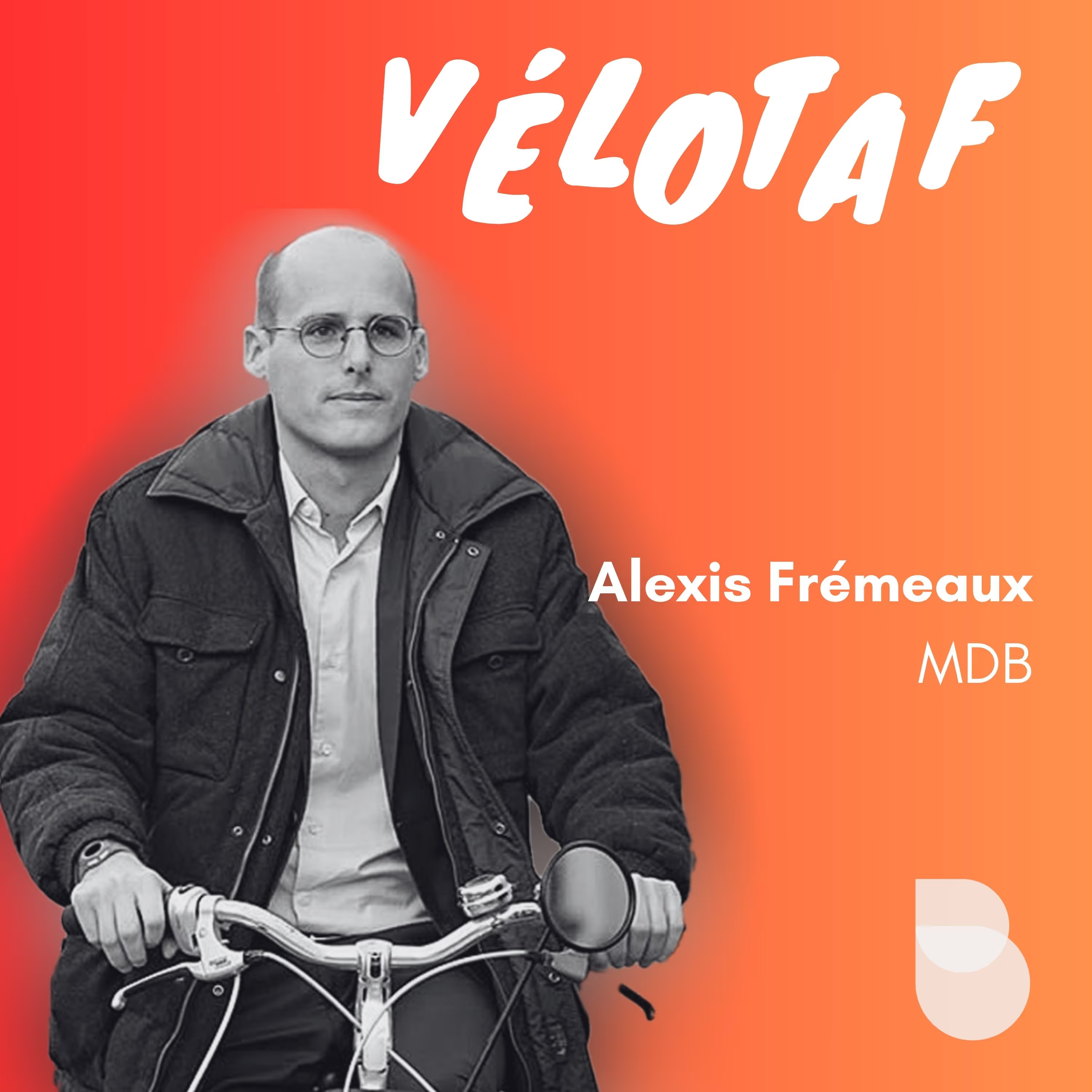
Founded in 1974 under the name Mouvement de Défense de la Bicyclette, Mieux se Déplacer à Bicyclette (MDB), which translates as ‘get around better by bike’, is France’s oldest cycling association. Alexis Frémeaux, its chair for five years at the time of recording, carries this legacy while reinventing it. The context has changed: cycling is no longer a fringe mode of transport to be defended, it is on the way to becoming the majority mode in urban travel.
The association is active in Paris and around sixty towns in the Paris suburbs. It is part of the Collectif Vélo Île-de-France, which brings together all the region’s cycling associations to speak with one voice to elected officials and institutions. Three employees work for the collective, two for MDB. The rest relies on volunteering and the membership of dedicated cyclists.
“If we get moving, things move. They do move eventually. Join an association, even for 10 euros, it helps us.”
Cycle tracks in Paris: the problem is not technical, it is political
Alexis Frémeaux illustrates this with the example of the pont de Neuilly, a strategic point linking La Défense to central Paris. For years, cyclists had to use an unlit pavement. In 48 hours, during the pandemic, a motorway lane was converted into a cycle track with nothing more than a concrete barrier. Proof that the obstacles are neither financial nor technical, but political.
“We managed to do in a few weeks what we had been asking for for years, sometimes decades.”
These so-called ‘tactical’ layouts were deployed on a large scale during the 2020 lockdown easing. Their advantage: light and adjustable, they allow for rapid iteration. Their effectiveness was shown by the figures: the number of cyclists in Paris nearly doubled in a year. MDB now campaigns for these fast methods to become the norm, rather than cycle track projects that drag on for three or four years.
How the pandemic transformed urban cycling in Paris
At the start of the lockdown, cycling nearly ended up banned. Decision-makers still saw cycling as a leisure activity, not a means of transport. The first battle for MDB and the Fédération française des usagers de la bicyclette (FUB), France’s cyclists’ federation, was to get cycling recognised as a legitimate form of transport during the health crisis. Nurses, checkout staff, delivery riders: many key workers were travelling by bike.
“Cycling is a legitimate means of transport like any other. People have the right to travel by bike during the pandemic.”
Once that right was won, the second battle was over infrastructure. MDB pushed elected officials to roll out cycling infrastructure before the lockdown eased, anticipating that people would turn away from public transport en masse. The shift to cycling was dramatic: thousands of new cyclists discovered urban cycling. But these new riders are also more fragile: without secure cycle tracks, the risk of losing them at the first winter or the first scare is real.
Bike commuting day to day: enjoyment, reliability and zero obligation
Alexis Frémeaux does not see himself as a ‘heroic’ bike commuter. His commute is four kilometres each way. He rides in a suit, without a tie, pacing his effort so he does not sweat. His rule: dress light, be cold for the first five minutes rather than arrive drenched in sweat. And when it rains heavily, he takes the metro without feeling guilty.
His three arguments for persuading a colleague to take up bike commuting are concrete. Enjoyment first: that decompression zone between office and home that neither the car nor the metro provides. Reliability next: on a bike, no unpredictable delays, journey time stays constant. Freedom last: no obligation to ride every day, bike commuting also works on a part-time basis.
“Bike commuting comes with no obligation to buy anything. Take it step by step, and you’ll see.”
Cyclists sharing space: sports cyclists, families and beginners on the same cycle track
With the boom in urban cycling, cycle tracks now welcome every kind of rider: three-year-olds, older people, sports cyclists, delivery riders in a hurry. Alexis Frémeaux sees this as a positive sign of inclusivity rather than a problem. Friction exists but stays minor compared with the dangers of sharing the road with cars.
He also observes a coming together of competitive cycling and urban cycling. Professional riders now openly use cargo bikes to take their children around, something unthinkable fifteen years ago. The line between the ‘utility’ cyclist and the ‘sports’ cyclist is blurring. For Frémeaux, road cyclists are in fact the most natural candidates for bike commuting: used to riding alongside cars at 80 km/h, urban traffic does not scare them.
“The future of cycling is in urban cycling. The image of the cyclist who arrives by car with the bike on a bike rack is outdated.”
Bike school for adults: learning to pedal at any age
Among MDB’s activities, the adult bike school holds a special place. The association teaches adults who have never ridden a bike how to pedal. Its members are often migrant women who did not have the chance to learn as children and who want to be able to take their own children out cycling. Learning takes anywhere from a few hours for the most confident to several weeks for others.
MDB also offers bike marking against theft and practical advice for urban cyclists. The association argues for a systemic view: it is not enough to know how to ride (‘knowing how to ride’), you also have to be able to ride (‘being able to ride’), meaning having infrastructure that makes the city rideable by bike. On this point, Frémeaux acknowledges France still has some way to go compared with the Netherlands or Denmark, but the movement is under way.