The episode in detail
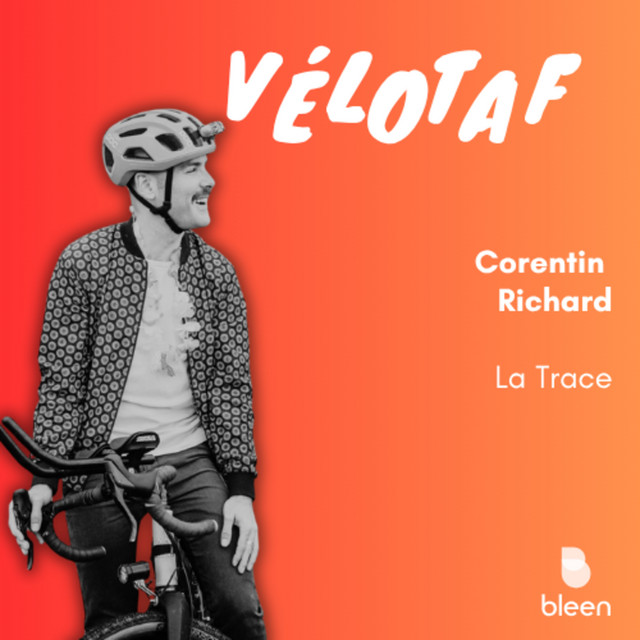
Corentin Richard is 32 and has more than 35,000 kilometres on the clock, a figure taken from his Strava that he reckons is on the low side. An engineer by training, an IT consultant for five years, he stopped everything in 2020 to build a business around cycling. Today he runs La Trace, which started as a bike travel agency selling organised trips in Brittany and turned into a mapping platform. His advice for getting started fits in one sentence, and it disappoints anyone dreaming of a feat.
Two thousand kilometres home from Warsaw
He got into bike travel in 2017, on the Tour de France des Fermes d’Avenir, a tour of farms moving towards lower-impact farming. He is a decent athlete, a judo black belt, and he still suffered: his bike weighed 25 to 30 kilos, he stopped on the climbs and napped on the passes.
The following year he lost a bet with his developers, who were based in Poland. He travelled out by bus, bike in the hold.
“I rode back from Warsaw to my place on my own. It took two weeks and I must have covered something like 2,000 km.”
How he progressed over those fifteen days says everything about the subject: 60 to 70 kilometres on the first days, close to 200 by the end, and the feeling that it was no longer really an athletic feat.
Sixteen hundred kilometres and fifteen stags at the top of the Aspin
The Trans-Pyrenees both appealed to him and scared him. A double crossing from Saint-Jean-de-Luz to Banyuls and back, once through Spain, once through France: 1,600 kilometres and 33,000 metres of climbing, swallowed in six days, much of it at night.
“I find myself in the middle of 15 stags that are bellowing. All that at 1am at the top of the Aspin, those are things I will never forget.”
He also describes the sunrise over Banyuls after three days, then the mental vertigo of turning round, and a seven-and-a-half-hour electro playlist a friend put together for him, which made the difference on the climbs. Elsewhere in the episode he draws the distinction that shapes his whole project: the Trans-Pyrenees is great, but it still speaks to very few people.
Where to start a bike trip
“To start bike touring, there is nothing better. So there is no point trying to find crazy gravel stuff in the mountains.”
He is talking about the existing cycle routes, and the Loire à Vélo in particular, which has more than twenty-five years of development behind it and a whole economy built along the way. His off-the-shelf itinerary for someone in Paris: an hour on the train to Orléans, bike carried or hired on the spot, then Chambord half a day or a day away. A weekend covers 50, 60 or 100 kilometres, with no pressure. The Blois-Chambord tourist office offers 30 to 40 kilometre loops designed for beginners and families.
On fitness he is blunt: you do not need to be very sporty, and most people have no wish to ride 250 kilometres a day.
Weight, the point he is most precise about
Bike included, he tries never to go over 20 kilos, with a usual range of 15 to 20. On the Trans-Pyrenees he was at 17 kilos, bivouac gear and about a kilo of food included. His carbon bike weighs 8.5 kilos and he adds around ten kilos of luggage to it.
For beginners he recommends a steel touring bike with two 35-litre panniers on the rear rack, the best setup for carrying a lot. He now travels lighter, still on a touring bike, but with bikepacking bags instead, for handling and for bulk: fifty centimetres sticking out on each side gets tiresome by the twelfth level crossing. His rule of thumb has nothing to do with speed, he rides slowly and never puts himself in the red.
What a bike trip weighs against a long-haul flight
La Trace started from a climate observation. Tourism accounts for 10% of global greenhouse gas emissions, and in his eyes that figure justifies a change of direction.
“The orders of magnitude are 100 to 1000 depending on what you look at. So it is cool to have the right to take 100 bike trips for one trip to the other side of the world.”
He refuses the posture of sacrifice, though. Bike travel is happiness to him, and he points out that the idea is not to go back to being Neanderthals. He flew a lot when he was young, a safari in Tanzania, trips to the United States, without giving it a thought. What he remembers from it is Maasai warriors in traditional dress who changed back into jeans and t-shirts as soon as your back was turned, while adding that it is not like that everywhere.
From travel agency to mapping platform
La Trace first ran bike trips in Brittany for two summers, with routes ridden and checked on the ground, bookings, and a coherent chain between train, accommodation and visits. Then companies and public bodies asked to use the mapping tool for their own areas, and the company pivoted towards technology.
Today the ecosystem counts around 20,000 active users, the app came out as a prototype in July, and the finest cycle routes in France can be downloaded for free with their points of interest. On the client side, the Blois-Chambord tourist office and Ouest-France, to digitise a back catalogue of paper guides. Just under ten people work on the project. No fundraising to date, but a non-dilutive financing round is taking shape with BPI and banks, with an equity round more likely in 2026 or 2027. The 2026 roadmap includes point-to-point route building, accommodation booking, and a conversational assistant that generates the GPX file as the user makes choices.
What the infrastructure still lacks
Asked whether cycle routes are getting saturated, he does not see it: France has several tens of thousands of kilometres of waymarked routes. The real black spot is elsewhere, on the way in and out of towns, where beginners and families have no wish to ride alongside cars.
“Now is when we have to hurt, not in 20 years, that will be too late.”
His answer to the magic wand question comes in two parts: money, and reusing the network of quiet secondary roads to create safe routes at lower cost, trusting the engineers to do it. Asked what else is needed beyond cycle routes, he adds a network of places to stay for every budget, from bivouac spots to small wooden cabins, and repair stations with a pump and tools along the way.
Spanish drivers, an unsolved mystery
On a Trans-Pyrenees pass, at 7 or 8 kilometres an hour, he describes behaviour he has met nowhere else: if it means waiting five minutes behind a cyclist, the Spanish driver waits five minutes, only overtakes when visibility allows, and often cheers you on as they pass. He is careful about his sample of two or three trips to Spain, and admits he has no explanation. The question stays open, and he puts it to listeners.